AQA · GCSE · Biology
Course version: 8461 · Version from Sept 2018
Students should be able to relate knowledge of enzymes to Metabolism.
Full specification wording
The human digestive system: Students should be able to relate knowledge of enzymes to Metabolism.
This statement asks you to connect digestive enzymes to metabolism as a whole.
Checked against the AQA 8461 specification (opens in a new tab) on .
- Point 2 of 25
- 4 key terms
Study notes
From the checked teaching notes for this specification point.
The idea
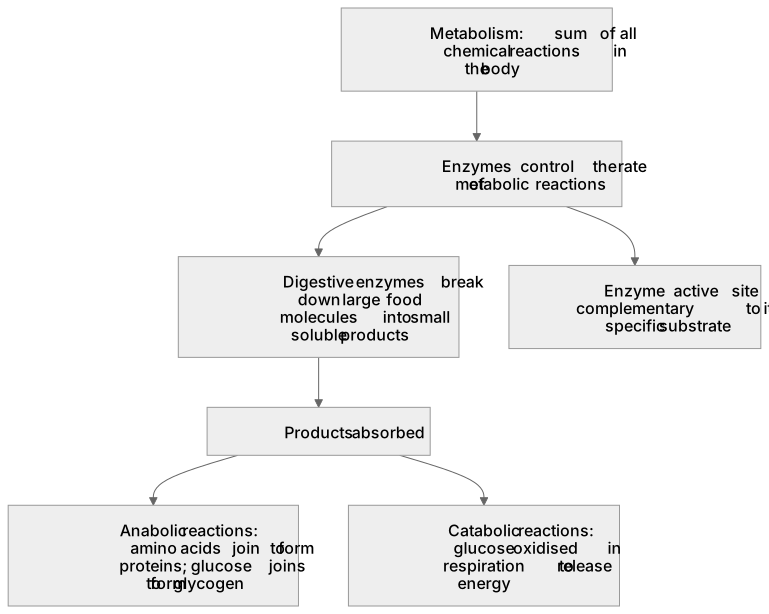
This statement asks you to connect digestive enzymes to metabolism as a whole. Metabolism is the sum of all the chemical reactions in the body, and almost all of them are controlled by enzymes. Digestive enzymes are extracellular: carbohydrases, proteases and lipases are released into the gut, where they hydrolyse large food molecules into small soluble products. Those products are then absorbed and used in metabolism. Some are built into new molecules in anabolic reactions, such as amino acids joining to form proteins or glucose joining to form glycogen. Others are broken down in catabolic reactions, such as glucose being oxidised in respiration to release energy. So digestion supplies the substrates for metabolism, and enzymes control both the digestive reactions and the metabolic reactions that follow.
What earns the marks
- Metabolism is the sum of all the chemical reactions in a cell or the body.
- Enzymes are biological catalysts that control the rate of metabolic reactions.
- Digestive enzymes break down large food molecules into small soluble products that can be absorbed.
- Absorbed products are used in anabolic reactions, such as building proteins from amino acids or glycogen from glucose.
- Absorbed products are also used in catabolic reactions, such as respiration breaking down glucose to release energy.
- Enzyme action is specific because each enzyme has an active site complementary to its substrate.
Common mistakes and how to put them right
Defining metabolism as only the breakdown of food.
Put it right by stating that metabolism includes both breakdown and building reactions.
Thinking enzymes are only found in the digestive system.
Put it right by noting that enzymes control reactions throughout cells and the body.
Saying an enzyme is complementary to any substrate.
Put it right by stating that each enzyme's active site is complementary to one specific substrate.
Exam tips
- Define metabolism clearly before giving examples of reactions it includes.
- Link each digestive enzyme to the metabolic use of its product, such as amino acids for protein synthesis.
- Use the terms anabolic and catabolic correctly when classifying example reactions.
Try the lesson
The start of the The human digestive system: Students should be able to relate knowledge of enzymes to Metabolism. lesson, made from checked teaching notes for this specification point.
Have a go first
What is the role of enzymes in metabolism?
Listen
This statement asks you to connect digestive enzymes to metabolism as a whole. Metabolism is the sum of all the chemical reactions in the body, and almost all of them are controlled by enzymes. Digestive enzymes are extracellular: carbohydrases, proteases and lipases are released into the gut, where they hydrolyse large food molecules into small soluble products. Those products are then absorbed and used in metabolism. Some are built into new molecules in anabolic reactions, such as amino acids joining to form proteins or glucose joining to form glycogen. Others are broken down in catabolic reactions, such as glucose being oxidised in respiration to release energy. So digestion supplies the substrates for metabolism, and enzymes control both the digestive reactions and the metabolic reactions that follow. A strong answer earns marks for these points. Metabolism is the sum of all the chemical reactions in a cell or the body. Enzymes are biological catalysts that control the rate of metabolic reactions. Digestive enzymes break down large food molecules into small soluble products that can be absorbed. Absorbed products are used in anabolic reactions, such as building proteins from amino acids or glycogen from glucose. A common slip: Defining metabolism as only the breakdown of food. Instead, stating that metabolism includes both breakdown and building reactions. Exam tip: Define metabolism clearly before giving examples of reactions it includes.
See it
Key words
Say what each word means before you turn the card.
Metabolism
Try answering aloud or in your head before turning the card.
Anabolic and catabolic reactions
Try answering aloud or in your head before turning the card.
Digestion as a supply of substrates
Try answering aloud or in your head before turning the card.
Enzyme specificity
Try answering aloud or in your head before turning the card.
See every definition
- Metabolism
- The sum of all the chemical reactions in a cell or the body.
- Anabolic and catabolic reactions
- Anabolic reactions build new molecules, such as amino acids joining to form proteins, while catabolic reactions break molecules down, such as glucose being oxidised in respiration to release energy.
- Digestion as a supply of substrates
- Digestive enzymes break down large food molecules into small soluble products that can be absorbed and used in metabolism.
- Enzyme specificity
- Each enzyme has an active site complementary to its substrate.
Label the diagram
Some boxes have lost their names. Pick the right name for each number.
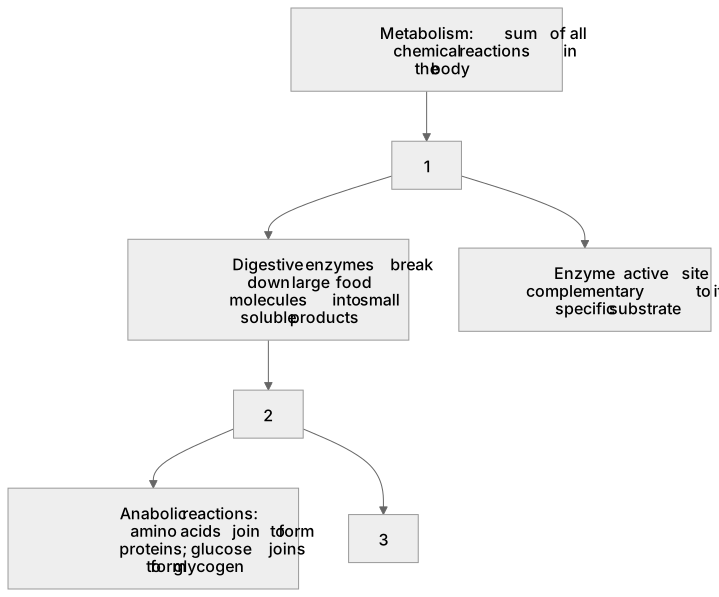
1Box 1
2Box 2
3Box 3
There is more to this lesson
The full lesson goes on to check your understanding and help you earn the marks. Create a free account to carry on, with your progress saved.
A week of Premium from your first lesson · Then the free plan continues · No card, no charge
Test your understanding of The human digestive system: Students should be able to relate knowledge of enzymes to Metabolism.
Active recall beats re-reading. Take an instant quiz now to test what you’ve learned and lock it into long-term memory.
A week of Premium from your first lesson · Then the free plan continues · No card, no charge