AQA · GCSE · Biology
Course version: 8461 · Version from Sept 2018
Students should be able to use the ‘lock and key theory’ as a simplified…
Full specification wording
The human digestive system: Students should be able to use the ‘lock and key theory’ as a simplified model to explain enzyme action.
The lock and key theory models an enzyme as a lock and its substrate as the matching key.
Checked against the AQA 8461 specification (opens in a new tab) on .
- Point 6 of 25
Study notes
From the checked teaching notes for this specification point.
The idea
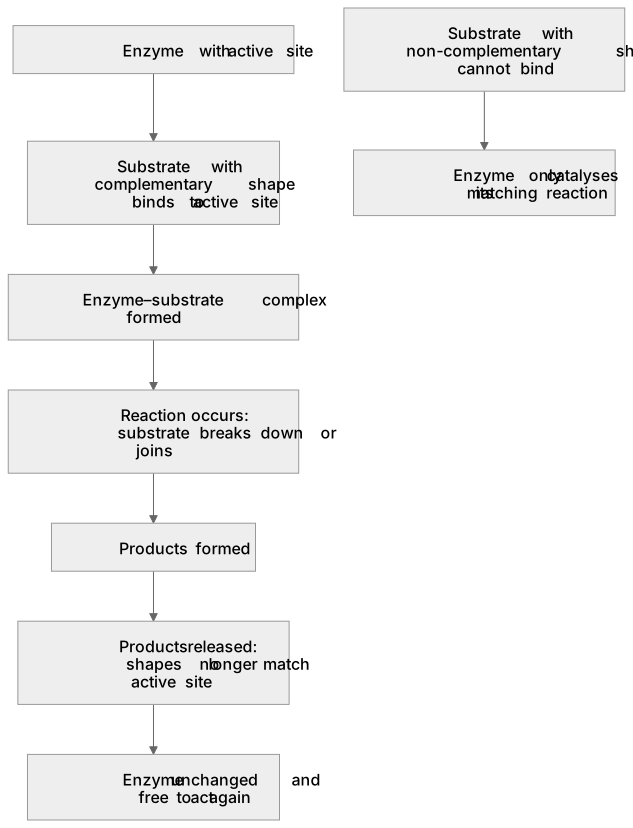
The lock and key theory models an enzyme as a lock and its substrate as the matching key. The substrate binds to a region called the active site, whose shape is complementary to the substrate. This binding is specific: only a substrate with the correct complementary shape fits, so each enzyme catalyses one type of reaction. Once bound, the enzyme helps the substrate break down or join, forming products. The products are released because their shapes no longer match the active site, leaving the enzyme unchanged and free to act again. For example, the enzyme amylase has an active site complementary to starch, not to protein, so amylase does not digest protein. The model is simplified: it does not show how temperature or pH change the active site's shape, which is why denaturation is described separately.
What earns the marks
- An enzyme has a region called the active site whose shape is complementary to its substrate.
- The substrate binds to the active site, forming an enzyme–substrate complex.
- The reaction occurs and products are formed, then released because they no longer fit the active site.
- The enzyme is not used up and can catalyse further reactions.
- Specificity arises because a substrate with a non-complementary shape cannot bind, so the enzyme only catalyses its matching reaction.
- The model is simplified and does not by itself explain the effect of temperature or pH on enzyme activity.
Common mistakes and how to put them right
Saying the substrate and active site have the same shape rather than complementary shapes.
Put it right by stating that the shapes are complementary, like a key fitting a lock.
Describing the enzyme as being used up or changed permanently during the reaction.
Put it right by stating that the enzyme is unchanged and can be reused.
Claiming that any substrate can fit any enzyme.
Put it right by explaining that binding depends on a complementary shape, so enzymes are specific.
Exam tips
- Name the active site and the substrate explicitly in your answer, then state that their shapes are complementary.
- Use the sequence bind, react, release, enzyme unchanged to give a complete account of enzyme action.
- When asked to explain specificity, contrast a matching substrate with a non-matching one rather than only defining the term.
Try the lesson
The start of the The human digestive system: Students should be able to use the ‘lock and key theory’ as a simplified model to explain enzyme action. lesson, made from checked teaching notes for this specification point.
Have a go first
In the lock and key theory, what does the enzyme act as?
Listen
The lock and key theory models an enzyme as a lock and its substrate as the matching key. The substrate binds to a region called the active site, whose shape is complementary to the substrate. This binding is specific: only a substrate with the correct complementary shape fits, so each enzyme catalyses one type of reaction. Once bound, the enzyme helps the substrate break down or join, forming products. The products are released because their shapes no longer match the active site, leaving the enzyme unchanged and free to act again. For example, the enzyme amylase has an active site complementary to starch, not to protein, so amylase does not digest protein. The model is simplified: it does not show how temperature or pH change the active site's shape, which is why denaturation is described separately. A strong answer earns marks for these points. An enzyme has a region called the active site whose shape is complementary to its substrate. The substrate binds to the active site, forming an enzyme–substrate complex. The reaction occurs and products are formed, then released because they no longer fit the active site. The enzyme is not used up and can catalyse further reactions. A common slip: Saying the substrate and active site have the same shape rather than complementary shapes. Instead, stating that the shapes are complementary, like a key fitting a lock. Exam tip: Name the active site and the substrate explicitly in your answer, then state that their shapes are complementary.
See it
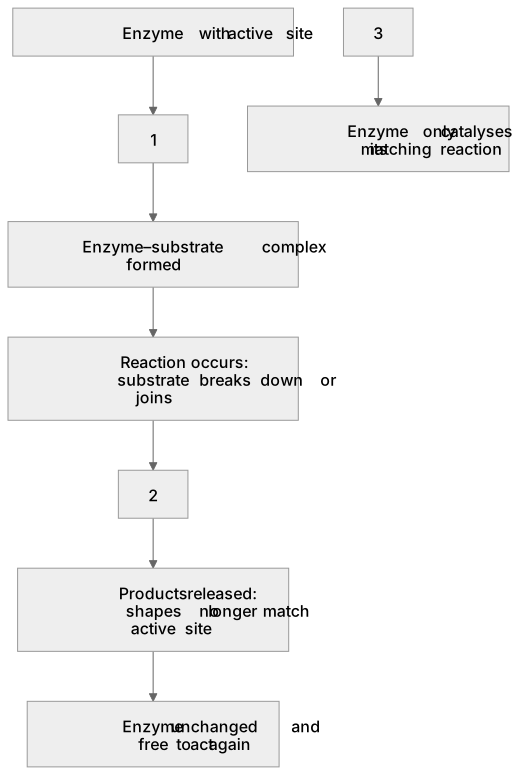
Label the diagram
Some boxes have lost their names. Pick the right name for each number.
1Box 1
2Box 2
3Box 3
There is more to this lesson
The full lesson goes on to check your understanding and help you earn the marks. Create a free account to carry on, with your progress saved.
A week of Premium from your first lesson · Then the free plan continues · No card, no charge
Test your understanding of The human digestive system: Students should be able to use the ‘lock and key theory’ as a simplified model to explain enzyme action.
Active recall beats re-reading. Take an instant quiz now to test what you’ve learned and lock it into long-term memory.
A week of Premium from your first lesson · Then the free plan continues · No card, no charge