AQA · GCSE · Biology
Course version: 8461 · Version from Sept 2018
To include: Benedict’s test for sugars; iodine test for starch; and Biuret…
Full specification wording
The human digestive system: To include: Benedict’s test for sugars; iodine test for starch; and Biuret reagent for protein.
This statement specifies the three named qualitative tests you must know: Benedict’s test for sugars, the iodine test for starch and the Biuret test for protein.
Checked against the AQA 8461 specification (opens in a new tab) on .
- Point 19 of 25
- 4 key terms
Study notes
From the checked teaching notes for this specification point.
The idea
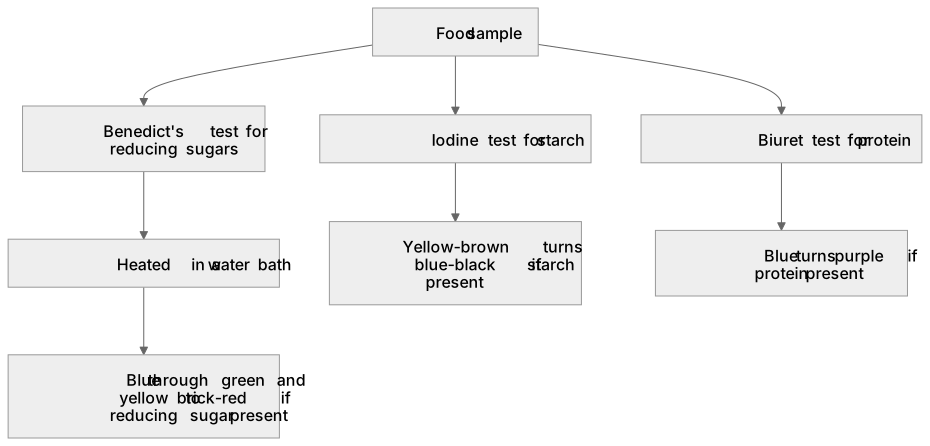
This statement specifies the three named qualitative tests you must know: Benedict’s test for sugars, the iodine test for starch and the Biuret test for protein. Benedict’s solution is blue and, when heated with a reducing sugar such as glucose, changes through green and yellow to brick-red; the colour reflects how much reducing sugar is present. Iodine solution is yellow-brown and turns blue-black in the presence of starch. Biuret reagent is blue and turns purple when protein is present. You should be able to state the reagent, the conditions and the positive result for each test, and use these tests to identify unknown food samples. The tests are qualitative, so they show whether a substance is present rather than giving an exact concentration.
What earns the marks
- Names Benedict’s solution as the reagent for reducing sugars and states that the sample must be heated in a water bath.
- Describes the positive Benedict’s result as a colour change from blue through green and yellow to brick-red.
- Names iodine solution as the reagent for starch and states that a blue-black colour is a positive result.
- Names Biuret reagent as the reagent for protein and states that a colour change from blue to purple is a positive result.
- Applies the tests to identify the biological molecules present in an unknown food sample from the observed colours.
- Recognises that these tests are qualitative and indicate presence rather than exact concentration.
Common mistakes and how to put them right
Stating that Benedict’s test detects all sugars.
Put it right: Benedict’s test detects reducing sugars such as glucose, while sucrose is a non-reducing sugar and gives a negative result unless it is first hydrolysed.
Describing the iodine positive result as brown or orange.
Put it right: Iodine solution is yellow-brown and turns blue-black with starch.
Saying Biuret reagent turns purple immediately without noting the starting colour.
Put it right: Biuret reagent starts blue and changes to purple when protein is present.
Exam tips
- Make a three-column summary table of reagent, conditions and positive result for the three tests and use it for quick revision.
- When a question gives a colour result, name the molecule detected and the test used, rather than only naming the colour.
- Use the term reducing sugar accurately when writing about Benedict’s test, and remember that starch and protein tests do not require heating.
Try the lesson
The start of the The human digestive system: To include: Benedict’s test for sugars; iodine test for starch; and Biuret reagent for protein. lesson, made from checked teaching notes for this specification point.
Have a go first
Which reagent is used to test a food sample for the presence of protein?
Listen
This statement specifies the three named qualitative tests you must know: Benedict’s test for sugars, the iodine test for starch and the Biuret test for protein. Benedict’s solution is blue and, when heated with a reducing sugar such as glucose, changes through green and yellow to brick-red; the colour reflects how much reducing sugar is present. Iodine solution is yellow-brown and turns blue-black in the presence of starch. Biuret reagent is blue and turns purple when protein is present. You should be able to state the reagent, the conditions and the positive result for each test, and use these tests to identify unknown food samples. The tests are qualitative, so they show whether a substance is present rather than giving an exact concentration. A strong answer earns marks for these points. Names Benedict’s solution as the reagent for reducing sugars and states that the sample must be heated in a water bath. Describes the positive Benedict’s result as a colour change from blue through green and yellow to brick-red. Names iodine solution as the reagent for starch and states that a blue-black colour is a positive result. Names Biuret reagent as the reagent for protein and states that a colour change from blue to purple is a positive result. A common slip: Stating that Benedict’s test detects all sugars. Instead, Benedict’s test detects reducing sugars such as glucose, while sucrose is a non-reducing sugar and gives a negative result unless it is first hydrolysed. Exam tip: Make a three-column summary table of reagent, conditions and positive result for the three tests and use it for quick revision.
See it
Key words
Say what each word means before you turn the card.
Benedict’s test for reducing sugars
Try answering aloud or in your head before turning the card.
Iodine test for starch
Try answering aloud or in your head before turning the card.
Biuret test for protein
Try answering aloud or in your head before turning the card.
Qualitative identification of biological molecules
Try answering aloud or in your head before turning the card.
See every definition
- Benedict’s test for reducing sugars
- Benedict’s solution is blue and, when heated with a reducing sugar such as glucose, changes through green and yellow to brick-red, reflecting how much reducing sugar is present.
- Iodine test for starch
- Iodine solution is yellow-brown and turns blue-black in the presence of starch.
- Biuret test for protein
- Biuret reagent is blue and turns purple when protein is present.
- Qualitative identification of biological molecules
- The tests are qualitative, so they show whether a substance is present rather than giving an exact concentration.
Label the diagram
Some boxes have lost their names. Pick the right name for each number.
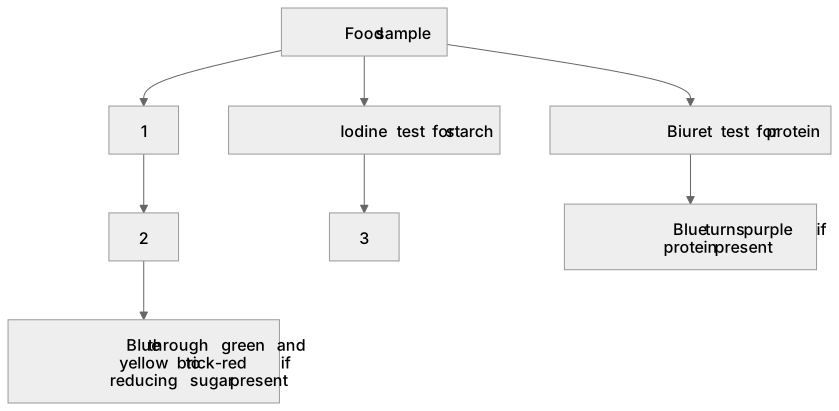
1Box 1
2Box 2
3Box 3
There is more to this lesson
The full lesson goes on to check your understanding and help you earn the marks. Create a free account to carry on, with your progress saved.
A week of Premium from your first lesson · Then the free plan continues · No card, no charge
Test your understanding of The human digestive system: To include: Benedict’s test for sugars; iodine test for starch; and Biuret reagent for protein.
Active recall beats re-reading. Take an instant quiz now to test what you’ve learned and lock it into long-term memory.
A week of Premium from your first lesson · Then the free plan continues · No card, no charge