AQA · GCSE · Biology
Course version: 8461 · Version from Sept 2018
The theory of evolution by natural selection was only gradually accepted…
Full specification wording
Theory of evolution (biology only): The theory of evolution by natural selection was only gradually accepted because: • the theory challenged the idea that God made all the animals and plants that live on Earth • there was insufficient evidence at the time the theory was published to convince many scientists • the mechanism of inheritance and variation was not known until 50 years after the theory was published.
Darwin and Wallace proposed evolution by natural selection in the mid-19th century, yet acceptance took decades.
Checked against the AQA 8461 specification (opens in a new tab) on .
- Point 6 of 8
Study notes
From the checked teaching notes for this specification point.
The idea
Darwin and Wallace proposed evolution by natural selection in the mid-19th century, yet acceptance took decades. Three barriers explain the delay. First, the theory challenged the widely held religious belief that God created all species in their present form, so many people rejected it on faith rather than evidence. Second, the evidence available in 1859 was limited: Darwin had finches, fossils and artificial selection, but no direct demonstration of how variation arose or how traits passed to offspring. Third, the mechanism of inheritance was unknown; Mendel's work on 'units' was published in 1866 but ignored, and chromosomes were not linked to heredity until the early 20th century, roughly 50 years later. Without a mechanism, natural selection seemed incomplete. Acceptance grew as genetics, the modern synthesis and the fossil record provided supporting evidence.
What earns the marks
- State that the theory challenged the religious idea that God made all animals and plants, so it conflicted with accepted beliefs.
- Explain that evidence available when the theory was published was insufficient to convince many scientists.
- Explain that the mechanism of inheritance and variation was not understood until about 50 years after publication.
- Link the delay in acceptance to the later discovery of genes, chromosomes and DNA, which supplied the missing mechanism.
- Use the example of Darwin's finches or fossil evidence to show how evidence accumulated gradually.
- Recognise that scientific ideas are accepted when evidence and mechanisms support them, not immediately on publication.
Common mistakes and how to put them right
Thinking the theory was rejected only because it was wrong.
Put it right: It lacked a known mechanism of inheritance at the time.
Believing Darwin published after Mendel.
Put it right: Mendel's work came later and was itself unrecognised for decades.
Assuming all scientists immediately accepted evolution.
Put it right: Acceptance was gradual and involved religious and evidential objections.
Exam tips
- Name all three reasons in the statement and give a short explanation for each to secure full credit.
- Use the phrase 'mechanism of inheritance' when discussing the 50-year gap, and link it to genes and chromosomes.
- If asked why acceptance was gradual, structure your answer around religion, evidence and mechanism rather than writing a general history of Darwin.
Try the lesson
The start of the Theory of evolution (biology only): The theory of evolution by natural selection was only gradually accepted because: • the theory challenged the idea that God made all the animals and plants that live on Earth • there was insufficient evidence at the time the theory was published to convince many scientists • the mechanism of inheritance and variation was not known until 50 years after the theory was published. lesson, made from checked teaching notes for this specification point.
Have a go first
Which statement explains why many people in the 19th century rejected the theory of evolution by natural selection?
Listen
Darwin and Wallace proposed evolution by natural selection in the mid-19th century, yet acceptance took decades. Three barriers explain the delay. First, the theory challenged the widely held religious belief that God created all species in their present form, so many people rejected it on faith rather than evidence. Second, the evidence available in 1859 was limited: Darwin had finches, fossils and artificial selection, but no direct demonstration of how variation arose or how traits passed to offspring. Third, the mechanism of inheritance was unknown; Mendel's work on 'units' was published in 1866 but ignored, and chromosomes were not linked to heredity until the early 20th century, roughly 50 years later. Without a mechanism, natural selection seemed incomplete. Acceptance grew as genetics, the modern synthesis and the fossil record provided supporting evidence. A strong answer earns marks for these points. State that the theory challenged the religious idea that God made all animals and plants, so it conflicted with accepted beliefs. Explain that evidence available when the theory was published was insufficient to convince many scientists. Explain that the mechanism of inheritance and variation was not understood until about 50 years after publication. Link the delay in acceptance to the later discovery of genes, chromosomes and DNA, which supplied the missing mechanism. A common slip: Thinking the theory was rejected only because it was wrong. Instead, it lacked a known mechanism of inheritance at the time. Exam tip: Name all three reasons in the statement and give a short explanation for each to secure full credit.
See it
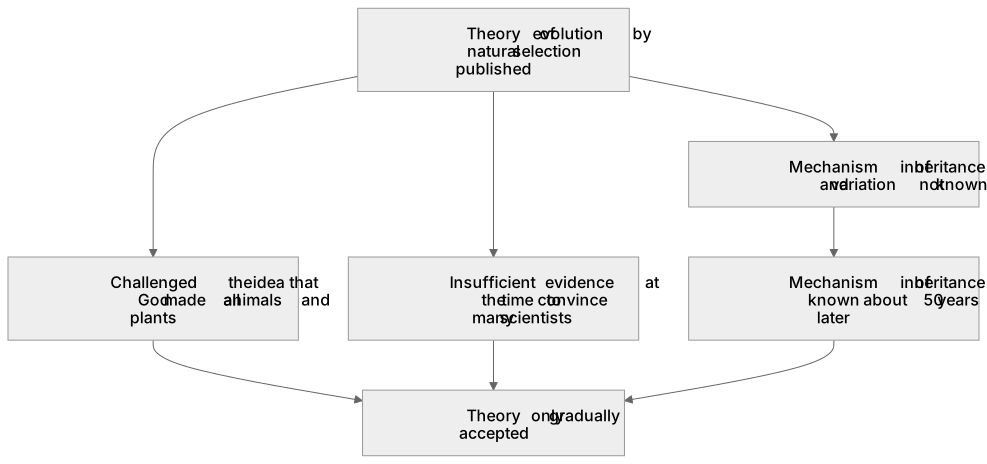
Label the diagram
Some boxes have lost their names. Pick the right name for each number.
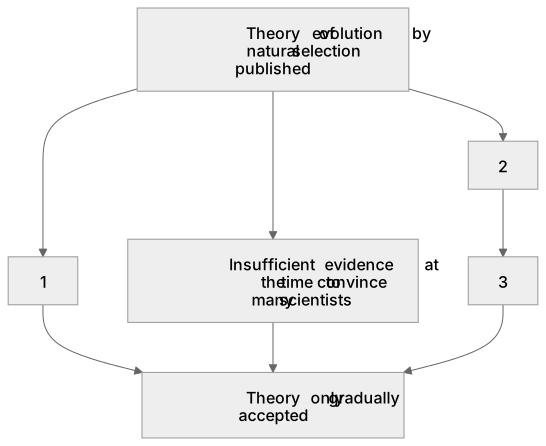
1Box 1
2Box 2
3Box 3
There is more to this lesson
The full lesson goes on to check your understanding and help you earn the marks. Create a free account to carry on, with your progress saved.
A week of Premium from your first lesson · Then the free plan continues · No card, no charge
Test your understanding of Theory of evolution (biology only): The theory of evolution by natural selection was only gradually accepted because: • the theory challenged the idea that God made all the animals and plants that live on Earth • there was insufficient evidence at the time the theory was published to convince many scientists • the mechanism of inheritance and variation was not known until 50 years after the theory was published.
Active recall beats re-reading. Take an instant quiz now to test what you’ve learned and lock it into long-term memory.
A week of Premium from your first lesson · Then the free plan continues · No card, no charge