AQA · GCSE · Biology
Course version: 8461 · Version from Sept 2018
Students should be able to: • describe pyramids of biomass • explain how…
Full specification wording
Transfer of biomass: Students should be able to: • describe pyramids of biomass • explain how biomass is lost between the different trophic levels.
A pyramid of biomass is a quantitative diagram in which each trophic level is drawn as a horizontal bar whose area is proportional to the dry mass of living material present, usually measured in g…
Checked against the AQA 8461 specification (opens in a new tab) on .
- Point 1 of 7
- 4 key terms
Study notes
From the checked teaching notes for this specification point.
The idea
A pyramid of biomass is a quantitative diagram in which each trophic level is drawn as a horizontal bar whose area is proportional to the dry mass of living material present, usually measured in g m⁻² or kg m⁻². Producers form the wide base, primary consumers the next bar, and so on, so the shape shows how much energy-containing material is available at each stage. Biomass is lost between levels because much ingested material is not absorbed and is egested as faeces, absorbed material is used in respiration and lost as carbon dioxide and water, and some is excreted as urea or other waste. Energy also leaves as heat, and dead organisms and waste become detritus for decomposers. Because only about 10 % of biomass passes to the next level, pyramids usually narrow sharply, and food chains rarely have more than four or five trophic levels.
What earns the marks
- Defines a pyramid of biomass as a diagram whose bar areas represent the dry mass of organisms at each trophic level, with producers at the base.
- States that biomass is measured as dry mass per unit area, for example g m⁻², and that the bars are drawn to scale.
- Explains that not all ingested material is absorbed, so some is egested as faeces and is not available to the next trophic level.
- Explains that absorbed material is used in respiration, releasing carbon dioxide and water, so biomass is lost as these waste products.
- Explains that some absorbed material is excreted as waste such as urea, and that heat from respiration is also lost to the environment.
- Uses the idea that only about 10 % of biomass is transferred to the next trophic level to explain why pyramids narrow and food chains are short.
Common mistakes and how to put them right
Drawing bars of equal width or using numbers of organisms instead of biomass.
Put it right: Make each bar's area proportional to the dry mass at that trophic level.
Claiming that energy is destroyed or simply disappears between levels.
Put it right: State that energy is transferred to the environment by respiration, heat and waste, and is not destroyed.
Confusing biomass with the total mass of water-containing tissue.
Put it right: Use dry mass, since water content varies and is not useful for comparing trophic levels.
Exam tips
- Label each bar with the trophic level and the organism, and state the unit of biomass on the axis.
- When explaining losses, work through the sequence ingestion, absorption, egestion, respiration and excretion so no stage is omitted.
- Use the 10 % figure as a quantitative anchor when asked why a food chain has few trophic levels.
Try the lesson
The start of the Transfer of biomass: Students should be able to: • describe pyramids of biomass • explain how biomass is lost between the different trophic levels. lesson, made from checked teaching notes for this specification point.
Have a go first
A pyramid of biomass for a food chain is drawn with the producer at the bottom. What does the width of each bar represent?
Listen
A pyramid of biomass is a quantitative diagram in which each trophic level is drawn as a horizontal bar whose area is proportional to the dry mass of living material present, usually measured in g m⁻² or kg m⁻². Producers form the wide base, primary consumers the next bar, and so on, so the shape shows how much energy-containing material is available at each stage. Biomass is lost between levels because much ingested material is not absorbed and is egested as faeces, absorbed material is used in respiration and lost as carbon dioxide and water, and some is excreted as urea or other waste. Energy also leaves as heat, and dead organisms and waste become detritus for decomposers. Because only about 10 % of biomass passes to the next level, pyramids usually narrow sharply, and food chains rarely have more than four or five trophic levels. A strong answer earns marks for these points. Defines a pyramid of biomass as a diagram whose bar areas represent the dry mass of organisms at each trophic level, with producers at the base. States that biomass is measured as dry mass per unit area, for example g m⁻², and that the bars are drawn to scale. Explains that not all ingested material is absorbed, so some is egested as faeces and is not available to the next trophic level. Explains that absorbed material is used in respiration, releasing carbon dioxide and water, so biomass is lost as these waste products. A common slip: Drawing bars of equal width or using numbers of organisms instead of biomass. Instead, make each bar's area proportional to the dry mass at that trophic level. Exam tip: Label each bar with the trophic level and the organism, and state the unit of biomass on the axis.
See it
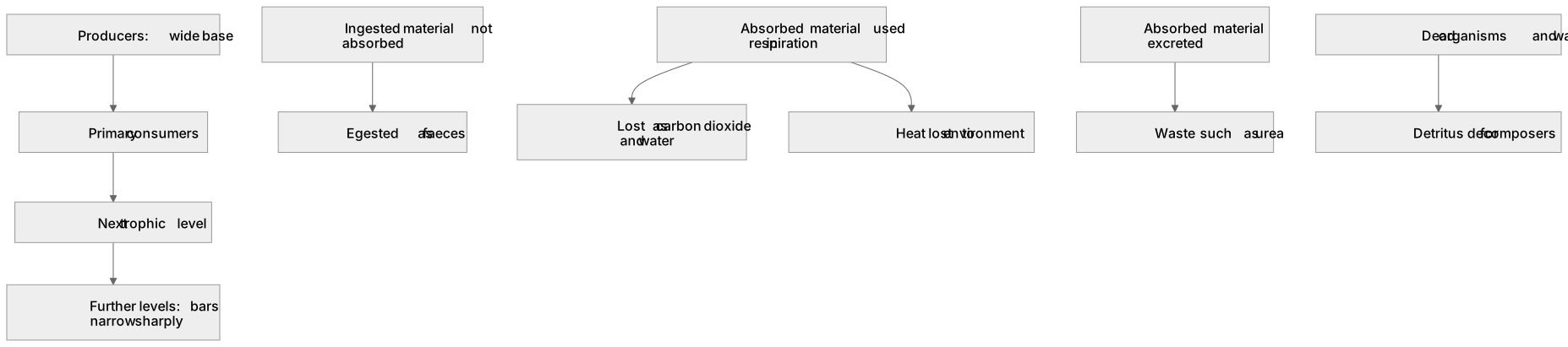
Key words
Say what each word means before you turn the card.
Pyramid of biomass
Try answering aloud or in your head before turning the card.
Dry mass
Try answering aloud or in your head before turning the card.
Egestion
Try answering aloud or in your head before turning the card.
Trophic levels
Try answering aloud or in your head before turning the card.
See every definition
- Pyramid of biomass
- A quantitative diagram in which each trophic level is drawn as a horizontal bar whose area is proportional to the dry mass of living material present.
- Dry mass
- The mass of living material measured without water, usually in g m⁻² or kg m⁻², since water content varies and is not useful for comparing trophic levels.
- Egestion
- The loss of ingested material that is not absorbed and is passed out as faeces, so it is not available to the next trophic level.
- Trophic levels
- The stages of a food chain, with producers forming the wide base and primary consumers the next bar, and so on.
Label the diagram
Some boxes have lost their names. Pick the right name for each number.
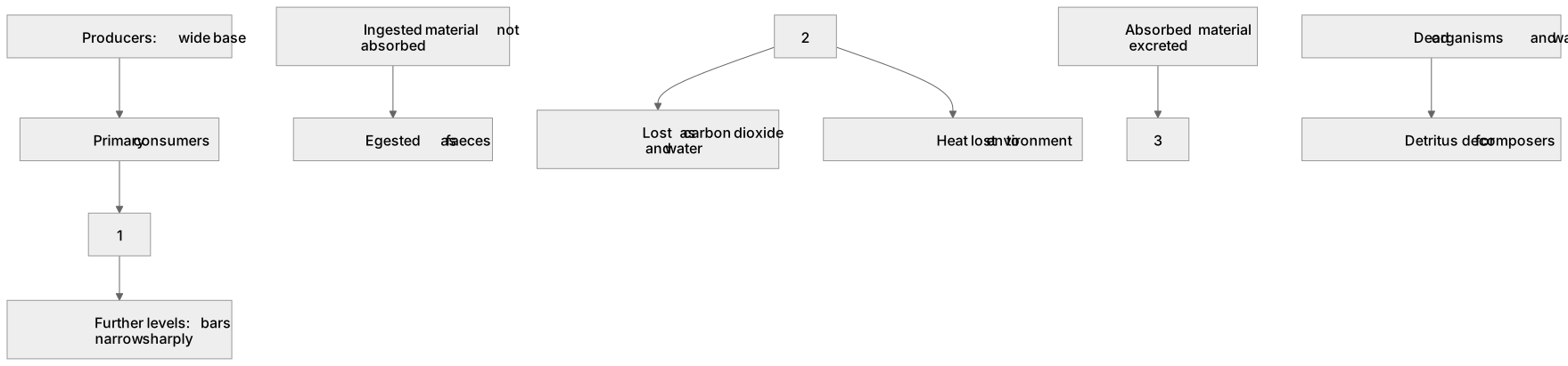
1Box 1
2Box 2
3Box 3
There is more to this lesson
The full lesson goes on to check your understanding and help you earn the marks. Create a free account to carry on, with your progress saved.
A week of Premium from your first lesson · Then the free plan continues · No card, no charge
Test your understanding of Transfer of biomass: Students should be able to: • describe pyramids of biomass • explain how biomass is lost between the different trophic levels.
Active recall beats re-reading. Take an instant quiz now to test what you’ve learned and lock it into long-term memory.
A week of Premium from your first lesson · Then the free plan continues · No card, no charge