AQA · GCSE · Biology
Course version: 8461 · Version from Sept 2018
Students should be able to explain how this affects the number of…
Full specification wording
Transfer of biomass: Students should be able to explain how this affects the number of organisms at each trophic level.
Because biomass transfer between trophic levels is inefficient, less biomass and energy are available at each successive level.
Checked against the AQA 8461 specification (opens in a new tab) on .
- Point 7 of 7
- 3 key terms
Study notes
From the checked teaching notes for this specification point.
The idea
Because biomass transfer between trophic levels is inefficient, less biomass and energy are available at each successive level. This limits how many organisms each level can support. If only about 10% of biomass passes on, the next trophic level has far less material and energy for growth, reproduction and survival, so it usually contains fewer organisms. For example, a field may support many thousands of grass plants, fewer rabbits and only a few foxes. The effect is not always a simple decrease in numbers because some organisms are larger or smaller than others, but the total biomass and energy generally decrease. This is why food chains are usually short, with only four or five trophic levels.
What earns the marks
- Biomass and energy are lost at each transfer, mainly through respiration, movement, excretion and heat.
- Less biomass and energy are available to organisms at higher trophic levels.
- Fewer organisms can be supported at higher trophic levels because there is less material and energy for growth and reproduction.
- Numbers of organisms usually decrease along a food chain, although body size can affect the exact numbers.
- Food chains are usually short because too little energy remains after several transfers to support another level.
- A pyramid of biomass or numbers can represent the decrease, with the producer level usually the largest.
Common mistakes and how to put them right
Saying energy is destroyed.
Put it right by stating energy is transferred to the surroundings as heat and is not destroyed.
Assuming numbers always decrease in exactly the same way.
Put it right by stating biomass and energy decrease, but numbers also depend on organism size.
Ignoring the loss of biomass in excretion and uneaten parts.
Put it right by including respiration, movement, excretion and heat as reasons for loss.
Exam tips
- Link the idea of inefficient transfer to the limited number of trophic levels in a food chain.
- Use the phrase less energy available at each trophic level rather than no energy.
- If a question gives biomass values, calculate the transfer efficiency first, then use it to explain the effect on numbers.
Try the lesson
The start of the Transfer of biomass: Students should be able to explain how this affects the number of organisms at each trophic level. lesson, made from checked teaching notes for this specification point.
Have a go first
Why are there usually fewer organisms at each successive trophic level in a food chain?
Listen
Because biomass transfer between trophic levels is inefficient, less biomass and energy are available at each successive level. This limits how many organisms each level can support. If only about 10% of biomass passes on, the next trophic level has far less material and energy for growth, reproduction and survival, so it usually contains fewer organisms. For example, a field may support many thousands of grass plants, fewer rabbits and only a few foxes. The effect is not always a simple decrease in numbers because some organisms are larger or smaller than others, but the total biomass and energy generally decrease. This is why food chains are usually short, with only four or five trophic levels. A strong answer earns marks for these points. Biomass and energy are lost at each transfer, mainly through respiration, movement, excretion and heat. Less biomass and energy are available to organisms at higher trophic levels. Fewer organisms can be supported at higher trophic levels because there is less material and energy for growth and reproduction. Numbers of organisms usually decrease along a food chain, although body size can affect the exact numbers. A common slip: Saying energy is destroyed. Instead, stating energy is transferred to the surroundings as heat and is not destroyed. Exam tip: Link the idea of inefficient transfer to the limited number of trophic levels in a food chain.
See it
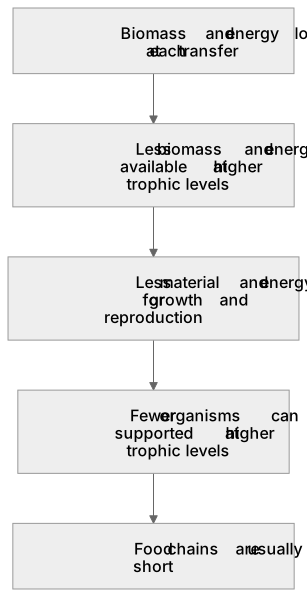
Put it in order
Put these steps in the order they happen.
- 1. Less biomass and energy available at higher trophic levels
- 2. Less material and energy for growth and reproduction
- 3. Biomass and energy lost at each transfer
- 4. Food chains are usually short
- 5. Fewer organisms can be supported at higher trophic levels
Key words
Say what each word means before you turn the card.
Trophic levels and food chains
Try answering aloud or in your head before turning the card.
Energy loss in ecosystems
Try answering aloud or in your head before turning the card.
Pyramids of biomass and numbers
Try answering aloud or in your head before turning the card.
See every definition
- Trophic levels and food chains
- Successive levels in a food chain, where less biomass and energy are available at each level because transfer between them is inefficient.
- Energy loss in ecosystems
- Biomass and energy are lost at each transfer, mainly through respiration, movement, excretion and heat, so less is available at higher trophic levels.
- Pyramids of biomass and numbers
- A representation of the decrease between trophic levels, with the producer level usually the largest.
Label the diagram
Some boxes have lost their names. Pick the right name for each number.
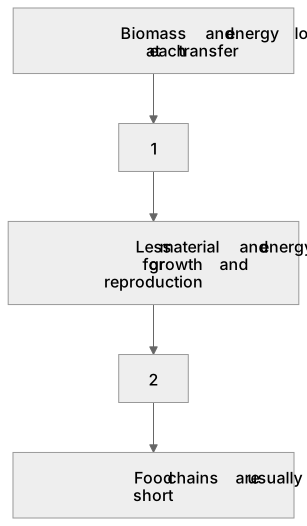
1Box 1
2Box 2
There is more to this lesson
The full lesson goes on to check your understanding and help you earn the marks. Create a free account to carry on, with your progress saved.
A week of Premium from your first lesson · Then the free plan continues · No card, no charge
Test your understanding of Transfer of biomass: Students should be able to explain how this affects the number of organisms at each trophic level.
Active recall beats re-reading. Take an instant quiz now to test what you’ve learned and lock it into long-term memory.
A week of Premium from your first lesson · Then the free plan continues · No card, no charge