AQA · GCSE · Biology
Course version: 8461 · Version from Sept 2018
The glucose produced in photosynthesis may be: • used for respiration •…
Full specification wording
Uses of glucose from photosynthesis: The glucose produced in photosynthesis may be: • used for respiration • converted into insoluble starch for storage • used to produce fat or oil for storage • used to produce cellulose, which strengthens the cell wall • used to produce amino acids for protein synthesis.
Glucose made in photosynthesis is not simply stored as sugar; it is used in several ways.
Checked against the AQA 8461 specification (opens in a new tab) on .
- Point 1 of 2
- 3 key terms
Study notes
From the checked teaching notes for this specification point.
The idea
Glucose made in photosynthesis is not simply stored as sugar; it is used in several ways. Some glucose is respired to release energy for the plant's life processes. Some is converted into insoluble starch, which is compact and does not affect water potential, making it ideal for storage in roots, seeds or tubers. Some glucose is converted into fats or oils for storage, especially in seeds. Some is used to make cellulose, a structural carbohydrate that strengthens cell walls. Some is combined with nitrate ions to make amino acids, which are joined to form proteins for growth and enzymes.
For example: A potato tuber stores starch, while a sunflower seed stores oil.
What earns the marks
- Glucose is used in respiration to release energy for processes such as growth and active transport.
- Glucose is converted into insoluble starch for storage because it is compact and does not draw water into cells.
- Glucose is converted into fats or oils for storage, often in seeds, providing a concentrated energy store.
- Glucose is used to produce cellulose, which strengthens the cell wall and provides structural support.
- Glucose is used with nitrate ions to produce amino acids, which are linked to form proteins for growth and enzymes.
Common mistakes and how to put them right
Stating that glucose is stored directly as glucose.
Put it right: Glucose is converted into insoluble starch for storage.
Confusing cellulose with starch.
Put it right: Cellulose is a structural carbohydrate in cell walls, while starch is a storage carbohydrate.
Forgetting that amino acid production requires nitrate ions.
Put it right: Nitrate ions absorbed from the soil are needed to make amino acids.
Exam tips
- Use the phrase 'insoluble starch' to show understanding of why it is a good storage molecule.
- When asked about proteins, always mention nitrate ions as well as glucose.
- Link each use of glucose to a named plant part, such as starch in potato tubers or oil in seeds.
Try the lesson
The start of the Uses of glucose from photosynthesis: The glucose produced in photosynthesis may be: • used for respiration • converted into insoluble starch for storage • used to produce fat or oil for storage • used to produce cellulose, which strengthens the cell wall • used to produce amino acids for protein synthesis. lesson, made from checked teaching notes for this specification point.
Have a go first
A plant makes glucose during photosynthesis. Which substance is made from this glucose to strengthen the cell wall?
Listen
Glucose made in photosynthesis is not simply stored as sugar; it is used in several ways. Some glucose is respired to release energy for the plant's life processes. Some is converted into insoluble starch, which is compact and does not affect water potential, making it ideal for storage in roots, seeds or tubers. Some glucose is converted into fats or oils for storage, especially in seeds. Some is used to make cellulose, a structural carbohydrate that strengthens cell walls. Some is combined with nitrate ions to make amino acids, which are joined to form proteins for growth and enzymes. For example, a potato tuber stores starch, while a sunflower seed stores oil. A strong answer earns marks for these points. Glucose is used in respiration to release energy for processes such as growth and active transport. Glucose is converted into insoluble starch for storage because it is compact and does not draw water into cells. Glucose is converted into fats or oils for storage, often in seeds, providing a concentrated energy store. Glucose is used to produce cellulose, which strengthens the cell wall and provides structural support. A common slip: Stating that glucose is stored directly as glucose. Instead, glucose is converted into insoluble starch for storage. Exam tip: Use the phrase 'insoluble starch' to show understanding of why it is a good storage molecule.
See it

Key words
Say what each word means before you turn the card.
Storage molecules
Try answering aloud or in your head before turning the card.
Plant structure and growth
Try answering aloud or in your head before turning the card.
Respiration and biosynthesis
Try answering aloud or in your head before turning the card.
See every definition
- Storage molecules
- Glucose is converted into insoluble starch for storage, or into fat or oil for storage.
- Plant structure and growth
- Glucose is used to produce cellulose, which strengthens the cell wall, and to produce amino acids for protein synthesis.
- Respiration and biosynthesis
- Glucose is used for respiration, and is used to produce amino acids for protein synthesis.
Label the diagram
Some boxes have lost their names. Pick the right name for each number.
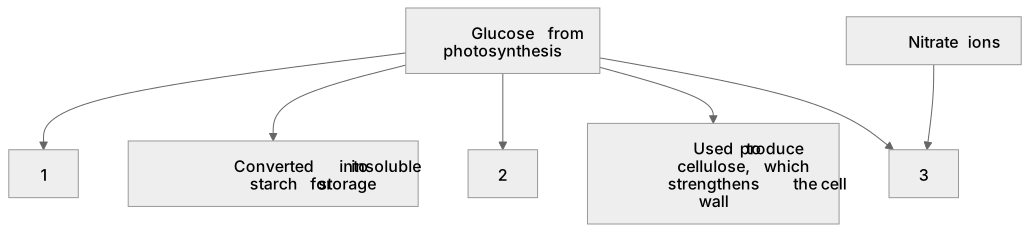
1Box 1
2Box 2
3Box 3
There is more to this lesson
The full lesson goes on to check your understanding and help you earn the marks. Create a free account to carry on, with your progress saved.
A week of Premium from your first lesson · Then the free plan continues · No card, no charge
Test your understanding of Uses of glucose from photosynthesis: The glucose produced in photosynthesis may be: • used for respiration • converted into insoluble starch for storage • used to produce fat or oil for storage • used to produce cellulose, which strengthens the cell wall • used to produce amino acids for protein synthesis.
Active recall beats re-reading. Take an instant quiz now to test what you’ve learned and lock it into long-term memory.
A week of Premium from your first lesson · Then the free plan continues · No card, no charge