AQA · GCSE · Biology
Course version: 8461 · Version from Sept 2018
Students are not expected to recall any specific tests or treatments but…
Full specification wording
Uses of monoclonal antibodies: Students are not expected to recall any specific tests or treatments but given appropriate information they should be able to explain how they work.
This statement sets out how you are assessed on monoclonal antibody uses.
Checked against the AQA 8461 specification (opens in a new tab) on .
- Point 4 of 5
- 3 key terms
Study notes
From the checked teaching notes for this specification point.
The idea
This statement sets out how you are assessed on monoclonal antibody uses. You do not need to memorise named tests or named treatments. Instead, a question supplies the information, such as a diagram of an antibody with a substance attached, or a short paragraph about a test strip. You then use that information with your knowledge of antibody specificity to explain the mechanism. For example, if told that a test uses an antibody that binds a particular antigen, you explain that the antibody binds only that antigen, so a colour or line appears only when that antigen is present. The skill is applying the principle of specific binding to unfamiliar material.
What earns the marks
- You are not required to recall named tests or named treatments for monoclonal antibodies.
- Information about an unfamiliar test or treatment will be given in the question.
- You should use the given information together with the idea that an antibody binds one specific antigen.
- An explanation should link the binding event to the result, such as a colour change or a line appearing.
- Answers should apply the principle to the unfamiliar context rather than recall a memorised example.
Common mistakes and how to put them right
Trying to recall a named test or treatment instead of using the information provided.
Put it right: Read the passage or diagram and apply the principle of specific binding.
Describing the antibody as binding generally rather than to one specific antigen.
Put it right: State that the antibody binds only its matching antigen.
Leaving out the link between binding and the observed result.
Put it right: Explain that binding causes the colour change or line to appear.
Exam tips
- Underline the key information in the question before you start writing.
- Use the phrase binds to its specific antigen in your explanation.
- Finish by stating the observable result, such as a colour change or a line appearing.
Try the lesson
The start of the Uses of monoclonal antibodies: Students are not expected to recall any specific tests or treatments but given appropriate information they should be able to explain how they work. lesson, made from checked teaching notes for this specification point.
Have a go first
A new diagnostic test uses monoclonal antibodies attached to a fluorescent dye. The antibodies are specific to a protein found on the surface of a certain pathogen. How does this test indicate that a patient is infected with the pathogen?
Listen
This statement sets out how you are assessed on monoclonal antibody uses. You do not need to memorise named tests or named treatments. Instead, a question supplies the information, such as a diagram of an antibody with a substance attached, or a short paragraph about a test strip. You then use that information with your knowledge of antibody specificity to explain the mechanism. For example, if told that a test uses an antibody that binds a particular antigen, you explain that the antibody binds only that antigen, so a colour or line appears only when that antigen is present. The skill is applying the principle of specific binding to unfamiliar material. A strong answer earns marks for these points. You are not required to recall named tests or named treatments for monoclonal antibodies. Information about an unfamiliar test or treatment will be given in the question. You should use the given information together with the idea that an antibody binds one specific antigen. An explanation should link the binding event to the result, such as a colour change or a line appearing. Exam tip: Underline the key information in the question before you start writing.
See it
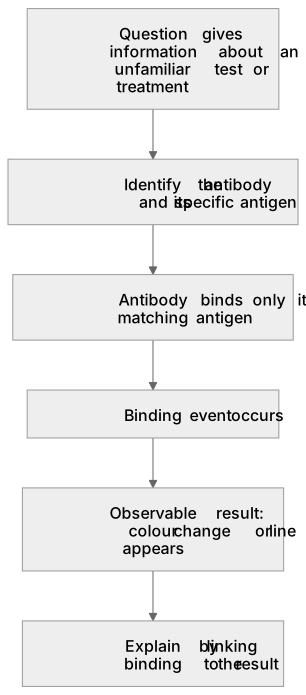
Put it in order
Put these steps in the order they happen.
- 1. Antibody binds only its matching antigen
- 2. Identify the antibody and its specific antigen
- 3. Question gives information about an unfamiliar test or treatment
- 4. Explain by linking binding to the result
- 5. Observable result: colour change or line appears
- 6. Binding event occurs
Key words
Say what each word means before you turn the card.
Application of knowledge to unfamiliar contexts
Try answering aloud or in your head before turning the card.
Interpreting given information
Try answering aloud or in your head before turning the card.
Explaining how a test or treatment produces a result
Try answering aloud or in your head before turning the card.
See every definition
- Application of knowledge to unfamiliar contexts
- Using the principle of specific binding with information supplied in a question rather than recalling a memorised example.
- Interpreting given information
- Reading the passage or diagram provided in the question and using it to explain the mechanism.
- Explaining how a test or treatment produces a result
- Linking the binding event to the observable result, such as a colour change or a line appearing.
Label the diagram
Some boxes have lost their names. Pick the right name for each number.
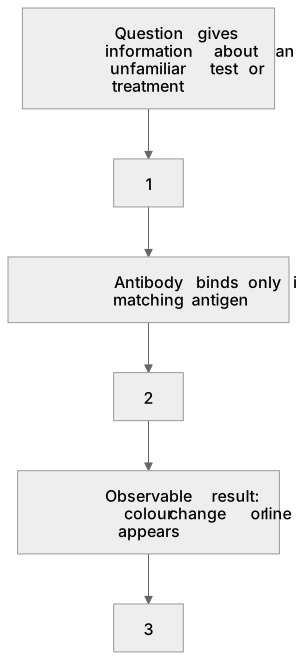
1Box 1
2Box 2
3Box 3
There is more to this lesson
The full lesson goes on to check your understanding and help you earn the marks. Create a free account to carry on, with your progress saved.
A week of Premium from your first lesson · Then the free plan continues · No card, no charge
Test your understanding of Uses of monoclonal antibodies: Students are not expected to recall any specific tests or treatments but given appropriate information they should be able to explain how they work.
Active recall beats re-reading. Take an instant quiz now to test what you’ve learned and lock it into long-term memory.
A week of Premium from your first lesson · Then the free plan continues · No card, no charge