AQA · GCSE · Biology
Course version: 8461 · Version from Sept 2018
Variation: Very rarely a mutation will lead to a new phenotype.
A mutation changes the base sequence of DNA, but a new phenotype appears only when that change alters the protein the gene codes for in a way that affects the organism.
Checked against the AQA 8461 specification (opens in a new tab) on .
- Point 5 of 6
- 3 key terms
Study notes
From the checked teaching notes for this specification point.
The idea
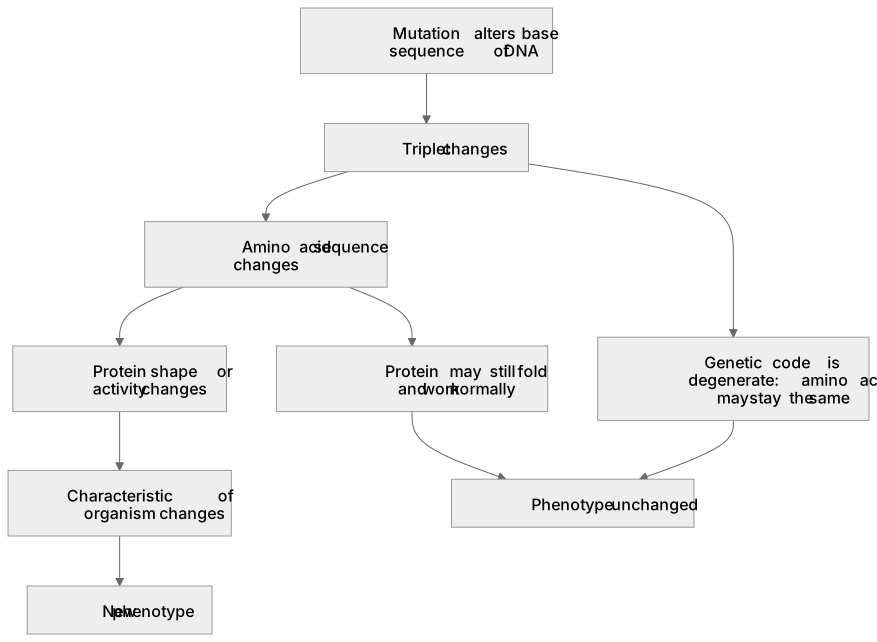
A mutation changes the base sequence of DNA, but a new phenotype appears only when that change alters the protein the gene codes for in a way that affects the organism. Most mutations are in non-coding DNA or produce the same amino acid because the genetic code is degenerate, so the phenotype is unchanged. Even when an amino acid changes, the protein may still fold and work normally. Very rarely, the altered protein changes a characteristic, such as fur colour, enzyme activity or disease resistance, giving a new phenotype. A useful method is to trace the chain: base sequence changes, triplet changes, amino acid changes, protein shape or activity changes, phenotype changes. Each step must occur for a new phenotype to result.
What earns the marks
- A mutation alters the base sequence of DNA and so may change the sequence of amino acids in a protein.
- The genetic code is degenerate, so many mutations do not change the amino acid and have no effect.
- A new phenotype appears only if the altered protein changes a characteristic of the organism.
- Most mutations have no effect on phenotype, so a new phenotype is very rare.
- Examples of new phenotypes include changed fur colour, altered enzyme activity or resistance to a disease.
Common mistakes and how to put them right
Assuming every mutation changes the phenotype.
Put it right by stating that most mutations have no visible effect.
Thinking a mutation always changes one amino acid.
Put it right by noting that the code is degenerate and the amino acid may stay the same.
Saying a mutation directly creates a new species.
Put it right by stating that it may produce a new phenotype, which natural selection may then act on.
Exam tips
- Use the chain base sequence, amino acid sequence, protein, phenotype to explain how a mutation can have an effect.
- State explicitly that a new phenotype is rare because most mutations do not alter the protein.
- Give a named example of a phenotype, such as fur colour, rather than writing only that the organism changes.
Try the lesson
The start of the Variation: Very rarely a mutation will lead to a new phenotype. lesson, made from checked teaching notes for this specification point.
Have a go first
How often does a mutation lead to a new phenotype in an organism?
Listen
A mutation changes the base sequence of DNA, but a new phenotype appears only when that change alters the protein the gene codes for in a way that affects the organism. Most mutations are in non-coding DNA or produce the same amino acid because the genetic code is degenerate, so the phenotype is unchanged. Even when an amino acid changes, the protein may still fold and work normally. Very rarely, the altered protein changes a characteristic, such as fur colour, enzyme activity or disease resistance, giving a new phenotype. A useful method is to trace the chain: base sequence changes, triplet changes, amino acid changes, protein shape or activity changes, phenotype changes. Each step must occur for a new phenotype to result. A strong answer earns marks for these points. A mutation alters the base sequence of DNA and so may change the sequence of amino acids in a protein. The genetic code is degenerate, so many mutations do not change the amino acid and have no effect. A new phenotype appears only if the altered protein changes a characteristic of the organism. Most mutations have no effect on phenotype, so a new phenotype is very rare. A common slip: Assuming every mutation changes the phenotype. Instead, stating that most mutations have no visible effect. Exam tip: Use the chain base sequence, amino acid sequence, protein, phenotype to explain how a mutation can have an effect.
See it
Key words
Say what each word means before you turn the card.
Mutation
Try answering aloud or in your head before turning the card.
Phenotype
Try answering aloud or in your head before turning the card.
New phenotype
Try answering aloud or in your head before turning the card.
See every definition
- Mutation
- A change in the base sequence of DNA, which may change the sequence of amino acids in a protein.
- Phenotype
- A characteristic of the organism, such as fur colour, enzyme activity or disease resistance, which changes only if the altered protein changes it.
- New phenotype
- A changed characteristic of the organism that appears very rarely, only when a mutation alters the protein in a way that affects the organism.
Label the diagram
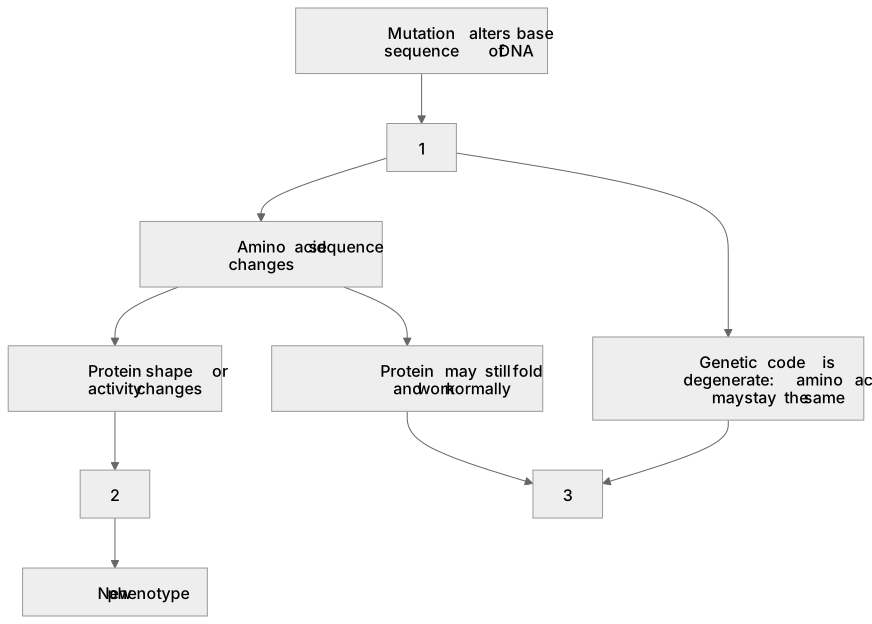
Some boxes have lost their names. Pick the right name for each number.
1Box 1
2Box 2
3Box 3
There is more to this lesson
The full lesson goes on to check your understanding and help you earn the marks. Create a free account to carry on, with your progress saved.
A week of Premium from your first lesson · Then the free plan continues · No card, no charge
Test your understanding of Variation: Very rarely a mutation will lead to a new phenotype.
Active recall beats re-reading. Take an instant quiz now to test what you’ve learned and lock it into long-term memory.
A week of Premium from your first lesson · Then the free plan continues · No card, no charge