OCR · A-Level · Biology
Course version: H420 · Version from Sept 2025
Biodiversity: (h) in situ and ex situ methods of maintaining biodiversity
Conservation methods are grouped as in situ (protecting organisms in their natural habitat) or ex situ (protecting them away from their natural habitat).
Checked against the OCR H420 specification (opens in a new tab) on .
- Point 9 of 10
- 3 key terms
Study notes
From the checked teaching notes for this specification point.
The idea
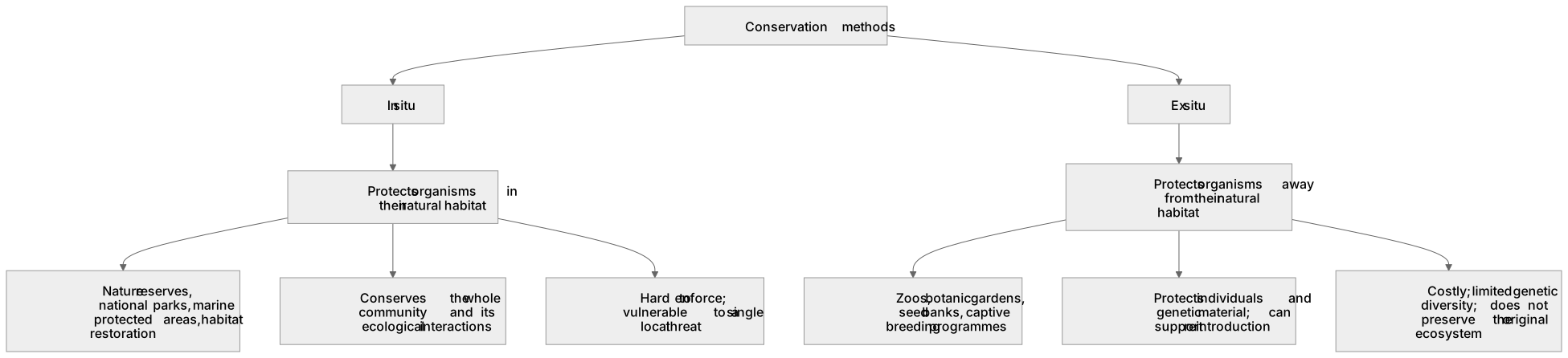
Conservation methods are grouped as in situ (protecting organisms in their natural habitat) or ex situ (protecting them away from their natural habitat). In situ methods include nature reserves, national parks, marine protected areas and habitat restoration; they conserve the species alongside the rest of the community and its ecological interactions, but can be hard to enforce and vulnerable to a single local threat. Ex situ methods include zoos, botanic gardens, seed banks and captive breeding programmes; they protect individuals and genetic material when a habitat is lost or a population is critically small, and can support reintroduction, but are costly, hold limited genetic diversity and do not preserve the original ecosystem. A multiple-choice question will typically give a scenario and ask you to classify the method or to select an advantage or limitation of it.
What earns the marks
- In situ conservation protects species within their natural habitat, for example nature reserves, national parks and marine protected areas.
- In situ methods conserve the whole community and its ecological interactions but may be difficult to enforce or vulnerable to local threats.
- Ex situ conservation protects organisms away from their natural habitat, for example zoos, botanic gardens, seed banks and captive breeding.
- Ex situ methods can protect species when habitat is lost and can support reintroduction, but are costly and hold limited genetic diversity.
- Classify a described method as in situ or ex situ before selecting an advantage or limitation.
Common mistakes and how to put them right
Reversing the terms, calling a zoo in situ or a reserve ex situ.
Put it right: In situ means in the natural habitat, ex situ means away from it.
Assuming ex situ conservation preserves the whole ecosystem.
Put it right: It protects individuals or genetic material, not the original habitat and community.
Treating in situ conservation as always successful.
Put it right: Reserves can be hard to enforce and remain exposed to pollution, climate change or poaching.
Exam tips
- Label each option as in situ or ex situ first, then check whether the stem asks for a method, an advantage or a limitation.
- Match the scenario's location to the habitat to decide the category.
- Reject options that describe a benefit belonging to the other category.
Try the lesson
The start of the Biodiversity: (h) in situ and ex situ methods of maintaining biodiversity lesson, made from checked teaching notes for this specification point.
Have a go first
Which method of maintaining biodiversity is an example of ex situ conservation?
Listen
Conservation methods are grouped as in situ (protecting organisms in their natural habitat) or ex situ (protecting them away from their natural habitat). In situ methods include nature reserves, national parks, marine protected areas and habitat restoration; they conserve the species alongside the rest of the community and its ecological interactions, but can be hard to enforce and vulnerable to a single local threat. Ex situ methods include zoos, botanic gardens, seed banks and captive breeding programmes; they protect individuals and genetic material when a habitat is lost or a population is critically small, and can support reintroduction, but are costly, hold limited genetic diversity and do not preserve the original ecosystem. A multiple-choice question will typically give a scenario and ask you to classify the method or to select an advantage or limitation of it. A strong answer earns marks for these points. In situ conservation protects species within their natural habitat, for example nature reserves, national parks and marine protected areas. In situ methods conserve the whole community and its ecological interactions but may be difficult to enforce or vulnerable to local threats. Ex situ conservation protects organisms away from their natural habitat, for example zoos, botanic gardens, seed banks and captive breeding. Ex situ methods can protect species when habitat is lost and can support reintroduction, but are costly and hold limited genetic diversity. A common slip: Reversing the terms, calling a zoo in situ or a reserve ex situ. Instead, in situ means in the natural habitat, ex situ means away from it. Exam tip: Label each option as in situ or ex situ first, then check whether the stem asks for a method, an advantage or a limitation.
See it
Key words
Say what each word means before you turn the card.
In situ conservation methods
Try answering aloud or in your head before turning the card.
Ex situ conservation methods
Try answering aloud or in your head before turning the card.
Classifying conservation scenarios
Try answering aloud or in your head before turning the card.
See every definition
- In situ conservation methods
- Methods that protect organisms in their natural habitat, such as nature reserves, national parks, marine protected areas and habitat restoration.
- Ex situ conservation methods
- Methods that protect organisms away from their natural habitat, such as zoos, botanic gardens, seed banks and captive breeding programmes.
- Classifying conservation scenarios
- Deciding whether a described method is in situ or ex situ before selecting an advantage or limitation of it.
Label the diagram
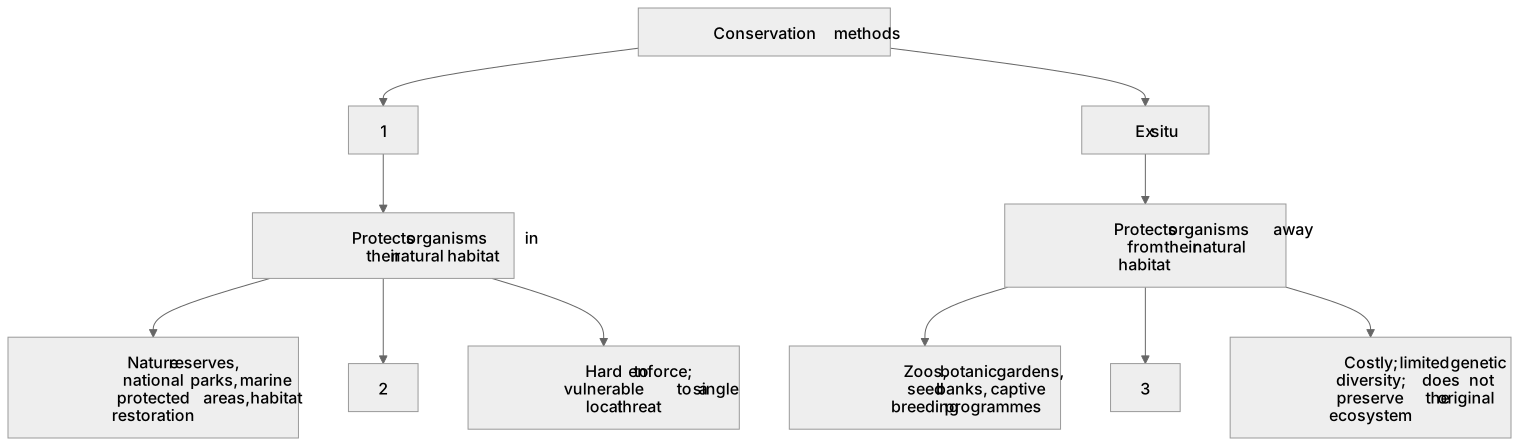
Some boxes have lost their names. Pick the right name for each number.
1Box 1
2Box 2
3Box 3
There is more to this lesson
The full lesson goes on to check your understanding and help you earn the marks. Create a free account to carry on, with your progress saved.
A week of Premium from your first lesson · Then the free plan continues · No card, no charge
Test your understanding of Biodiversity: (h) in situ and ex situ methods of maintaining biodiversity
Active recall beats re-reading. Take an instant quiz now to test what you’ve learned and lock it into long-term memory.
A week of Premium from your first lesson · Then the free plan continues · No card, no charge