OCR · A-Level · Biology
Course version: H420 · Version from Sept 2025
(i) international and local conservation agreements made to protect…
Full specification wording
Biodiversity: (i) international and local conservation agreements made to protect species and habitats.
Conservation agreements are formal commitments between countries or between organisations and communities that protect species and habitats.
Checked against the OCR H420 specification (opens in a new tab) on .
- Point 10 of 10
- 4 key terms
Study notes
From the checked teaching notes for this specification point.
The idea
Conservation agreements are formal commitments between countries or between organisations and communities that protect species and habitats. International agreements operate across national borders: CITES regulates trade in endangered species so that a species is not depleted by legal trade, and the Convention on Biological Diversity commits signatories to conserve biodiversity and use it sustainably. The Ramsar Convention protects wetlands of international importance as habitats for waterbirds and other species. Local agreements work at a smaller scale, for example a local wildlife trust managing a reserve under a management agreement with a landowner, or a community agreeing to protect a hedgerow or pond. Learn to distinguish the scale of each agreement and the mechanism it uses: trade restriction, habitat designation, or land management.
What earns the marks
- CITES is an international agreement controlling international trade in endangered species and their products.
- The Convention on Biological Diversity is an international agreement committing signatories to conserve biodiversity and use its components sustainably.
- The Ramsar Convention is an international agreement designating and protecting wetlands of international importance, especially as habitat for waterbirds.
- Local agreements involve organisations such as wildlife trusts or local authorities working with landowners or communities to manage and protect a named local habitat or species.
- The scale distinction matters: international agreements coordinate action between countries, while local agreements apply to a specific site or community.
- Agreements protect species and habitats by restricting harmful activity, designating protected areas, or setting management obligations.
Common mistakes and how to put them right
Treating every conservation agreement as international.
Put it right: Some agreements are local, made between a landowner and a wildlife trust or community for a specific site.
Confusing CITES with a habitat-designation agreement.
Put it right: CITES restricts trade in species and their products, whereas Ramsar designates wetland habitats.
Assuming an agreement alone protects a species without any enforcement or management.
Put it right: Protection depends on the obligations being implemented, such as trade controls or site management.
Exam tips
- Learn each named agreement with its scale (international or local) and its specific mechanism.
- When a question names an agreement, ask what it actually restricts or designates before choosing an option.
- Eliminate options that mix up trade control with habitat designation.
Try the lesson
The start of the Biodiversity: (i) international and local conservation agreements made to protect species and habitats. lesson, made from checked teaching notes for this specification point.
Have a go first
CITES is an international agreement. Which action does CITES mainly regulate?
Listen
Conservation agreements are formal commitments between countries or between organisations and communities that protect species and habitats. International agreements operate across national borders: CITES regulates trade in endangered species so that a species is not depleted by legal trade, and the Convention on Biological Diversity commits signatories to conserve biodiversity and use it sustainably. The Ramsar Convention protects wetlands of international importance as habitats for waterbirds and other species. Local agreements work at a smaller scale, for example a local wildlife trust managing a reserve under a management agreement with a landowner, or a community agreeing to protect a hedgerow or pond. Learn to distinguish the scale of each agreement and the mechanism it uses: trade restriction, habitat designation, or land management. A strong answer earns marks for these points. CITES is an international agreement controlling international trade in endangered species and their products. The Convention on Biological Diversity is an international agreement committing signatories to conserve biodiversity and use its components sustainably. The Ramsar Convention is an international agreement designating and protecting wetlands of international importance, especially as habitat for waterbirds. Local agreements involve organisations such as wildlife trusts or local authorities working with landowners or communities to manage and protect a named local habitat or species. A common slip: Treating every conservation agreement as international. Instead, some agreements are local, made between a landowner and a wildlife trust or community for a specific site. Exam tip: Learn each named agreement with its scale (international or local) and its specific mechanism.
See it

Key words
Say what each word means before you turn the card.
International conservation agreements
Try answering aloud or in your head before turning the card.
Local conservation agreements
Try answering aloud or in your head before turning the card.
CITES
Try answering aloud or in your head before turning the card.
Ramsar Convention
Try answering aloud or in your head before turning the card.
See every definition
- International conservation agreements
- Formal commitments between countries that coordinate action across national borders to protect species and habitats.
- Local conservation agreements
- Agreements made at a smaller scale, such as a wildlife trust managing a reserve with a landowner or a community protecting a hedgerow or pond.
- CITES
- An international agreement that regulates trade in endangered species so that a species is not depleted by legal trade.
- Ramsar Convention
- An international agreement that protects wetlands of international importance as habitats for waterbirds and other species.
Label the diagram
Some boxes have lost their names. Pick the right name for each number.
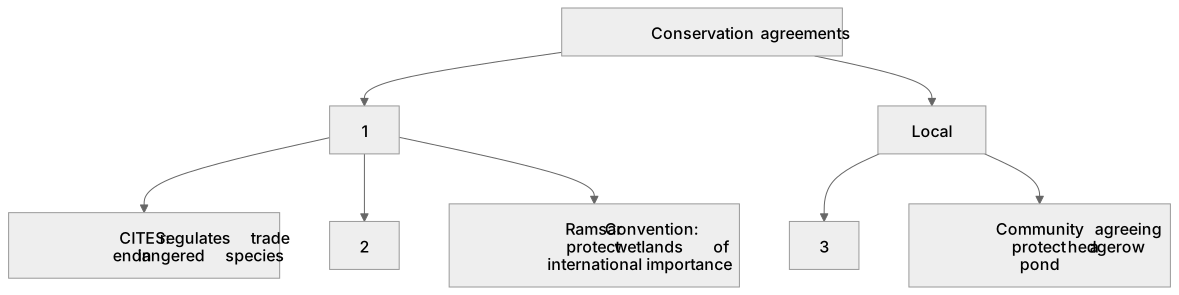
1Box 1
2Box 2
3Box 3
There is more to this lesson
The full lesson goes on to check your understanding and help you earn the marks. Create a free account to carry on, with your progress saved.
A week of Premium from your first lesson · Then the free plan continues · No card, no charge
Test your understanding of Biodiversity: (i) international and local conservation agreements made to protect species and habitats.
Active recall beats re-reading. Take an instant quiz now to test what you’ve learned and lock it into long-term memory.
A week of Premium from your first lesson · Then the free plan continues · No card, no charge