OCR · A-Level · Biology
Course version: H420 · Version from Sept 2025
(ii) practical investigations collecting random and non-random samples in…
Full specification wording
Biodiversity: (ii) practical investigations collecting random and non-random samples in the field
Field sampling turns a question about biodiversity into data.
Checked against the OCR H420 specification (opens in a new tab) on .
- Point 3 of 10
- 4 key terms
Study notes
From the checked teaching notes for this specification point.
The idea
Field sampling turns a question about biodiversity into data. Random sampling removes investigator bias: define the area, generate coordinates with a random number generator or random number table, and place quadrats at those positions, or use a transect with quadrats at random intervals along it. Non-random sampling is chosen deliberately: a belt transect follows a gradient, a line transect records organisms touching the line, and opportunistic or stratified placement targets particular zones. In the field you must standardise quadrat size, record percentage cover or frequency consistently, and repeat enough samples to be representative. Compare random and non-random methods by asking which suits the question: random for an overall estimate of a whole area, non-random for change along a gradient or for rare, patchily distributed species.
What earns the marks
- Random sampling uses coordinates generated independently of the investigator, for example random numbers to position quadrats, so personal choice does not bias placement.
- Non-random sampling is deliberate: a belt or line transect follows a chosen gradient, and stratified or opportunistic placement targets selected zones.
- Standardising quadrat size, recording method (percentage cover or frequency) and sample number makes results comparable and representative.
- Choosing between methods depends on the question: random for an overall estimate across an area, non-random for change along a gradient or patchy species.
Common mistakes and how to put them right
Thinking random sampling means throwing a quadrat without looking.
Put it right: Positions must come from an independent random-number process over a defined area.
Assuming non-random sampling is always invalid.
Put it right: It is appropriate when deliberately following a gradient or targeting a specific habitat.
Recording different quadrat sizes or cover scales across samples.
Put it right: Keep quadrat size and recording method constant so data are comparable.
Exam tips
- State the exact randomising step (random number table or generator giving coordinates) rather than saying 'randomly'.
- Link each method to the question it answers: whole-area estimate versus gradient or patchy distribution.
- Name the standardised variables (quadrat size, recording scale, number of samples) when justifying reliability.
Try the lesson
The start of the Biodiversity: (ii) practical investigations collecting random and non-random samples in the field lesson, made from checked teaching notes for this specification point.
Have a go first
A student wants to place quadrats at random positions in a field. Which method produces genuinely random placement?
Listen
Field sampling turns a question about biodiversity into data. Random sampling removes investigator bias: define the area, generate coordinates with a random number generator or random number table, and place quadrats at those positions, or use a transect with quadrats at random intervals along it. Non-random sampling is chosen deliberately: a belt transect follows a gradient, a line transect records organisms touching the line, and opportunistic or stratified placement targets particular zones. In the field you must standardise quadrat size, record percentage cover or frequency consistently, and repeat enough samples to be representative. Compare random and non-random methods by asking which suits the question: random for an overall estimate of a whole area, non-random for change along a gradient or for rare, patchily distributed species. A strong answer earns marks for these points. Random sampling uses coordinates generated independently of the investigator, for example random numbers to position quadrats, so personal choice does not bias placement. Non-random sampling is deliberate: a belt or line transect follows a chosen gradient, and stratified or opportunistic placement targets selected zones. Standardising quadrat size, recording method (percentage cover or frequency) and sample number makes results comparable and representative. Choosing between methods depends on the question: random for an overall estimate across an area, non-random for change along a gradient or patchy species. A common slip: Thinking random sampling means throwing a quadrat without looking. Instead, positions must come from an independent random-number process over a defined area. Exam tip: State the exact randomising step (random number table or generator giving coordinates) rather than saying 'randomly'.
See it
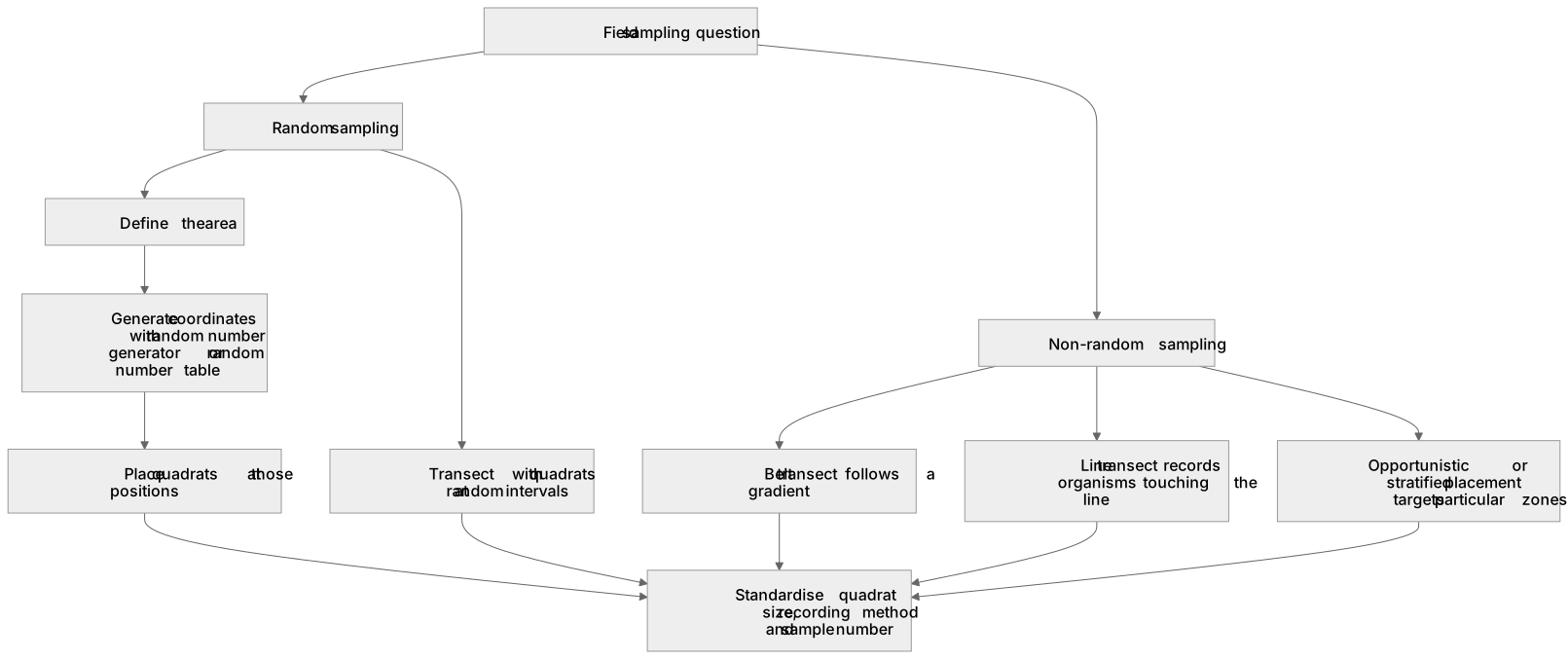
Key words
Say what each word means before you turn the card.
Random sampling
Try answering aloud or in your head before turning the card.
Non-random sampling
Try answering aloud or in your head before turning the card.
Standardisation
Try answering aloud or in your head before turning the card.
Method choice
Try answering aloud or in your head before turning the card.
See every definition
- Random sampling
- Uses coordinates generated independently of the investigator, for example random numbers to position quadrats, so personal choice does not bias placement.
- Non-random sampling
- Deliberate sampling where a belt or line transect follows a chosen gradient, and stratified or opportunistic placement targets selected zones.
- Standardisation
- Keeping quadrat size, recording method (percentage cover or frequency) and sample number constant so results are comparable and representative.
- Method choice
- Depends on the question: random for an overall estimate across an area, non-random for change along a gradient or patchy species.
Label the diagram
Some boxes have lost their names. Pick the right name for each number.
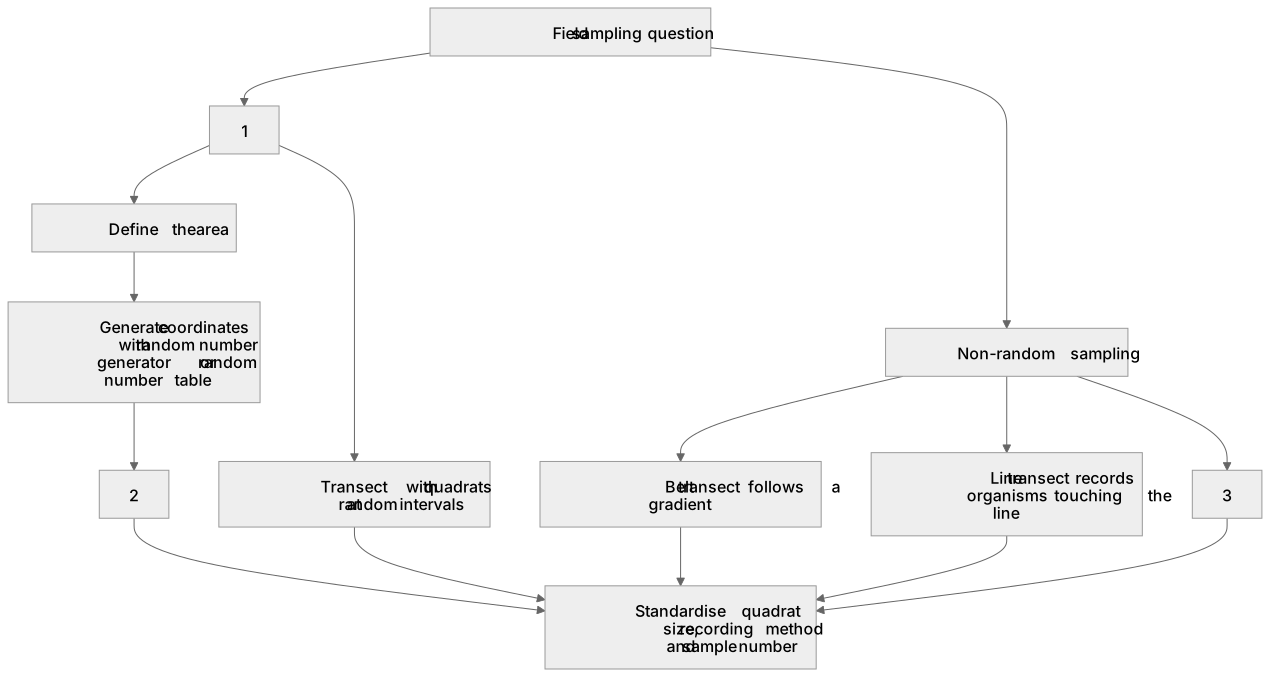
1Box 1
2Box 2
3Box 3
There is more to this lesson
The full lesson goes on to check your understanding and help you earn the marks. Create a free account to carry on, with your progress saved.
A week of Premium from your first lesson · Then the free plan continues · No card, no charge
Test your understanding of Biodiversity: (ii) practical investigations collecting random and non-random samples in the field
Active recall beats re-reading. Take an instant quiz now to test what you’ve learned and lock it into long-term memory.
A week of Premium from your first lesson · Then the free plan continues · No card, no charge