OCR · A-Level · Biology
Course version: H420 · Version from Sept 2025
(c) how to measure species richness and species evenness in a habitat
Full specification wording
Biodiversity: (c) how to measure species richness and species evenness in a habitat
Species richness is the number of different species present in a habitat; species evenness describes how similar the abundances of those species are.
Checked against the OCR H420 specification (opens in a new tab) on .
- Point 4 of 10
- 4 key terms
Study notes
From the checked teaching notes for this specification point.
The idea
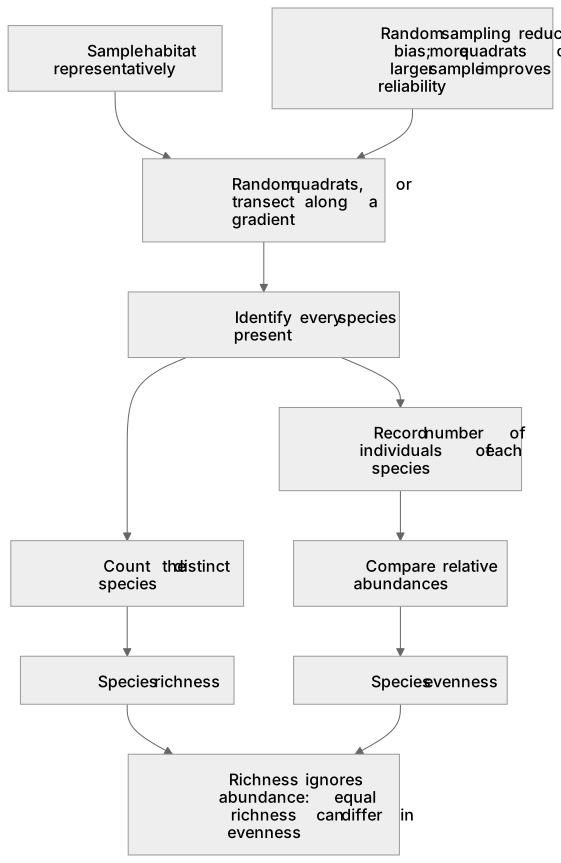
Species richness is the number of different species present in a habitat; species evenness describes how similar the abundances of those species are. To measure richness, sample the habitat representatively, for example with random quadrats (or a transect where a gradient exists), identify every species present and count the distinct species. To measure evenness, record the number of individuals of each species, then compare the relative abundances: a community where species have similar counts is even, while one dominated by a single species is uneven. Random sampling avoids bias, and a large enough sample or several quadrats improves reliability. Richness ignores abundance, so two habitats with equal richness can differ in evenness.
What earns the marks
- Species richness is the number of different species in a habitat, counted without regard to how many individuals each species has.
- Species evenness describes the relative abundance of the different species; a community is even when species have similar numbers of individuals.
- Richness is measured by representative sampling (for example random quadrats, or a transect along a gradient), identifying and counting the distinct species present.
- Evenness is measured by recording the number of individuals of each species and comparing their relative abundances.
- Random sampling reduces bias and using more quadrats or a larger sample improves reliability of the estimates.
- Two habitats can have the same richness but different evenness if one is dominated by a single species.
Common mistakes and how to put them right
Confusing richness with evenness.
Put it right: Richness counts species, not individuals; evenness compares how many individuals each species has.
Assuming a habitat with more individuals is always richer.
Put it right: Abundance does not change the number of species present.
Ignoring sampling method: non-random or too few quadrats give unreliable, biased estimates of both richness and evenness.
Exam tips
- State clearly that richness counts species and evenness compares relative abundances, using those exact distinctions.
- Link measurement to a method: random quadrats for richness and counts per species for evenness.
- Mention that random sampling and adequate sample size improve reliability when justifying a method.
Try the lesson
The start of the Biodiversity: (c) how to measure species richness and species evenness in a habitat lesson, made from checked teaching notes for this specification point.
Have a go first
A student wants to record the number of different species present in a meadow. Which measurement is the student making?
Listen
Species richness is the number of different species present in a habitat; species evenness describes how similar the abundances of those species are. To measure richness, sample the habitat representatively, for example with random quadrats (or a transect where a gradient exists), identify every species present and count the distinct species. To measure evenness, record the number of individuals of each species, then compare the relative abundances: a community where species have similar counts is even, while one dominated by a single species is uneven. Random sampling avoids bias, and a large enough sample or several quadrats improves reliability. Richness ignores abundance, so two habitats with equal richness can differ in evenness. A strong answer earns marks for these points. Species richness is the number of different species in a habitat, counted without regard to how many individuals each species has. Species evenness describes the relative abundance of the different species; a community is even when species have similar numbers of individuals. Richness is measured by representative sampling (for example random quadrats, or a transect along a gradient), identifying and counting the distinct species present. Evenness is measured by recording the number of individuals of each species and comparing their relative abundances. Exam tip: State clearly that richness counts species and evenness compares relative abundances, using those exact distinctions.
See it
Key words
Say what each word means before you turn the card.
Species richness
Try answering aloud or in your head before turning the card.
Species evenness
Try answering aloud or in your head before turning the card.
Random sampling and quadrats
Try answering aloud or in your head before turning the card.
Reliability and bias in sampling
Try answering aloud or in your head before turning the card.
See every definition
- Species richness
- The number of different species present in a habitat, counted without regard to how many individuals each species has.
- Species evenness
- The relative abundance of the different species; a community is even when species have similar numbers of individuals.
- Random sampling and quadrats
- Representative sampling of a habitat, for example with random quadrats, used to identify and count the distinct species present.
- Reliability and bias in sampling
- Random sampling reduces bias, and using more quadrats or a larger sample improves reliability of the estimates.
Label the diagram
Some boxes have lost their names. Pick the right name for each number.
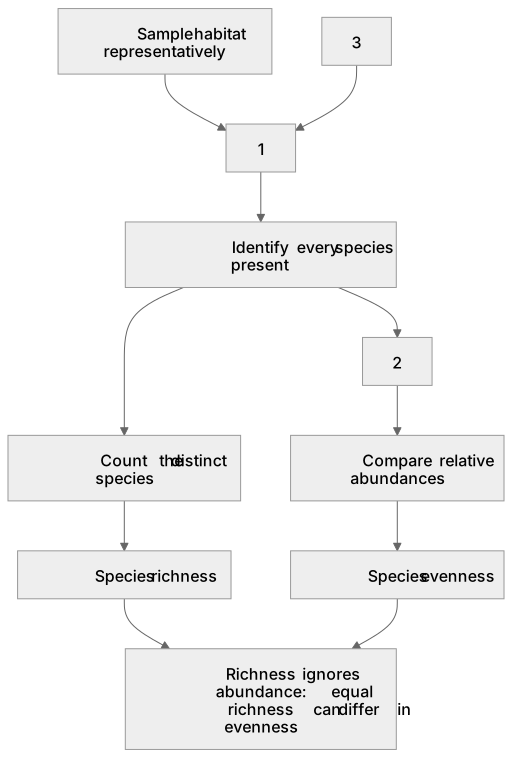
1Box 1
2Box 2
3Box 3
There is more to this lesson
The full lesson goes on to check your understanding and help you earn the marks. Create a free account to carry on, with your progress saved.
A week of Premium from your first lesson · Then the free plan continues · No card, no charge
Test your understanding of Biodiversity: (c) how to measure species richness and species evenness in a habitat
Active recall beats re-reading. Take an instant quiz now to test what you’ve learned and lock it into long-term memory.
A week of Premium from your first lesson · Then the free plan continues · No card, no charge