OCR · A-Level · Biology
Course version: H420 · Version from Sept 2025
Biological membranes: (d) (i) the movement of molecules across membranes
Molecules cross membranes by several distinct routes, and the specification clause asks you to know how each works.
Checked against the OCR H420 specification (opens in a new tab) on .
- Point 5 of 8
- 4 key terms
Study notes
From the checked teaching notes for this specification point.
The idea
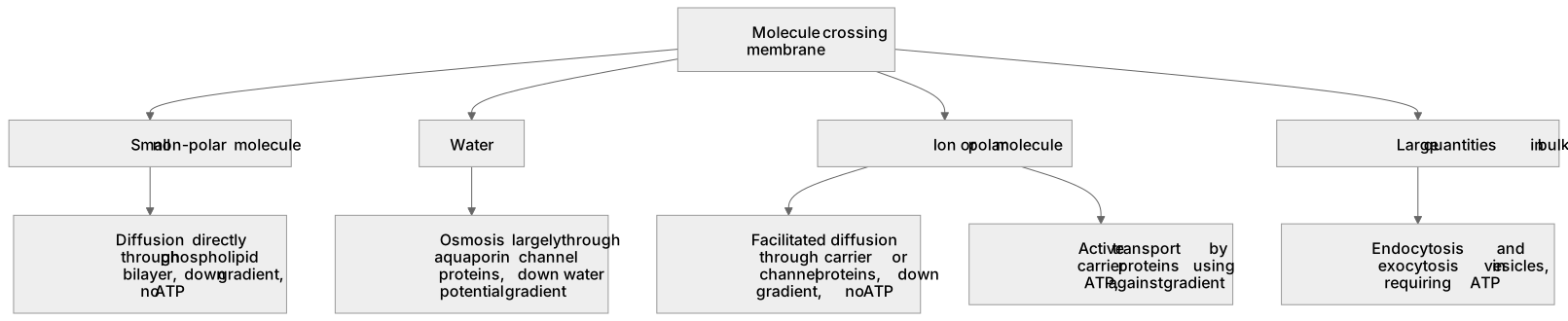
Molecules cross membranes by several distinct routes, and the specification clause asks you to know how each works. Small non-polar molecules such as oxygen and carbon dioxide diffuse directly through the phospholipid bilayer down a concentration gradient. Water moves by osmosis, largely through channel proteins called aquaporins. Ions and polar molecules such as glucose cannot pass freely through the hydrophobic core, so they use facilitated diffusion through carrier or channel proteins, again down a gradient and without ATP. Active transport uses carrier proteins and ATP hydrolysis to move substances against a concentration gradient, as in the sodium-potassium pump. Bulk transport moves large quantities in vesicles: endocytosis brings material in, exocytosis releases it, both requiring ATP.
What earns the marks
- Diffusion: net movement of small, non-polar molecules such as O₂ and CO₂ directly through the phospholipid bilayer, down a concentration gradient, without ATP.
- Osmosis: movement of water down a water potential gradient, largely through aquaporin channel proteins in the membrane.
- Facilitated diffusion: polar molecules and ions move down their gradient through carrier or channel proteins; no ATP is used.
- Active transport: carrier proteins use ATP to move substances against a concentration gradient, for example the sodium-potassium pump.
- Bulk transport: endocytosis and exocytosis move large amounts in vesicles and require ATP.
- Selecting the correct route depends on molecule size and polarity, gradient direction and whether energy is required.
Common mistakes and how to put them right
Assuming all diffusion needs a protein channel.
Put it right: Small non-polar molecules diffuse directly through the bilayer, so a channel is not always required.
Confusing facilitated diffusion with active transport.
Put it right: Facilitated diffusion is passive and follows the gradient, whereas active transport uses ATP and can work against the gradient.
Thinking osmosis is a separate process from diffusion.
Put it right: Osmosis is the diffusion of water specifically, and it can occur through aquaporins.
Exam tips
- Read the stem for the molecule's size and polarity before choosing a transport route.
- Check whether the stem says 'against the concentration gradient' or mentions ATP; that points to active transport.
- Eliminate options that wrongly attach ATP to diffusion or osmosis.
Try the lesson
The start of the Biological membranes: (d) (i) the movement of molecules across membranes lesson, made from checked teaching notes for this specification point.
Have a go first
Oxygen moves from the alveoli into the blood across the alveolar epithelium. Which process describes this movement?
Listen
Molecules cross membranes by several distinct routes, and the specification clause asks you to know how each works. Small non-polar molecules such as oxygen and carbon dioxide diffuse directly through the phospholipid bilayer down a concentration gradient. Water moves by osmosis, largely through channel proteins called aquaporins. Ions and polar molecules such as glucose cannot pass freely through the hydrophobic core, so they use facilitated diffusion through carrier or channel proteins, again down a gradient and without ATP. Active transport uses carrier proteins and ATP hydrolysis to move substances against a concentration gradient, as in the sodium-potassium pump. Bulk transport moves large quantities in vesicles: endocytosis brings material in, exocytosis releases it, both requiring ATP. A strong answer earns marks for these points. Diffusion: net movement of small, non-polar molecules such as O₂ and CO₂ directly through the phospholipid bilayer, down a concentration gradient, without ATP. Osmosis: movement of water down a water potential gradient, largely through aquaporin channel proteins in the membrane. Facilitated diffusion: polar molecules and ions move down their gradient through carrier or channel proteins; no ATP is used. Active transport: carrier proteins use ATP to move substances against a concentration gradient, for example the sodium-potassium pump. Exam tip: Read the stem for the molecule's size and polarity before choosing a transport route.
See it
Key words
Say what each word means before you turn the card.
Phospholipid bilayer permeability
Try answering aloud or in your head before turning the card.
Passive versus active transport
Try answering aloud or in your head before turning the card.
Role of membrane proteins
Try answering aloud or in your head before turning the card.
Vesicular bulk transport
Try answering aloud or in your head before turning the card.
See every definition
- Phospholipid bilayer permeability
- Small non-polar molecules such as oxygen and carbon dioxide diffuse directly through the phospholipid bilayer down a concentration gradient, while ions and polar molecules cannot pass freely through the hydrophobic core.
- Passive versus active transport
- Facilitated diffusion moves polar molecules and ions down their gradient through carrier or channel proteins without ATP, whereas active transport uses carrier proteins and ATP hydrolysis to move substances against a concentration gradient.
- Role of membrane proteins
- Carrier or channel proteins allow facilitated diffusion down a gradient, aquaporin channel proteins carry water in osmosis, and carrier proteins use ATP in active transport.
- Vesicular bulk transport
- Endocytosis brings material in and exocytosis releases it, both moving large quantities in vesicles and requiring ATP.
Label the diagram
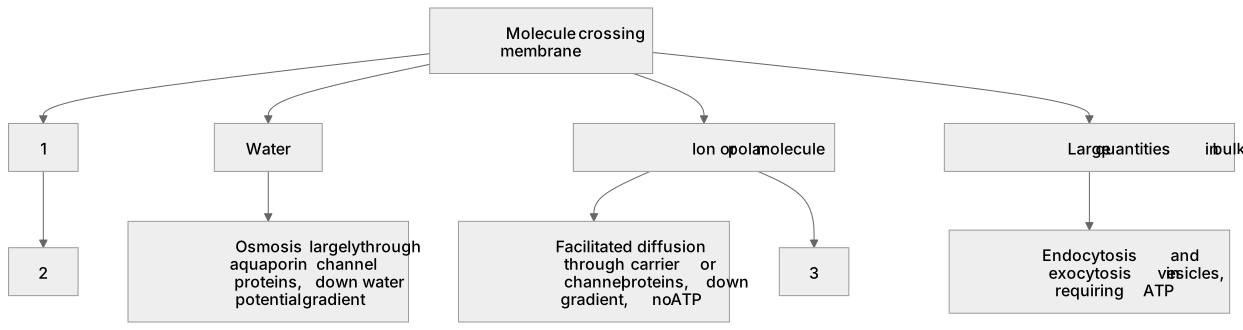
Some boxes have lost their names. Pick the right name for each number.
1Box 1
2Box 2
3Box 3
There is more to this lesson
The full lesson goes on to check your understanding and help you earn the marks. Create a free account to carry on, with your progress saved.
A week of Premium from your first lesson · Then the free plan continues · No card, no charge
Test your understanding of Biological membranes: (d) (i) the movement of molecules across membranes
Active recall beats re-reading. Take an instant quiz now to test what you’ve learned and lock it into long-term memory.
A week of Premium from your first lesson · Then the free plan continues · No card, no charge