OCR · A-Level · Biology
Course version: H420 · Version from Sept 2025
(d) the ring structure and properties of glucose as an example of a hexose…
Full specification wording
Biological molecules: (d) the ring structure and properties of glucose as an example of a hexose monosaccharide and the structure of ribose as an example of a pentose monosaccharide
Glucose and ribose are both sugars built from carbon, hydrogen and oxygen, but they differ in carbon number and in the ring they form.
Checked against the OCR H420 specification (opens in a new tab) on .
- Point 4 of 20
- 4 key terms
Study notes
From the checked teaching notes for this specification point.
The idea
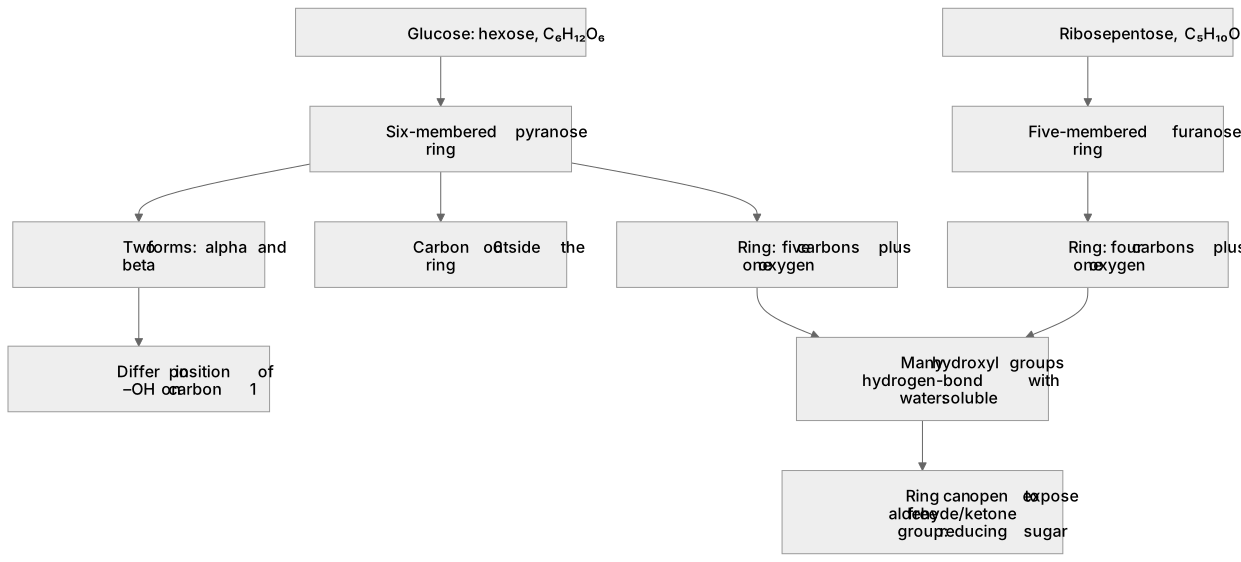
Glucose and ribose are both sugars built from carbon, hydrogen and oxygen, but they differ in carbon number and in the ring they form. Glucose is a hexose: six carbons, molecular formula C₆H₁₂O₆. In solution its open chain closes so that carbon 1 (the aldehyde carbon) bonds to the oxygen on carbon 5, giving a six-membered pyranose ring in which five carbons and one oxygen form the ring and carbon 6 sits outside it. The ring closes in two forms, alpha and beta, differing in the position of the –OH on carbon 1. Ribose is a pentose: five carbons, formula C₅H₁₀O₅. Its ring uses four carbons plus one oxygen, a five-membered furanose ring. Both are reducing sugars with free hydroxyl groups, soluble because of hydrogen bonding to water, and glucose is the respiratory substrate.
What earns the marks
- Glucose is a hexose with six carbon atoms and formula C₆H₁₂O₆; ribose is a pentose with five carbons and formula C₅H₁₀O₅.
- Glucose forms a six-membered ring containing five carbons and one oxygen (pyranose), with carbon 6 outside the ring.
- Ribose forms a five-membered ring containing four carbons and one oxygen (furanose).
- Glucose exists as alpha and beta ring forms differing in the orientation of the hydroxyl group on carbon 1.
Common mistakes and how to put them right
Counting the ring oxygen as a carbon.
Put it right: Glucose's six-membered ring has five carbons plus one oxygen, and the sixth carbon lies outside the ring.
Assuming ribose is a six-carbon sugar because it is a nucleic acid component.
Put it right: Ribose is a pentose with five carbons forming a five-membered ring.
Thinking the alpha and beta forms differ in carbon number.
Put it right: They differ only in the position of the –OH group on carbon 1 of the same six-carbon sugar.
Exam tips
- Learn the two molecular formulae and carbon counts so you can distinguish hexose from pentose quickly.
- Sketch each ring and label which atoms form the ring and which lie outside it.
- Link solubility and reducing behaviour to specific structural features (hydroxyl groups, ring opening) rather than stating them without reason.
Try the lesson
The start of the Biological molecules: (d) the ring structure and properties of glucose as an example of a hexose monosaccharide and the structure of ribose as an example of a pentose monosaccharide lesson, made from checked teaching notes for this specification point.
Have a go first
How many carbon atoms are present in one molecule of the pentose monosaccharide ribose?
Listen
Glucose and ribose are both sugars built from carbon, hydrogen and oxygen, but they differ in carbon number and in the ring they form. Glucose is a hexose: six carbons, molecular formula C₆H₁₂O₆. In solution its open chain closes so that carbon 1 (the aldehyde carbon) bonds to the oxygen on carbon 5, giving a six-membered pyranose ring in which five carbons and one oxygen form the ring and carbon 6 sits outside it. The ring closes in two forms, alpha and beta, differing in the position of the –OH on carbon 1. Ribose is a pentose: five carbons, formula C₅H₁₀O₅. Its ring uses four carbons plus one oxygen, a five-membered furanose ring. Both are reducing sugars with free hydroxyl groups, soluble because of hydrogen bonding to water, and glucose is the respiratory substrate. A strong answer earns marks for these points. Glucose is a hexose with six carbon atoms and formula C₆H₁₂O₆; ribose is a pentose with five carbons and formula C₅H₁₀O₅. Glucose forms a six-membered ring containing five carbons and one oxygen (pyranose), with carbon 6 outside the ring. Ribose forms a five-membered ring containing four carbons and one oxygen (furanose). Glucose exists as alpha and beta ring forms differing in the orientation of the hydroxyl group on carbon 1. A common slip: Counting the ring oxygen as a carbon. Instead, glucose's six-membered ring has five carbons plus one oxygen, and the sixth carbon lies outside the ring. Exam tip: Learn the two molecular formulae and carbon counts so you can distinguish hexose from pentose quickly.
See it
Watch it explained
What is the one idea the video explains? Say it in a sentence.
Read the described scene instead
Glucose and ribose are both sugars built from carbon, hydrogen and oxygen. Both are monosaccharides, single sugar units. But they differ in two ways: how many carbons they contain, and the ring each one forms in solution. This lesson compares their structures and links those structures to their properties. Start with carbon number. Glucose is a hexose, with six carbon atoms and the molecular formula C six H twelve O six. Ribose is a pentose: five carbons, formula C five H ten O five. Learn these two formulae and carbon counts, because they let you tell a hexose from a pentose quickly. Now the ring. In solution, glucose's open chain closes: carbon 1, the aldehyde carbon, bonds to the oxygen on carbon 5. That gives a six-membered pyranose ring in which five carbons and one oxygen form the ring, while carbon 6 sits outside it. The ring closes in two forms, alpha and beta, differing only in the position of the hydroxyl group on carbon 1. Ribose closes differently: four carbons plus one oxygen make a five-membered furanose ring. Let's apply that. If you sketch glucose's ring, count the ring atoms carefully. The hexagon has six positions, but only five of them are carbon; the sixth ring atom is oxygen. Carbon 6 is not in the ring at all — it sits outside. Pause here and try labelling your own sketch before I give the check. Ready? Ring: five carbons plus one oxygen. Outside: carbon 6. Three common slips. First, counting the ring oxygen as a carbon: glucose's six-membered ring has five carbons plus one oxygen. Second, assuming ribose is a six-carbon sugar because it is found in nucleic acids: ribose is a pentose, five carbons, five-membered ring. Third, thinking alpha and beta differ in carbon number: they differ only in the position of the hydroxyl group on carbon 1. Why does structure matter? Both sugars carry many hydroxyl groups, which hydrogen-bond with water, so both are soluble. Both are reducing sugars, because the ring can open to expose a free aldehyde or ketone group that reduces other substances. And glucose, the hexose, is the respiratory substrate.
Key words
Say what each word means before you turn the card.
Hexose
Try answering aloud or in your head before turning the card.
Pentose
Try answering aloud or in your head before turning the card.
Pyranose ring
Try answering aloud or in your head before turning the card.
Furanose ring
Try answering aloud or in your head before turning the card.
See every definition
- Hexose
- A sugar with six carbon atoms and the molecular formula C₆H₁₂O₆, of which glucose is an example.
- Pentose
- A sugar with five carbon atoms and the molecular formula C₅H₁₀O₅, of which ribose is an example.
- Pyranose ring
- A six-membered ring formed when glucose closes, in which five carbons and one oxygen form the ring and carbon 6 sits outside it.
- Furanose ring
- A five-membered ring formed by ribose, using four carbons plus one oxygen.
Label the diagram
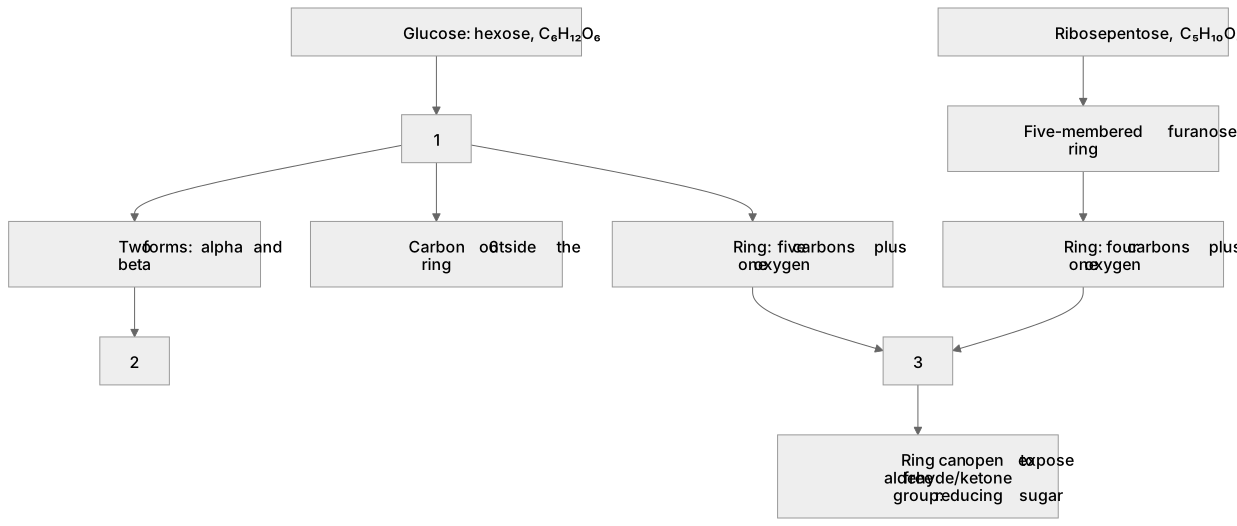
Some boxes have lost their names. Pick the right name for each number.
1Box 1
2Box 2
3Box 3
There is more to this lesson
The full lesson goes on to check your understanding and help you earn the marks. Create a free account to carry on, with your progress saved.
A week of Premium from your first lesson · Then the free plan continues · No card, no charge
Test your understanding of Biological molecules: (d) the ring structure and properties of glucose as an example of a hexose monosaccharide and the structure of ribose as an example of a pentose monosaccharide
Active recall beats re-reading. Take an instant quiz now to test what you’ve learned and lock it into long-term memory.
A week of Premium from your first lesson · Then the free plan continues · No card, no charge