OCR · A-Level · Biology
Course version: H420 · Version from Sept 2025
(e) the synthesis and breakdown of a disaccharide and polysaccharide by…
Full specification wording
Biological molecules: (e) the synthesis and breakdown of a disaccharide and polysaccharide by the formation and breakage of glycosidic bonds
A condensation reaction joins two monosaccharides: the hydroxyl group of one and the hydrogen of the other combine, water is released, and a glycosidic bond forms.
Checked against the OCR H420 specification (opens in a new tab) on .
- Point 5 of 20
- 4 key terms
Study notes
From the checked teaching notes for this specification point.
The idea
A condensation reaction joins two monosaccharides: the hydroxyl group of one and the hydrogen of the other combine, water is released, and a glycosidic bond forms. Two monosaccharides give a disaccharide, for example glucose plus fructose forming sucrose; many monosaccharides joined this way give a polysaccharide such as starch or glycogen. The reverse process is hydrolysis: water is added and the glycosidic bond breaks, releasing the monosaccharide units. In the body, enzymes such as amylase and maltase catalyse these hydrolyses; in a test tube, heating with dilute acid achieves the same breakage. Each bond formed or broken releases or consumes one water molecule, so a chain of n residues joined by n−1 glycosidic bonds needs n−1 water molecules to hydrolyse completely.
What earns the marks
- Condensation joins monosaccharides and releases one water molecule per glycosidic bond formed.
- A disaccharide forms from two monosaccharides; a polysaccharide forms from many monosaccharides joined by glycosidic bonds.
- Hydrolysis adds water and breaks glycosidic bonds, releasing monosaccharide units.
- Enzymes such as amylase and maltase catalyse hydrolysis of glycosidic bonds in digestion.
- The number of glycosidic bonds in a linear chain of n residues is n−1, so complete hydrolysis consumes n−1 water molecules.
Common mistakes and how to put them right
Saying condensation releases carbon dioxide.
Put it right: Condensation of sugars releases water, not carbon dioxide.
Confusing which process adds water.
Put it right: Hydrolysis adds water and breaks bonds; condensation removes water and forms bonds.
Claiming a disaccharide contains one glycosidic bond per monosaccharide.
Put it right: Two monosaccharides are joined by a single glycosidic bond.
Exam tips
- State clearly that water is released in condensation and used in hydrolysis, naming the bond each time.
- Link the reaction to a named example, such as glucose and fructose forming sucrose, to show understanding.
- When counting bonds, remember a chain of n units has n−1 glycosidic bonds.
Try the lesson
The start of the Biological molecules: (e) the synthesis and breakdown of a disaccharide and polysaccharide by the formation and breakage of glycosidic bonds lesson, made from checked teaching notes for this specification point.
Have a go first
What is the name of the bond that links two monosaccharides in a disaccharide such as maltose?
Listen
A condensation reaction joins two monosaccharides: the hydroxyl group of one and the hydrogen of the other combine, water is released, and a glycosidic bond forms. Two monosaccharides give a disaccharide, for example glucose plus fructose forming sucrose; many monosaccharides joined this way give a polysaccharide such as starch or glycogen. The reverse process is hydrolysis: water is added and the glycosidic bond breaks, releasing the monosaccharide units. In the body, enzymes such as amylase and maltase catalyse these hydrolyses; in a test tube, heating with dilute acid achieves the same breakage. Each bond formed or broken releases or consumes one water molecule, so a chain of n residues joined by n−1 glycosidic bonds needs n−1 water molecules to hydrolyse completely. A strong answer earns marks for these points. Condensation joins monosaccharides and releases one water molecule per glycosidic bond formed. A disaccharide forms from two monosaccharides; a polysaccharide forms from many monosaccharides joined by glycosidic bonds. Hydrolysis adds water and breaks glycosidic bonds, releasing monosaccharide units. Enzymes such as amylase and maltase catalyse hydrolysis of glycosidic bonds in digestion. A common slip: Saying condensation releases carbon dioxide. Instead, condensation of sugars releases water, not carbon dioxide. Exam tip: State clearly that water is released in condensation and used in hydrolysis, naming the bond each time.
See it
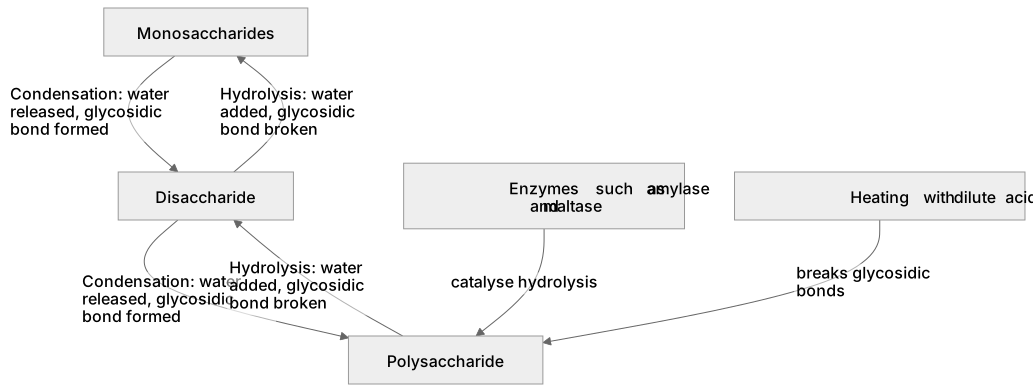
Watch it explained
What is the one idea the video explains? Say it in a sentence.
Read the described scene instead
In this lesson, we will look at how monosaccharides are joined together and how those joins are broken. The key bond is the glycosidic bond, and the two reactions are condensation and hydrolysis. Condensation and hydrolysis are opposite reactions. In condensation, the hydroxyl group of one monosaccharide and the hydrogen of another combine, water is released, and a glycosidic bond forms. Hydrolysis is the reverse: water is added and the glycosidic bond breaks. Two monosaccharides joined by condensation form a disaccharide. For example, glucose plus fructose forms sucrose. Many monosaccharides joined this way form a polysaccharide, such as starch or glycogen. Each glycosidic bond formed releases one water molecule. Hydrolysis adds water and breaks glycosidic bonds, releasing monosaccharide units. In the body, enzymes such as amylase and maltase catalyse these hydrolyses. In a test tube, heating with dilute acid achieves the same breakage. For a linear chain of n residues, there are n minus one glycosidic bonds. Complete hydrolysis therefore needs n minus one water molecules. Pause to check this relationship. Now apply it: a chain of five residues has four glycosidic bonds, so complete hydrolysis consumes four water molecules. A common mistake is saying condensation releases carbon dioxide. Condensation of sugars releases water, not carbon dioxide. Another mistake is confusing which process adds water. Hydrolysis adds water and breaks bonds; condensation removes water and forms bonds. Also, two monosaccharides are joined by a single glycosidic bond to make a disaccharide. To summarise, condensation joins monosaccharides and forms glycosidic bonds, releasing one water molecule per bond. Hydrolysis adds water and breaks glycosidic bonds, releasing monosaccharide units. In digestion, amylase and maltase catalyse hydrolysis. Remember, a chain of n residues has n minus one glycosidic bonds.
Key words
Say what each word means before you turn the card.
Condensation reactions
Try answering aloud or in your head before turning the card.
Hydrolysis reactions
Try answering aloud or in your head before turning the card.
Glycosidic bonds
Try answering aloud or in your head before turning the card.
Disaccharides and polysaccharides
Try answering aloud or in your head before turning the card.
See every definition
- Condensation reactions
- A reaction in which the hydroxyl group of one monosaccharide and the hydrogen of another combine, water is released, and a glycosidic bond forms.
- Hydrolysis reactions
- The reverse process in which water is added and the glycosidic bond breaks, releasing the monosaccharide units.
- Glycosidic bonds
- The bond formed between monosaccharides when water is released, and broken when water is added.
- Disaccharides and polysaccharides
- Two monosaccharides joined by a glycosidic bond give a disaccharide; many monosaccharides joined this way give a polysaccharide.
Label the diagram
Some boxes have lost their names. Pick the right name for each number.
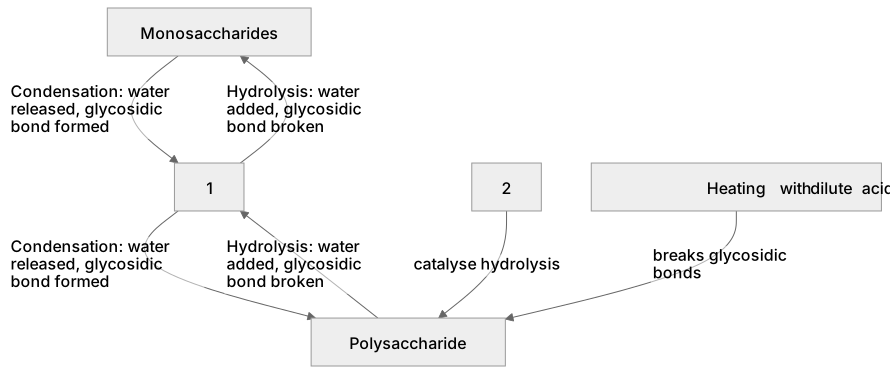
1Box 1
2Box 2
There is more to this lesson
The full lesson goes on to check your understanding and help you earn the marks. Create a free account to carry on, with your progress saved.
A week of Premium from your first lesson · Then the free plan continues · No card, no charge
Test your understanding of Biological molecules: (e) the synthesis and breakdown of a disaccharide and polysaccharide by the formation and breakage of glycosidic bonds
Active recall beats re-reading. Take an instant quiz now to test what you’ve learned and lock it into long-term memory.
A week of Premium from your first lesson · Then the free plan continues · No card, no charge