OCR · A-Level · Biology
Course version: H420 · Version from Sept 2025
(g) how the structures and properties of glucose, starch, glycogen and…
Full specification wording
Biological molecules: (g) how the structures and properties of glucose, starch, glycogen and cellulose molecules relate to their functions in living organisms
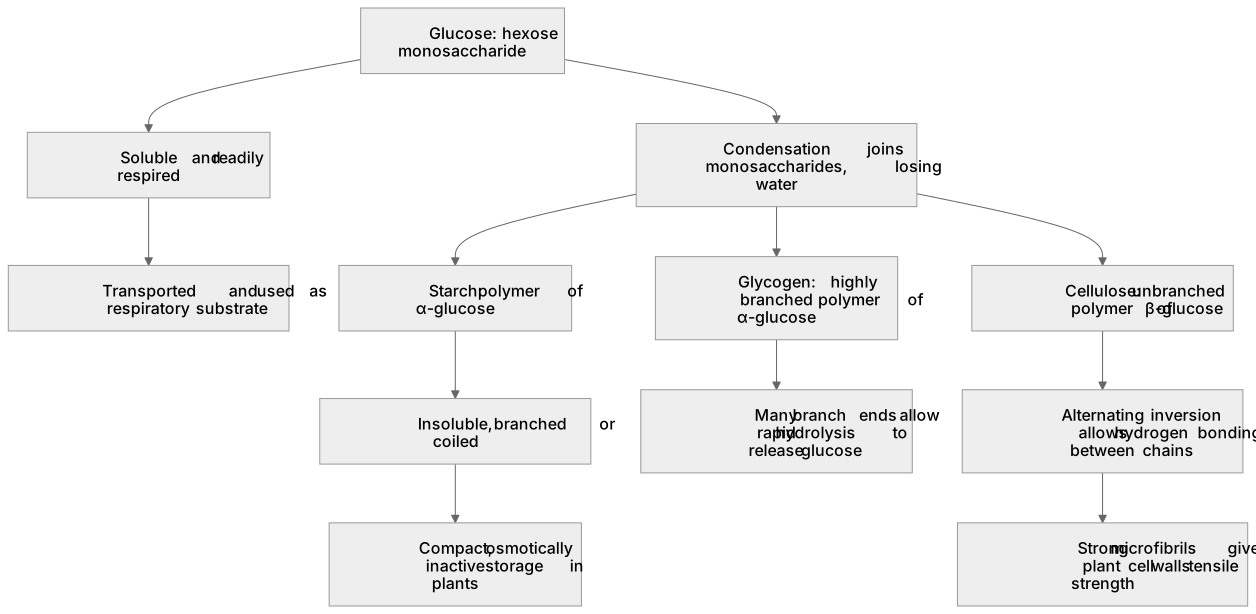
Glucose is a hexose monosaccharide; its soluble, reactive nature makes it the respiratory substrate transported in blood.
Checked against the OCR H420 specification (opens in a new tab) on .
- Point 7 of 20
- 4 key terms
Study notes
From the checked teaching notes for this specification point.
The idea
Glucose is a hexose monosaccharide; its soluble, reactive nature makes it the respiratory substrate transported in blood. Two glucose molecules condense to form maltose, and many form starch or glycogen. Starch is a compact, branched or helical polymer of α-glucose stored in plant cells; its insolubility and coiling make it a good storage carbohydrate. Glycogen is a more highly branched polymer of α-glucose stored in animal cells, giving rapid glucose release. Cellulose is a straight, unbranched polymer of β-glucose; alternating inversion lets chains form hydrogen-bonded microfibrils that give plant cell walls tensile strength. Relate each structural feature to the function it enables, and distinguish α- from β-glucose by the position of the hydroxyl group on carbon 1.
What earns the marks
- Glucose is a hexose monosaccharide that is soluble and readily respired, so it can be transported and used as a respiratory substrate.
- Starch is a polymer of α-glucose that is insoluble and often branched or coiled, making it a compact, osmotically inactive storage molecule in plants.
- Glycogen is a highly branched polymer of α-glucose stored in animals, and its many branch ends allow rapid hydrolysis to release glucose.
- Cellulose is an unbranched polymer of β-glucose; alternating inversion allows hydrogen bonding between chains to form strong microfibrils in cell walls.
- Condensation joins monosaccharides with the loss of water, and hydrolysis reverses this; α-glucose and β-glucose differ in the position of the hydroxyl group on carbon 1.
Common mistakes and how to put them right
Treating starch and glycogen as identical.
Put it right by noting glycogen is more highly branched than starch, giving faster glucose release.
Describing cellulose as branched or as made of α-glucose.
Put it right by stating it is an unbranched polymer of β-glucose.
Saying glucose is insoluble so it can be stored.
Put it right by noting glucose is soluble and is a transportable respiratory substrate, while storage polymers are insoluble.
Exam tips
- For each molecule, state the structural feature and then the function it enables, rather than listing features alone.
- Use precise terms such as α-glucose, β-glucose, condensation, hydrolysis and microfibril.
- When comparing storage polysaccharides, focus on branching and its effect on the rate of glucose release.
Try the lesson
The start of the Biological molecules: (g) how the structures and properties of glucose, starch, glycogen and cellulose molecules relate to their functions in living organisms lesson, made from checked teaching notes for this specification point.
Have a go first
Cellulose is important in plant cell walls because its structure makes it:
Listen
Glucose is a hexose monosaccharide; its soluble, reactive nature makes it the respiratory substrate transported in blood. Two glucose molecules condense to form maltose, and many form starch or glycogen. Starch is a compact, branched or helical polymer of α-glucose stored in plant cells; its insolubility and coiling make it a good storage carbohydrate. Glycogen is a more highly branched polymer of α-glucose stored in animal cells, giving rapid glucose release. Cellulose is a straight, unbranched polymer of β-glucose; alternating inversion lets chains form hydrogen-bonded microfibrils that give plant cell walls tensile strength. Relate each structural feature to the function it enables, and distinguish α- from β-glucose by the position of the hydroxyl group on carbon 1. A strong answer earns marks for these points. Glucose is a hexose monosaccharide that is soluble and readily respired, so it can be transported and used as a respiratory substrate. Starch is a polymer of α-glucose that is insoluble and often branched or coiled, making it a compact, osmotically inactive storage molecule in plants. Glycogen is a highly branched polymer of α-glucose stored in animals, and its many branch ends allow rapid hydrolysis to release glucose. Cellulose is an unbranched polymer of β-glucose; alternating inversion allows hydrogen bonding between chains to form strong microfibrils in cell walls. A common slip: Treating starch and glycogen as identical. Instead, noting glycogen is more highly branched than starch, giving faster glucose release. Exam tip: For each molecule, state the structural feature and then the function it enables, rather than listing features alone.
See it
Watch it explained
Why does glycogen release glucose faster than starch?
Read the described scene instead
Glucose is a hexose monosaccharide. It is soluble and readily respired, so it can be transported in blood and used as a respiratory substrate. Its structure and properties therefore relate directly to its function in living organisms. Condensation joins monosaccharides with the loss of water. Two glucose molecules condense to form maltose, and many form starch or glycogen. Hydrolysis reverses this, using water to break the bonds. These reactions explain how glucose units are assembled and released. α-glucose and β-glucose differ in the position of the hydroxyl group on carbon 1. This small difference matters: starch and glycogen are polymers of α-glucose, while cellulose is a polymer of β-glucose. The bond orientation changes the polymer's shape and properties. Starch is a polymer of α-glucose that is insoluble and often branched or coiled, making it a compact, osmotically inactive storage molecule in plants. Glycogen is a highly branched polymer of α-glucose stored in animals, and its many branch ends allow rapid hydrolysis to release glucose. Cellulose is an unbranched polymer of β-glucose; alternating inversion allows hydrogen bonding between chains to form strong microfibrils in cell walls. Here is a comparison. Why does glycogen release glucose faster than starch? Pause briefly to think. Glycogen is more highly branched than starch, so it has more branch ends. More branch ends allow more rapid hydrolysis, releasing glucose faster. That is the structure–function link to state. Avoid three common errors. Starch and glycogen are not identical: glycogen is more highly branched, giving faster glucose release. Cellulose is not branched and is not made of α-glucose: it is an unbranched polymer of β-glucose. And glucose is not insoluble for storage: it is soluble and transportable, while storage polymers are insoluble. So, relate each feature to its function. Glucose is soluble and respired. Starch is compact, insoluble α-glucose storage. Glycogen is highly branched for rapid glucose release. Cellulose is unbranched β-glucose, forming hydrogen-bonded microfibrils for cell wall strength. Use precise terms: α-glucose, β-glucose, condensation, hydrolysis and microfibril.
Key words
Say what each word means before you turn the card.
Structure–function relationships
Try answering aloud or in your head before turning the card.
Condensation and hydrolysis
Try answering aloud or in your head before turning the card.
α-glucose versus β-glucose
Try answering aloud or in your head before turning the card.
Storage versus structural polysaccharides
Try answering aloud or in your head before turning the card.
See every definition
- Structure–function relationships
- Each structural feature of glucose, starch, glycogen and cellulose is related to the function it enables in living organisms.
- Condensation and hydrolysis
- Condensation joins monosaccharides with the loss of water, and hydrolysis reverses this.
- α-glucose versus β-glucose
- The two forms differ in the position of the hydroxyl group on carbon 1.
- Storage versus structural polysaccharides
- Starch and glycogen are compact, insoluble storage polymers, while cellulose forms hydrogen-bonded microfibrils that give plant cell walls tensile strength.
Label the diagram
Some boxes have lost their names. Pick the right name for each number.
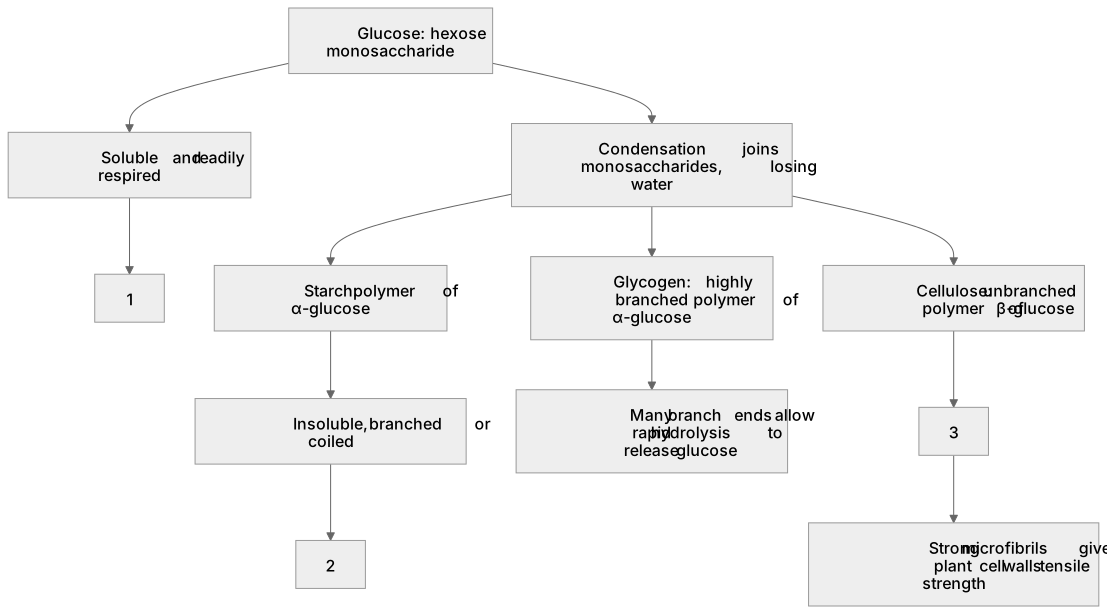
1Box 1
2Box 2
3Box 3
There is more to this lesson
The full lesson goes on to check your understanding and help you earn the marks. Create a free account to carry on, with your progress saved.
A week of Premium from your first lesson · Then the free plan continues · No card, no charge
Test your understanding of Biological molecules: (g) how the structures and properties of glucose, starch, glycogen and cellulose molecules relate to their functions in living organisms
Active recall beats re-reading. Take an instant quiz now to test what you’ve learned and lock it into long-term memory.
A week of Premium from your first lesson · Then the free plan continues · No card, no charge