OCR · A-Level · Biology
Course version: H420 · Version from Sept 2025
(f) the structure of starch (amylose and amylopectin), glycogen and…
Full specification wording
Biological molecules: (f) the structure of starch (amylose and amylopectin), glycogen and cellulose molecules
All three are polymers of glucose but differ in bonding and chain shape.
Checked against the OCR H420 specification (opens in a new tab) on .
- Point 6 of 20
- 4 key terms
Study notes
From the checked teaching notes for this specification point.
The idea
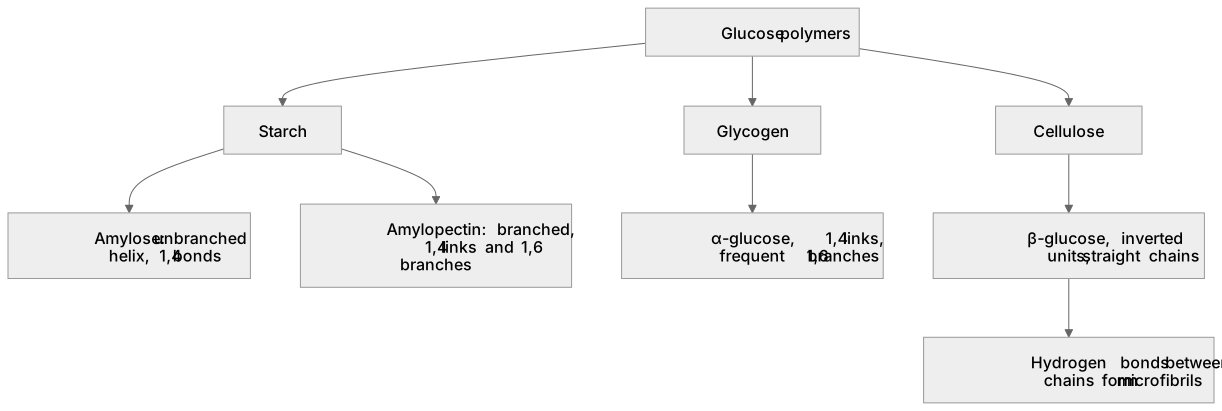
All three are polymers of glucose but differ in bonding and chain shape. Starch contains amylose, an unbranched helix of α-glucose joined by 1,4-glycosidic bonds, and amylopectin, a branched chain with 1,4 links and 1,6 branches. Glycogen is also α-glucose with 1,4 links and more frequent 1,6 branches, giving a compact store. Cellulose is built from β-glucose; adjacent units are inverted, so each chain is straight and neighbouring chains are held by hydrogen bonds into strong microfibrils. These structural differences explain function: branching gives many ends for rapid hydrolysis, helices pack densely for storage, and straight hydrogen-bonded chains give strength to plant cell walls.
What earns the marks
- Starch is made of amylose (unbranched helical α-glucose chains with 1,4 bonds) and amylopectin (branched with 1,6 bonds).
- Glycogen is a branched polymer of α-glucose with 1,4 links and frequent 1,6 branches.
- Cellulose is a polymer of β-glucose with alternating inverted units forming straight chains.
- Hydrogen bonds between cellulose chains form strong microfibrils.
- Branching increases the number of ends available for rapid hydrolysis, suiting energy storage.
Common mistakes and how to put them right
Describing cellulose as branched.
Put it right: Cellulose chains are straight and unbranched, held by hydrogen bonds.
Saying glycogen is made of β-glucose.
Put it right: Glycogen is a polymer of α-glucose.
Treating amylose and amylopectin as identical.
Put it right: Amylose is unbranched and helical, amylopectin is branched.
Exam tips
- Name the glycosidic bond types (1,4 and 1,6) when comparing the polymers.
- Link each structural feature to a function, such as branching for rapid energy release.
- Contrast α-glucose and β-glucose to explain why cellulose chains are straight.
Try the lesson
The start of the Biological molecules: (f) the structure of starch (amylose and amylopectin), glycogen and cellulose molecules lesson, made from checked teaching notes for this specification point.
Have a go first
Cellulose is a polysaccharide formed from which monomer?
Listen
All three are polymers of glucose but differ in bonding and chain shape. Starch contains amylose, an unbranched helix of α-glucose joined by 1,4-glycosidic bonds, and amylopectin, a branched chain with 1,4 links and 1,6 branches. Glycogen is also α-glucose with 1,4 links and more frequent 1,6 branches, giving a compact store. Cellulose is built from β-glucose; adjacent units are inverted, so each chain is straight and neighbouring chains are held by hydrogen bonds into strong microfibrils. These structural differences explain function: branching gives many ends for rapid hydrolysis, helices pack densely for storage, and straight hydrogen-bonded chains give strength to plant cell walls. A strong answer earns marks for these points. Starch is made of amylose (unbranched helical α-glucose chains with 1,4 bonds) and amylopectin (branched with 1,6 bonds). Glycogen is a branched polymer of α-glucose with 1,4 links and frequent 1,6 branches. Cellulose is a polymer of β-glucose with alternating inverted units forming straight chains. Hydrogen bonds between cellulose chains form strong microfibrils. A common slip: Describing cellulose as branched. Instead, cellulose chains are straight and unbranched, held by hydrogen bonds. Exam tip: Name the glycosidic bond types (1,4 and 1,6) when comparing the polymers.
See it
Key words
Say what each word means before you turn the card.
Amylose and amylopectin
Try answering aloud or in your head before turning the card.
Glycogen structure
Try answering aloud or in your head before turning the card.
Cellulose and microfibrils
Try answering aloud or in your head before turning the card.
Structure–function relationships
Try answering aloud or in your head before turning the card.
See every definition
- Amylose and amylopectin
- Starch contains amylose, an unbranched helix of α-glucose joined by 1,4-glycosidic bonds, and amylopectin, a branched chain with 1,4 links and 1,6 branches.
- Glycogen structure
- A polymer of α-glucose with 1,4 links and more frequent 1,6 branches, giving a compact store.
- Cellulose and microfibrils
- Built from β-glucose with adjacent units inverted, so each chain is straight and neighbouring chains are held by hydrogen bonds into strong microfibrils.
- Structure–function relationships
- Structural differences explain function: branching gives many ends for rapid hydrolysis, helices pack densely for storage, and straight hydrogen-bonded chains give strength to plant cell walls.
Label the diagram
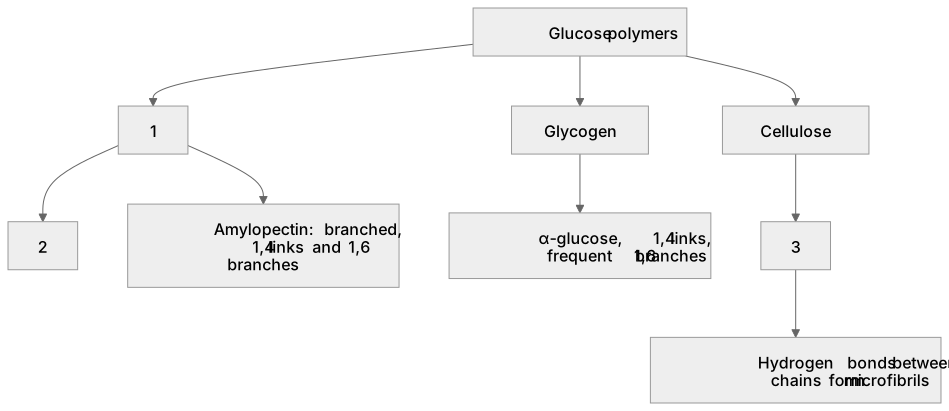
Some boxes have lost their names. Pick the right name for each number.
1Box 1
2Box 2
3Box 3
There is more to this lesson
The full lesson goes on to check your understanding and help you earn the marks. Create a free account to carry on, with your progress saved.
A week of Premium from your first lesson · Then the free plan continues · No card, no charge
Test your understanding of Biological molecules: (f) the structure of starch (amylose and amylopectin), glycogen and cellulose molecules
Active recall beats re-reading. Take an instant quiz now to test what you’ve learned and lock it into long-term memory.
A week of Premium from your first lesson · Then the free plan continues · No card, no charge