OCR · A-Level · Biology
Course version: H420 · Version from Sept 2025
(i) the synthesis and breakdown of triglycerides by the formation and…
Full specification wording
Biological molecules: (i) the synthesis and breakdown of triglycerides by the formation and breakage of ester bonds between fatty acids and glycerol
Triglycerides are built when one glycerol molecule bonds with three fatty acid molecules.
Checked against the OCR H420 specification (opens in a new tab) on .
- Point 9 of 20
- 4 key terms
Study notes
From the checked teaching notes for this specification point.
The idea
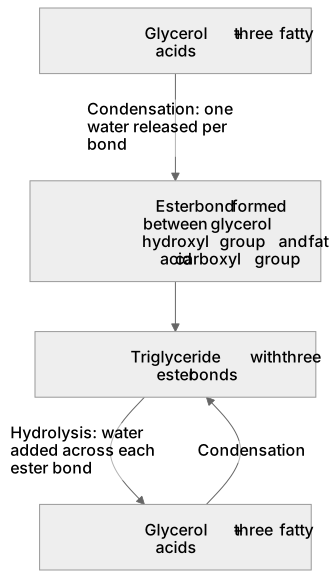
Triglycerides are built when one glycerol molecule bonds with three fatty acid molecules. Each bond forms by a condensation reaction: the hydroxyl group of glycerol reacts with the carboxyl group of a fatty acid, a water molecule is released, and an ester bond (—COO—) links the two. Repeating this three times gives a triglyceride plus three water molecules. Breakdown is the reverse: hydrolysis adds water across each ester bond, splitting the triglyceride back into glycerol and three fatty acids. This happens during digestion, catalysed by lipase, and in cells when fatty acids are respired. Learn the direction of each reaction, the number of water molecules involved and the location of the ester bond, then apply this to unfamiliar diagrams.
What earns the marks
- Synthesis is a condensation reaction joining glycerol to three fatty acids, releasing one water molecule per bond formed.
- Each ester bond forms between the hydroxyl group of glycerol and the carboxyl group of a fatty acid.
- A triglyceride contains three ester bonds, so complete synthesis releases three water molecules.
- Hydrolysis breaks ester bonds by adding water, regenerating glycerol and three fatty acids.
- Lipase catalyses hydrolysis of triglycerides during digestion; the reverse condensation is also enzyme-controlled in cells.
Common mistakes and how to put them right
Confusing condensation with hydrolysis.
Put it right: Condensation releases water and builds the bond, whereas hydrolysis adds water and breaks it.
Thinking one water molecule is released per triglyceride.
Put it right: Three ester bonds form, so three water molecules are released.
Placing the ester bond incorrectly, for example between two fatty acids.
Put it right: The ester bond links glycerol to each fatty acid.
Assuming breakdown requires no water.
Put it right: Hydrolysis consumes water as each ester bond is split.
Exam tips
- Count bonds and water molecules explicitly: three fatty acids means three ester bonds and three water molecules in condensation.
- Use the words condensation and hydrolysis precisely, matching each to synthesis or breakdown.
- When shown a structure, identify the ester linkage and state which groups reacted to form it.
Try the lesson
The start of the Biological molecules: (i) the synthesis and breakdown of triglycerides by the formation and breakage of ester bonds between fatty acids and glycerol lesson, made from checked teaching notes for this specification point.
Have a go first
What type of reaction joins a fatty acid to glycerol during triglyceride synthesis?
Listen
Triglycerides are built when one glycerol molecule bonds with three fatty acid molecules. Each bond forms by a condensation reaction: the hydroxyl group of glycerol reacts with the carboxyl group of a fatty acid, a water molecule is released, and an ester bond (—COO—) links the two. Repeating this three times gives a triglyceride plus three water molecules. Breakdown is the reverse: hydrolysis adds water across each ester bond, splitting the triglyceride back into glycerol and three fatty acids. This happens during digestion, catalysed by lipase, and in cells when fatty acids are respired. Learn the direction of each reaction, the number of water molecules involved and the location of the ester bond, then apply this to unfamiliar diagrams. A strong answer earns marks for these points. Synthesis is a condensation reaction joining glycerol to three fatty acids, releasing one water molecule per bond formed. Each ester bond forms between the hydroxyl group of glycerol and the carboxyl group of a fatty acid. A triglyceride contains three ester bonds, so complete synthesis releases three water molecules. Hydrolysis breaks ester bonds by adding water, regenerating glycerol and three fatty acids. Exam tip: Count bonds and water molecules explicitly: three fatty acids means three ester bonds and three water molecules in condensation.
See it
Watch it explained
What is the one idea the video explains? Say it in a sentence.
Read the described scene instead
Triglycerides are biological molecules built from one glycerol molecule and three fatty acid molecules. In this lesson, we will follow how those components join and how they are split apart again. The key contrast is between condensation and hydrolysis. Condensation builds a bond and releases water, while hydrolysis adds water and breaks the bond. These are opposing reactions, so the same bond is formed in one direction and broken in the other. Triglyceride synthesis happens by condensation. The hydroxyl group of glycerol reacts with the carboxyl group of a fatty acid, one water molecule is released, and an ester bond links the two. Repeating this three times gives a triglyceride plus three water molecules. Breakdown is the reverse process. Hydrolysis adds water across each ester bond and splits the triglyceride back into glycerol and three fatty acids. This occurs during digestion, catalysed by lipase, and in cells when fatty acids are respired. Before we work through it, pause and think about the bonds in a triglyceride with three fatty acids. Complete condensation releases three water molecules, not one. When shown a structure, locate the ester linkage between glycerol and each fatty acid, and state that the hydroxyl and carboxyl groups reacted to form it. Avoid confusing the two directions. Condensation releases water and builds the ester bond; hydrolysis adds water and breaks it. Do not place the ester bond between two fatty acids: it links glycerol to each fatty acid. Also remember that breakdown consumes water as each ester bond is split. So, for OCR, learn the direction of each reaction, the number of water molecules involved, and the location of the ester bond. Condensation joins glycerol to three fatty acids and releases three water molecules; hydrolysis uses water to reverse this, including during lipase-catalysed digestion.
Key words
Say what each word means before you turn the card.
Condensation
Try answering aloud or in your head before turning the card.
Hydrolysis
Try answering aloud or in your head before turning the card.
Ester bond
Try answering aloud or in your head before turning the card.
Lipase
Try answering aloud or in your head before turning the card.
See every definition
- Condensation
- A reaction in which the hydroxyl group of glycerol reacts with the carboxyl group of a fatty acid, a water molecule is released, and an ester bond links the two.
- Hydrolysis
- The reverse of condensation, in which water is added across each ester bond, splitting the triglyceride back into glycerol and three fatty acids.
- Ester bond
- The —COO— link formed between the hydroxyl group of glycerol and the carboxyl group of a fatty acid.
- Lipase
- The enzyme that catalyses the hydrolysis of triglycerides during digestion.
There is more to this lesson
The full lesson goes on to check your understanding and help you earn the marks. Create a free account to carry on, with your progress saved.
A week of Premium from your first lesson · Then the free plan continues · No card, no charge
Test your understanding of Biological molecules: (i) the synthesis and breakdown of triglycerides by the formation and breakage of ester bonds between fatty acids and glycerol
Active recall beats re-reading. Take an instant quiz now to test what you’ve learned and lock it into long-term memory.
A week of Premium from your first lesson · Then the free plan continues · No card, no charge