OCR · A-Level · Biology
Course version: H420 · Version from Sept 2025
(j) how the properties of triglyceride, phospholipid and cholesterol…
Full specification wording
Biological molecules: (j) how the properties of triglyceride, phospholipid and cholesterol molecules relate to their functions in living organisms
Each lipid's function follows from its structure.
Checked against the OCR H420 specification (opens in a new tab) on .
- Point 10 of 20
- 4 key terms
Study notes
From the checked teaching notes for this specification point.
The idea
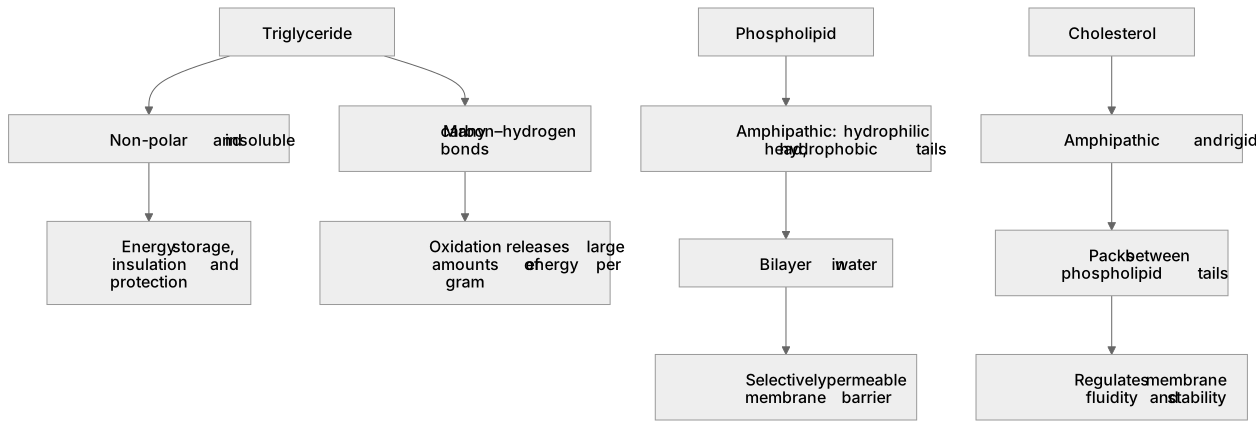
Each lipid's function follows from its structure. Triglycerides are non-polar and insoluble, store energy densely and provide insulation and buoyancy; their many carbon–hydrogen bonds release energy on oxidation. Phospholipids have a hydrophilic phosphate head and two hydrophobic fatty acid tails, so in water they form bilayers with tails inward, creating a selectively permeable barrier for membranes. Cholesterol is a small, rigid, amphipathic steroid: its hydrophobic region sits among fatty acid tails while its hydroxyl group faces the aqueous surface, restricting phospholipid movement to regulate membrane fluidity and stability. Link each structural feature to a named function and avoid describing properties without stating the function they enable.
What earns the marks
- Triglycerides are insoluble and non-polar, making them good energy stores and providing insulation and protection.
- Triglycerides contain many carbon–hydrogen bonds, so oxidation releases large amounts of energy per gram.
- Phospholipids are amphipathic, with a hydrophilic head and hydrophobic tails, so they form bilayers in water.
- The phospholipid bilayer forms the selectively permeable barrier of cell membranes.
- Cholesterol is amphipathic and rigid; it packs between phospholipid tails, regulating membrane fluidity and stability.
Common mistakes and how to put them right
Describing a property without linking it to a function.
Put it right: State what the property allows the molecule to do.
Claiming phospholipids are entirely hydrophobic.
Put it right: They are amphipathic, with a hydrophilic head and hydrophobic tails.
Saying cholesterol makes membranes rigid throughout.
Put it right: It regulates fluidity, reducing it at high temperatures and preventing stiffening at low temperatures.
Treating triglycerides as membrane components.
Put it right: Their role is energy storage, insulation and protection, not bilayer formation.
Exam tips
- Structure the answer as feature, then property, then function for each lipid type.
- Use precise terms such as amphipathic, hydrophilic, hydrophobic and selectively permeable.
- Name the organism context, for example energy storage in adipose tissue or membrane fluidity in animal cells.
Try the lesson
The start of the Biological molecules: (j) how the properties of triglyceride, phospholipid and cholesterol molecules relate to their functions in living organisms lesson, made from checked teaching notes for this specification point.
Have a go first
Which property of triglyceride molecules makes them suited to long-term energy storage in animals?
Listen
Each lipid's function follows from its structure. Triglycerides are non-polar and insoluble, store energy densely and provide insulation and buoyancy; their many carbon–hydrogen bonds release energy on oxidation. Phospholipids have a hydrophilic phosphate head and two hydrophobic fatty acid tails, so in water they form bilayers with tails inward, creating a selectively permeable barrier for membranes. Cholesterol is a small, rigid, amphipathic steroid: its hydrophobic region sits among fatty acid tails while its hydroxyl group faces the aqueous surface, restricting phospholipid movement to regulate membrane fluidity and stability. Link each structural feature to a named function and avoid describing properties without stating the function they enable. A strong answer earns marks for these points. Triglycerides are insoluble and non-polar, making them good energy stores and providing insulation and protection. Triglycerides contain many carbon–hydrogen bonds, so oxidation releases large amounts of energy per gram. Phospholipids are amphipathic, with a hydrophilic head and hydrophobic tails, so they form bilayers in water. The phospholipid bilayer forms the selectively permeable barrier of cell membranes. Exam tip: Structure the answer as feature, then property, then function for each lipid type.
See it
Watch it explained
What is the one idea the video explains? Say it in a sentence.
Read the described scene instead
In this lesson, we link the structure of three lipids to their functions in living organisms. For each one, ask what the molecule's properties allow it to do. Triglycerides are non-polar and insoluble. This makes them good energy stores, and they also provide insulation and protection. They contain many carbon–hydrogen bonds, so oxidation releases large amounts of energy per gram. Phospholipids are amphipathic. Each has a hydrophilic phosphate head and two hydrophobic fatty acid tails. In water, they form bilayers with the tails facing inward. This bilayer creates a selectively permeable barrier for membranes. Cholesterol is a small, rigid, amphipathic steroid. Its hydrophobic region sits among fatty acid tails, while its hydroxyl group faces the aqueous surface. There it restricts phospholipid movement, regulating membrane fluidity and stability. It reduces fluidity at high temperatures and prevents stiffening at low temperatures. Avoid describing a property without linking it to a function. Phospholipids are not entirely hydrophobic; they are amphipathic. Cholesterol regulates fluidity rather than making membranes rigid throughout. Triglycerides are not membrane components; their roles are energy storage, insulation and protection. Use the sequence feature, then property, then function. For triglycerides, non-polar insolubility supports dense energy storage and insulation. For phospholipids, amphipathy enables bilayer formation and a selectively permeable barrier. For cholesterol, a rigid amphipathic structure regulates membrane fluidity and stability.
Key words
Say what each word means before you turn the card.
Triglycerides
Try answering aloud or in your head before turning the card.
Phospholipids
Try answering aloud or in your head before turning the card.
Phospholipid bilayer
Try answering aloud or in your head before turning the card.
Cholesterol
Try answering aloud or in your head before turning the card.
See every definition
- Triglycerides
- Non-polar and insoluble molecules with many carbon–hydrogen bonds, so oxidation releases large amounts of energy per gram, making them good energy stores and providing insulation and protection.
- Phospholipids
- Amphipathic molecules with a hydrophilic phosphate head and two hydrophobic fatty acid tails, so in water they form bilayers with tails inward.
- Phospholipid bilayer
- The structure formed by phospholipids in water that acts as the selectively permeable barrier of cell membranes.
- Cholesterol
- A small, rigid, amphipathic steroid whose hydrophobic region sits among fatty acid tails while its hydroxyl group faces the aqueous surface, restricting phospholipid movement to regulate membrane fluidity and stability.
Label the diagram
Some boxes have lost their names. Pick the right name for each number.
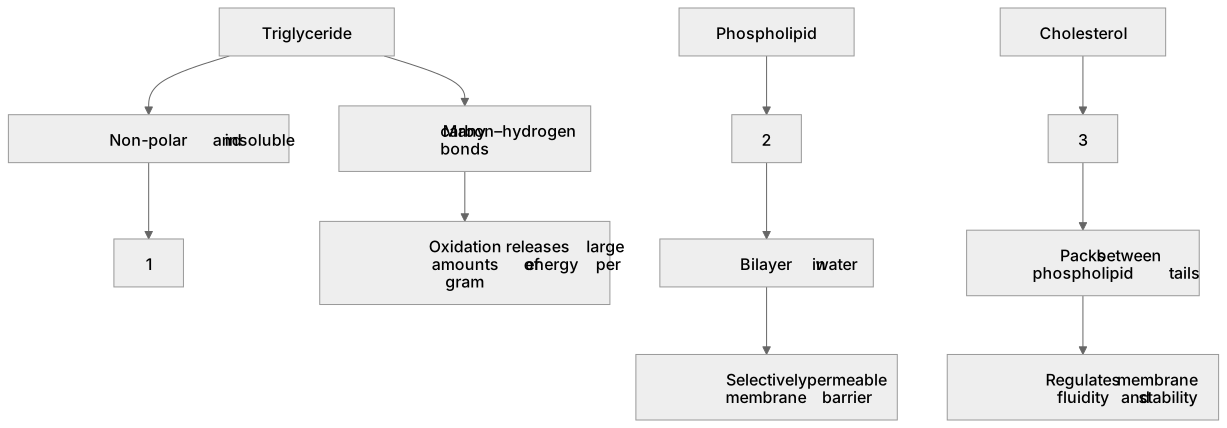
1Box 1
2Box 2
3Box 3
There is more to this lesson
The full lesson goes on to check your understanding and help you earn the marks. Create a free account to carry on, with your progress saved.
A week of Premium from your first lesson · Then the free plan continues · No card, no charge
Test your understanding of Biological molecules: (j) how the properties of triglyceride, phospholipid and cholesterol molecules relate to their functions in living organisms
Active recall beats re-reading. Take an instant quiz now to test what you’ve learned and lock it into long-term memory.
A week of Premium from your first lesson · Then the free plan continues · No card, no charge