OCR · A-Level · Biology
Course version: H420 · Version from Sept 2025
Biological molecules: (k) the general structure of an amino acid
An amino acid is built around a central (alpha) carbon atom.
Checked against the OCR H420 specification (opens in a new tab) on .
- Point 11 of 20
- 4 key terms
Study notes
From the checked teaching notes for this specification point.
The idea
An amino acid is built around a central (alpha) carbon atom. Attached to this carbon are four groups: an amine group (—NH₂), a carboxyl group (—COOH), a hydrogen atom (—H) and a variable R group (side chain). The amine and carboxyl groups are common to every amino acid; it is the R group that differs between the twenty or so standard amino acids and gives each its distinct properties, such as charge or polarity. Because the same carbon carries both an acidic carboxyl group and a basic amine group, amino acids can act as zwitterions and buffer solutions. Learn the four groups and their positions on the central carbon.
What earns the marks
- Identifies the central (alpha) carbon as the atom to which the four groups are bonded.
- Names the amine group (—NH₂) and the carboxyl group (—COOH) as the groups common to all amino acids.
- States that a hydrogen atom and a variable R group are also attached to the central carbon.
- Recognises that the R group (side chain) is the part that differs between different amino acids.
- Applies the structure to explain a property, such as the R group determining charge, polarity or reactivity.
Common mistakes and how to put them right
Thinking the R group is the same in all amino acids.
Put it right by stating the R group is the variable side chain that distinguishes one amino acid from another.
Confusing the amine group with the carboxyl group.
Put it right by noting the amine group is —NH₂ (basic) and the carboxyl group is —COOH (acidic).
Placing the four groups on different carbon atoms.
Put it right by stating all four groups are bonded to the same central (alpha) carbon.
Exam tips
- Memorise the four groups attached to the central carbon and their positions before attempting structure questions.
- When checking a drawn structure, verify that the amine, carboxyl, hydrogen and R groups all attach to one central carbon.
- Read each option fully; distractors often swap the amine and carboxyl groups or move a group to the wrong atom.
Try the lesson
The start of the Biological molecules: (k) the general structure of an amino acid lesson, made from checked teaching notes for this specification point.
Have a go first
What does the R group of an amino acid represent?
Listen
An amino acid is built around a central (alpha) carbon atom. Attached to this carbon are four groups: an amine group (—NH₂), a carboxyl group (—COOH), a hydrogen atom (—H) and a variable R group (side chain). The amine and carboxyl groups are common to every amino acid; it is the R group that differs between the twenty or so standard amino acids and gives each its distinct properties, such as charge or polarity. Because the same carbon carries both an acidic carboxyl group and a basic amine group, amino acids can act as zwitterions and buffer solutions. Learn the four groups and their positions on the central carbon. A strong answer earns marks for these points. Identifies the central (alpha) carbon as the atom to which the four groups are bonded. Names the amine group (—NH₂) and the carboxyl group (—COOH) as the groups common to all amino acids. States that a hydrogen atom and a variable R group are also attached to the central carbon. Recognises that the R group (side chain) is the part that differs between different amino acids. A common slip: Thinking the R group is the same in all amino acids. Instead, stating the R group is the variable side chain that distinguishes one amino acid from another. Exam tip: Memorise the four groups attached to the central carbon and their positions before attempting structure questions.
See it
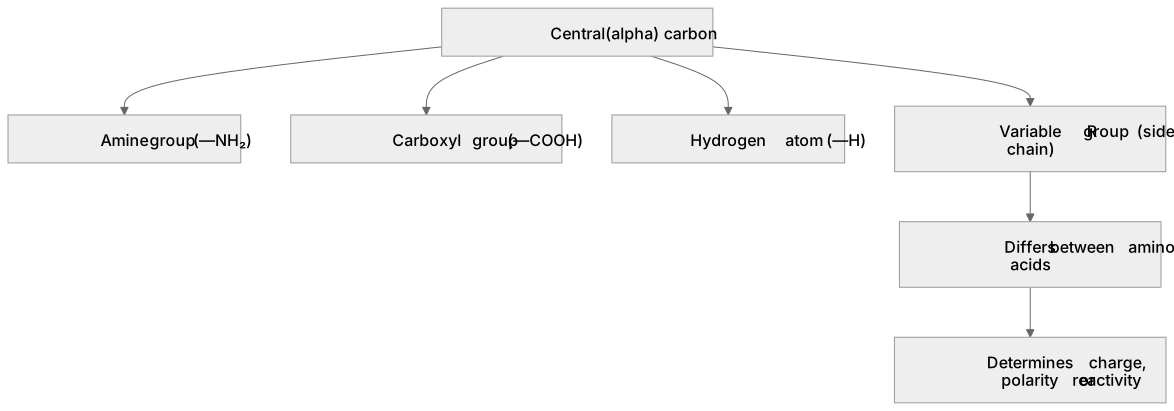
Key words
Say what each word means before you turn the card.
Central (alpha) carbon
Try answering aloud or in your head before turning the card.
Amine and carboxyl groups
Try answering aloud or in your head before turning the card.
Variable R group
Try answering aloud or in your head before turning the card.
Buffering
Try answering aloud or in your head before turning the card.
See every definition
- Central (alpha) carbon
- The atom at the centre of an amino acid to which the four groups are bonded.
- Amine and carboxyl groups
- The —NH₂ and —COOH groups that are common to all amino acids.
- Variable R group
- The side chain that differs between the twenty or so standard amino acids and gives each its distinct properties.
- Buffering
- Acting on solutions because the same carbon carries both an acidic carboxyl group and a basic amine group.
Label the diagram
Some boxes have lost their names. Pick the right name for each number.
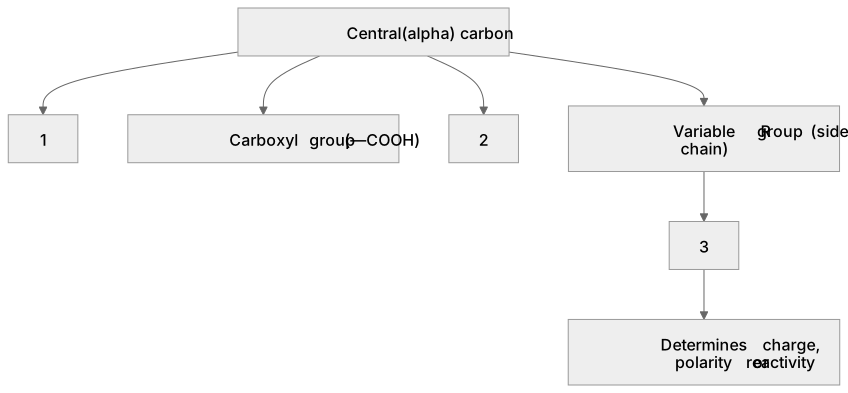
1Box 1
2Box 2
3Box 3
There is more to this lesson
The full lesson goes on to check your understanding and help you earn the marks. Create a free account to carry on, with your progress saved.
A week of Premium from your first lesson · Then the free plan continues · No card, no charge
Test your understanding of Biological molecules: (k) the general structure of an amino acid
Active recall beats re-reading. Take an instant quiz now to test what you’ve learned and lock it into long-term memory.
A week of Premium from your first lesson · Then the free plan continues · No card, no charge