OCR · A-Level · Biology
Course version: H420 · Version from Sept 2025
Biological molecules: (o) the properties and functions of fibrous proteins
Fibrous proteins are long, strand-like molecules whose amino acid chains run parallel along one axis and are held together by cross-links, so they are insoluble in water and structurally strong.
Checked against the OCR H420 specification (opens in a new tab) on .
- Point 15 of 20
- 4 key terms
Study notes
From the checked teaching notes for this specification point.
The idea
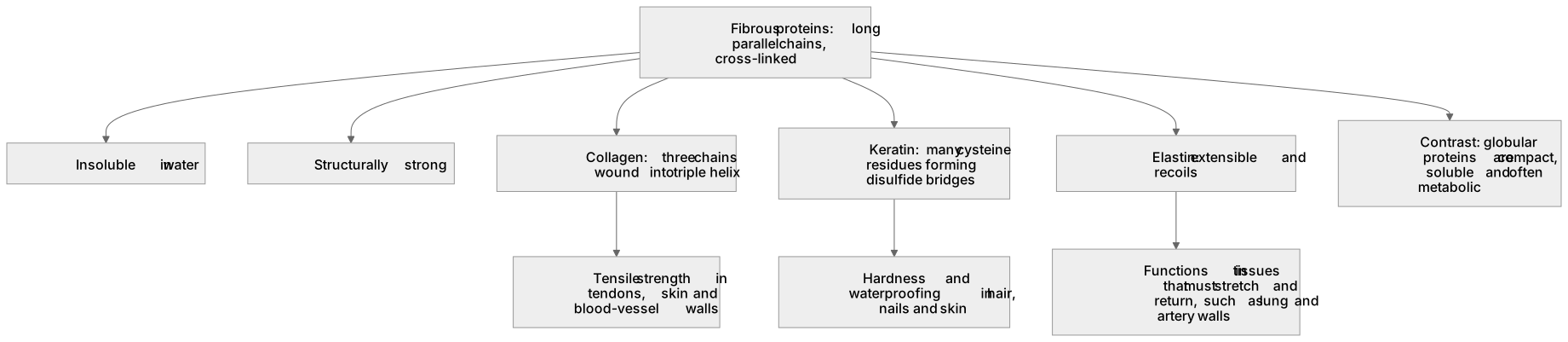
Fibrous proteins are long, strand-like molecules whose amino acid chains run parallel along one axis and are held together by cross-links, so they are insoluble in water and structurally strong. Their repeating sequence and extensive hydrogen bonding and, where present, disulfide bridges give tensile strength and resistance to stretching. Collagen is the classic example: three polypeptide chains wound into a triple helix, cross-linked in fibrils, giving high tensile strength in tendons, skin and blood-vessel walls. Keratin has many cysteine residues forming disulfide bridges, giving hardness and waterproofing in hair, nails and skin. Elastin is extensible and recoils. Learn to link each structural feature to a named function and to contrast fibrous proteins with globular ones, which are compact and soluble.
What earns the marks
- Fibrous proteins have long, parallel polypeptide chains forming extended strand-like structures rather than compact folded shapes.
- Cross-links such as hydrogen bonds and disulfide bridges between chains give strength and insolubility in water.
- Collagen consists of three polypeptide chains wound into a triple helix, providing tensile strength in tendons, skin and blood-vessel walls.
- Keratin contains many cysteine residues whose disulfide bridges give hardness and waterproofing in hair, nails and skin.
- Elastin is extensible and recoils, so it functions in tissues that must stretch and return, such as lung and artery walls.
- Fibrous proteins are structural, whereas globular proteins are compact, soluble and often metabolic (for example enzymes).
Common mistakes and how to put them right
Describing fibrous proteins as compact and soluble.
Put it right by stating they are elongated and generally insoluble because of extensive cross-linking.
Confusing the roles of collagen and keratin.
Put it right by linking collagen's triple helix to tensile strength and keratin's disulfide bridges to hardness and waterproofing.
Claiming all fibrous proteins are identical in structure.
Put it right by distinguishing collagen's triple helix, keratin's cysteine cross-links and elastin's extensibility.
Exam tips
- When a question names a fibrous protein, state one structural feature and then the function it produces, rather than listing functions alone.
- Use precise terms such as triple helix, disulfide bridge and tensile strength instead of vague words like strong or tough.
- If asked to compare, set fibrous against globular proteins on shape, solubility and role in one sentence each.
Try the lesson
The start of the Biological molecules: (o) the properties and functions of fibrous proteins lesson, made from checked teaching notes for this specification point.
Have a go first
Keratin is a fibrous protein found in hair and nails. Which function does its structure most directly serve?
Listen
Fibrous proteins are long, strand-like molecules whose amino acid chains run parallel along one axis and are held together by cross-links, so they are insoluble in water and structurally strong. Their repeating sequence and extensive hydrogen bonding and, where present, disulfide bridges give tensile strength and resistance to stretching. Collagen is the classic example: three polypeptide chains wound into a triple helix, cross-linked in fibrils, giving high tensile strength in tendons, skin and blood-vessel walls. Keratin has many cysteine residues forming disulfide bridges, giving hardness and waterproofing in hair, nails and skin. Elastin is extensible and recoils. Learn to link each structural feature to a named function and to contrast fibrous proteins with globular ones, which are compact and soluble. A strong answer earns marks for these points. Fibrous proteins have long, parallel polypeptide chains forming extended strand-like structures rather than compact folded shapes. Cross-links such as hydrogen bonds and disulfide bridges between chains give strength and insolubility in water. Collagen consists of three polypeptide chains wound into a triple helix, providing tensile strength in tendons, skin and blood-vessel walls. Keratin contains many cysteine residues whose disulfide bridges give hardness and waterproofing in hair, nails and skin. A common slip: Describing fibrous proteins as compact and soluble. Instead, stating they are elongated and generally insoluble because of extensive cross-linking. Exam tip: When a question names a fibrous protein, state one structural feature and then the function it produces, rather than listing functions alone.
See it
Key words
Say what each word means before you turn the card.
Fibrous proteins
Try answering aloud or in your head before turning the card.
Collagen
Try answering aloud or in your head before turning the card.
Keratin
Try answering aloud or in your head before turning the card.
Elastin
Try answering aloud or in your head before turning the card.
See every definition
- Fibrous proteins
- Long, strand-like molecules whose amino acid chains run parallel along one axis and are held together by cross-links, so they are insoluble in water and structurally strong.
- Collagen
- Three polypeptide chains wound into a triple helix, cross-linked in fibrils, giving high tensile strength in tendons, skin and blood-vessel walls.
- Keratin
- Contains many cysteine residues forming disulfide bridges, giving hardness and waterproofing in hair, nails and skin.
- Elastin
- Extensible and recoils, so it functions in tissues that must stretch and return, such as lung and artery walls.
Label the diagram
Some boxes have lost their names. Pick the right name for each number.
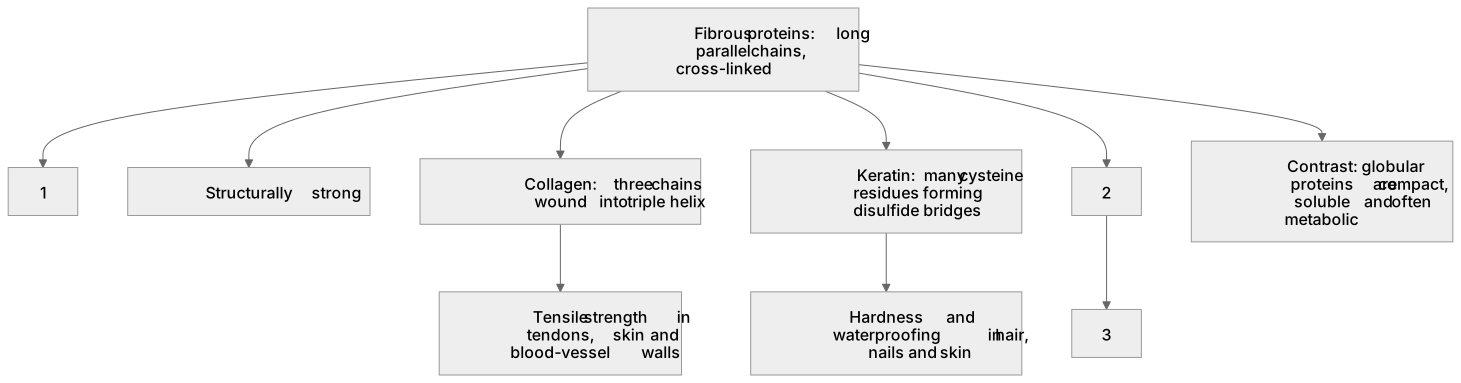
1Box 1
2Box 2
3Box 3
There is more to this lesson
The full lesson goes on to check your understanding and help you earn the marks. Create a free account to carry on, with your progress saved.
A week of Premium from your first lesson · Then the free plan continues · No card, no charge
Test your understanding of Biological molecules: (o) the properties and functions of fibrous proteins
Active recall beats re-reading. Take an instant quiz now to test what you’ve learned and lock it into long-term memory.
A week of Premium from your first lesson · Then the free plan continues · No card, no charge