OCR · A-Level · Biology
Course version: H420 · Version from Sept 2025
(n) the structure and function of globular proteins including a conjugated…
Full specification wording
Biological molecules: (n) the structure and function of globular proteins including a conjugated protein
Globular proteins fold so that hydrophobic residues cluster in the core and hydrophilic residues face the aqueous surroundings, giving a compact, roughly spherical shape that is soluble.
Checked against the OCR H420 specification (opens in a new tab) on .
- Point 14 of 20
- 4 key terms
Study notes
From the checked teaching notes for this specification point.
The idea
Globular proteins fold so that hydrophobic residues cluster in the core and hydrophilic residues face the aqueous surroundings, giving a compact, roughly spherical shape that is soluble. The precise three-dimensional shape comes from the primary sequence and is held by hydrogen bonds, ionic bonds, disulfide bridges and hydrophobic interactions; this shape creates a specific active site or binding site, so function depends on structure. Examples include enzymes, haemoglobin and antibodies. A conjugated protein contains a non-protein prosthetic group. Haemoglobin is the standard example: four polypeptide chains each associated with a haem group containing an iron ion (Fe²⁺) that binds oxygen. The prosthetic group is essential to function, so removing it destroys oxygen transport.
What earns the marks
- Globular proteins have a compact, roughly spherical shape with hydrophobic residues in the core and hydrophilic residues on the surface, making them soluble.
- The tertiary structure is held by hydrogen bonds, ionic bonds, disulfide bridges and hydrophobic interactions, determined by the primary sequence.
- The specific folded shape creates a precise active site or binding site, so structure relates directly to function.
- A conjugated protein contains a non-protein prosthetic group permanently associated with the polypeptide.
- In haemoglobin each of the four polypeptide chains is associated with a haem group containing an Fe²⁺ ion that binds oxygen.
- The prosthetic group is required for function; without the haem group the protein cannot transport oxygen.
Common mistakes and how to put them right
Describing globular proteins as insoluble and fibrous.
Put it right: Globular proteins are compact and soluble because hydrophilic groups face the water.
Treating the prosthetic group as a separate protein.
Put it right: It is a non-protein group attached to the polypeptide, such as the haem group in haemoglobin.
Saying shape is irrelevant to function.
Put it right: The specific folded shape forms the active or binding site, so loss of shape (denaturation) loses function.
Exam tips
- Always link a named structural feature to a named function rather than listing bonds alone.
- For conjugated proteins, name the prosthetic group and state what it does, e.g. haem binds oxygen via Fe²⁺.
- Use haemoglobin as your worked example and be ready to explain why its quaternary structure and prosthetic groups matter.
Try the lesson
The start of the Biological molecules: (n) the structure and function of globular proteins including a conjugated protein lesson, made from checked teaching notes for this specification point.
Have a go first
Which description best matches the overall shape of a globular protein such as an enzyme in aqueous solution?
Listen
Globular proteins fold so that hydrophobic residues cluster in the core and hydrophilic residues face the aqueous surroundings, giving a compact, roughly spherical shape that is soluble. The precise three-dimensional shape comes from the primary sequence and is held by hydrogen bonds, ionic bonds, disulfide bridges and hydrophobic interactions; this shape creates a specific active site or binding site, so function depends on structure. Examples include enzymes, haemoglobin and antibodies. A conjugated protein contains a non-protein prosthetic group. Haemoglobin is the standard example: four polypeptide chains each associated with a haem group containing an iron ion (Fe²⁺) that binds oxygen. The prosthetic group is essential to function, so removing it destroys oxygen transport. A strong answer earns marks for these points. Globular proteins have a compact, roughly spherical shape with hydrophobic residues in the core and hydrophilic residues on the surface, making them soluble. The tertiary structure is held by hydrogen bonds, ionic bonds, disulfide bridges and hydrophobic interactions, determined by the primary sequence. The specific folded shape creates a precise active site or binding site, so structure relates directly to function. A conjugated protein contains a non-protein prosthetic group permanently associated with the polypeptide. A common slip: Describing globular proteins as insoluble and fibrous. Instead, globular proteins are compact and soluble because hydrophilic groups face the water. Exam tip: Always link a named structural feature to a named function rather than listing bonds alone.
See it
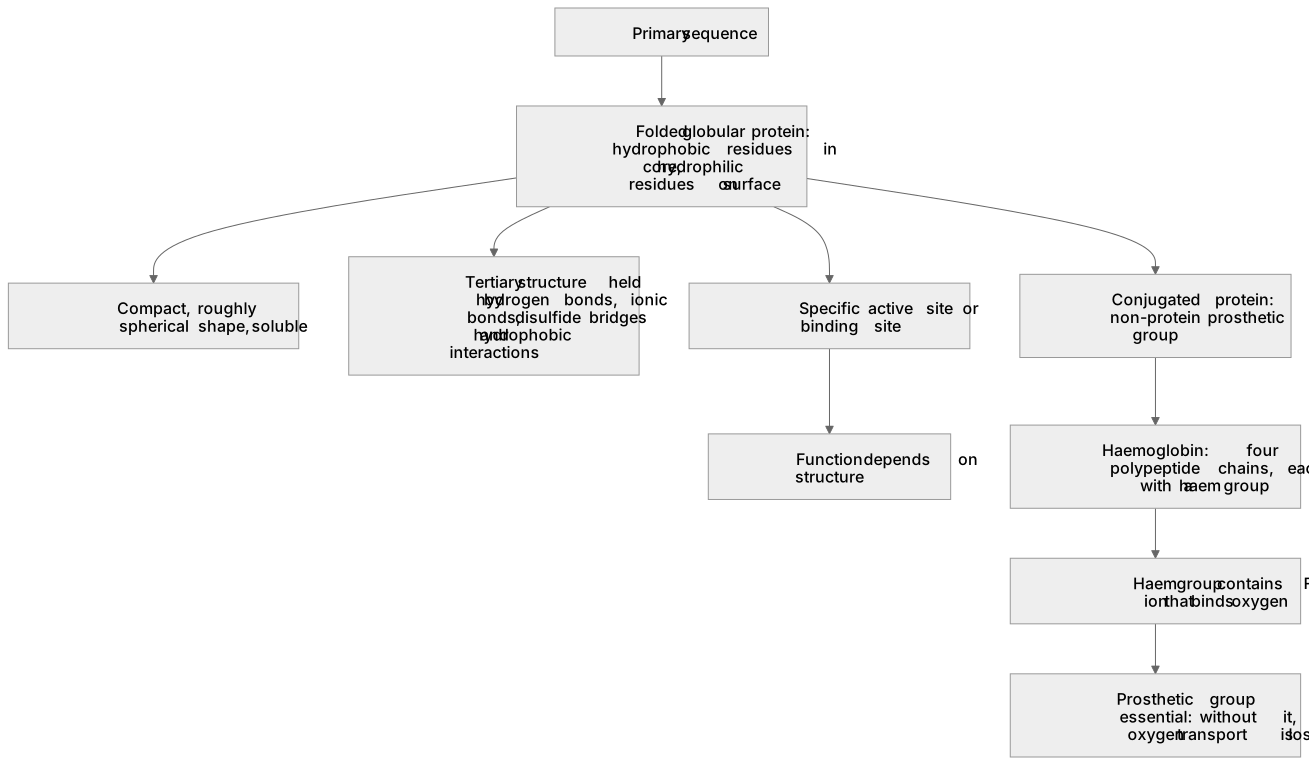
Key words
Say what each word means before you turn the card.
Tertiary and quaternary structure
Try answering aloud or in your head before turning the card.
Solubility and folding of globular proteins
Try answering aloud or in your head before turning the card.
Structure–function relationship
Try answering aloud or in your head before turning the card.
Conjugated proteins and prosthetic groups
Try answering aloud or in your head before turning the card.
See every definition
- Tertiary and quaternary structure
- The precise three-dimensional shape comes from the primary sequence and is held by hydrogen bonds, ionic bonds, disulfide bridges and hydrophobic interactions; haemoglobin has four polypeptide chains.
- Solubility and folding of globular proteins
- Globular proteins fold so that hydrophobic residues cluster in the core and hydrophilic residues face the aqueous surroundings, giving a compact, roughly spherical shape that is soluble.
- Structure–function relationship
- The specific folded shape creates a precise active site or binding site, so function depends on structure.
- Conjugated proteins and prosthetic groups
- A conjugated protein contains a non-protein prosthetic group permanently associated with the polypeptide, such as the haem group containing an iron ion (Fe²⁺) that binds oxygen in haemoglobin.
Label the diagram
Some boxes have lost their names. Pick the right name for each number.
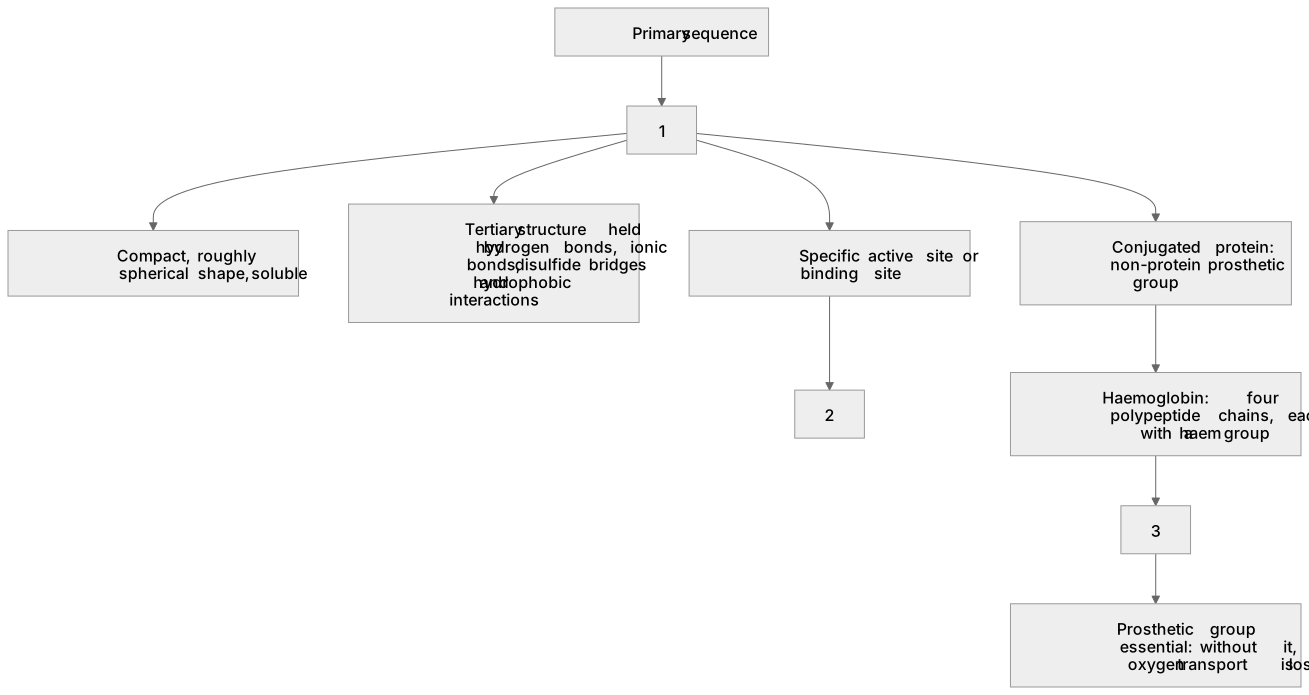
1Box 1
2Box 2
3Box 3
There is more to this lesson
The full lesson goes on to check your understanding and help you earn the marks. Create a free account to carry on, with your progress saved.
A week of Premium from your first lesson · Then the free plan continues · No card, no charge
Test your understanding of Biological molecules: (n) the structure and function of globular proteins including a conjugated protein
Active recall beats re-reading. Take an instant quiz now to test what you’ve learned and lock it into long-term memory.
A week of Premium from your first lesson · Then the free plan continues · No card, no charge