OCR · A-Level · Biology
Course version: H420 · Version from Sept 2025
(q) how to carry out and interpret the results of the following chemical…
Full specification wording
Biological molecules: (q) how to carry out and interpret the results of the following chemical tests: • biuret test for proteins • Benedict’s test for reducing and non-reducing sugars • iodine test for starch • emulsion test for lipids
Each test detects a specific molecule through a colour change.
Checked against the OCR H420 specification (opens in a new tab) on .
- Point 17 of 20
- 4 key terms
Study notes
From the checked teaching notes for this specification point.
The idea
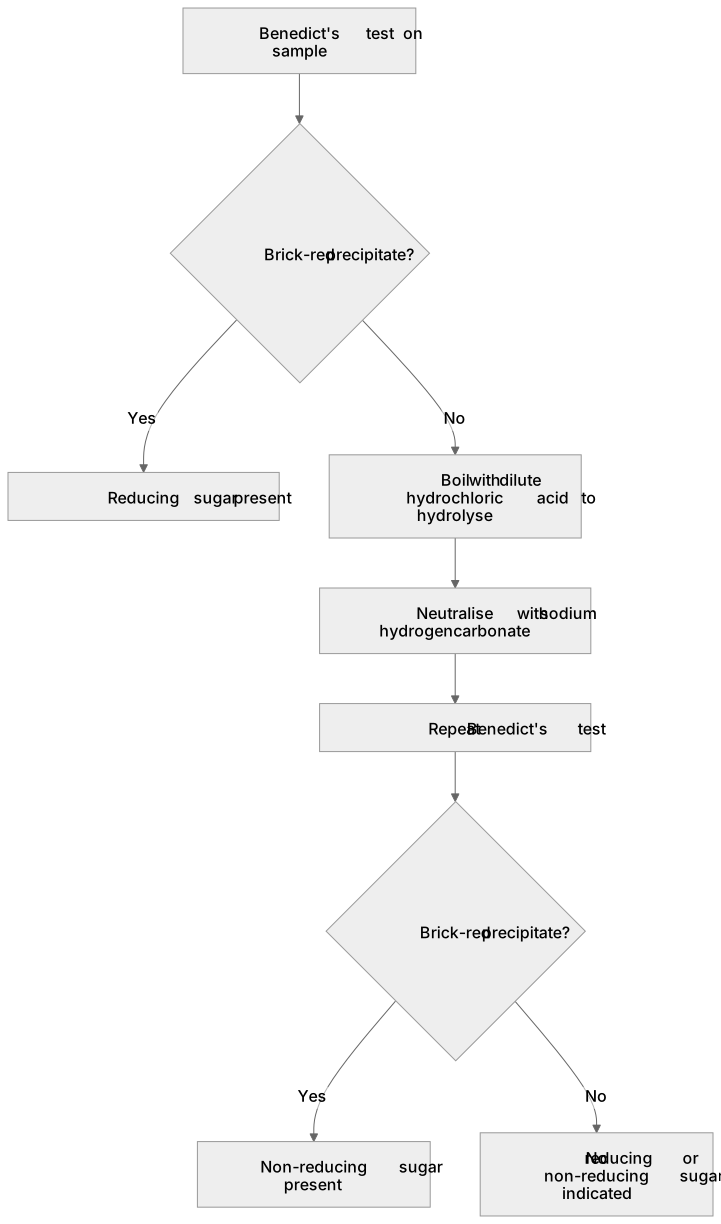
Each test detects a specific molecule through a colour change. Biuret: add an equal volume of biuret solution (sodium hydroxide plus dilute copper(II) sulfate) to the sample; a purple colour indicates peptide bonds, so protein is present, while a blue colour is negative. Benedict's: add Benedict's reagent (blue copper(II) sulfate) and heat in a water bath; a brick-red precipitate shows a reducing sugar. For a non-reducing sugar, first boil with dilute hydrochloric acid to hydrolyse it, neutralise with sodium hydrogencarbonate, then repeat Benedict's; a positive result after hydrolysis but not before indicates a non-reducing sugar such as sucrose. Iodine: add iodine in potassium iodide solution; blue-black indicates starch, orange-brown is negative. Emulsion: add ethanol and shake, then pour into water; a cloudy white emulsion indicates lipid.
What earns the marks
- Biuret test: add biuret solution to the sample; purple indicates protein (peptide bonds present), blue is a negative result.
- Benedict's test for reducing sugar: add Benedict's reagent and heat in a water bath; a brick-red precipitate indicates a reducing sugar.
- Non-reducing sugar: boil with dilute acid to hydrolyse, neutralise with sodium hydrogencarbonate, then repeat Benedict's; positive only after hydrolysis indicates a non-reducing sugar.
- Iodine test: add iodine in potassium iodide solution; blue-black indicates starch, orange-brown is negative.
- Emulsion test: add ethanol and shake, then pour into water; a cloudy white emulsion indicates lipid.
- Interpretation requires comparing the observed colour or precipitate with the known positive and negative outcomes for each test.
Common mistakes and how to put them right
Assuming Benedict's reagent detects all sugars directly.
Put it right: It detects reducing sugars only; non-reducing sugars need acid hydrolysis and neutralisation first.
Forgetting to neutralise the acid before adding Benedict's reagent after hydrolysis.
Put it right: Sodium hydrogencarbonate must be added, or the acid prevents the colour change.
Confusing the iodine positive colour with the emulsion result.
Put it right: Iodine gives blue-black with starch; the emulsion test gives a cloudy white emulsion with lipid.
Treating a blue biuret result as positive.
Put it right: Blue is negative; purple indicates protein.
Exam tips
- Learn the reagent, the condition (for example heating for Benedict's) and the positive colour for each test as a matched set.
- For non-reducing sugars, state the full sequence: hydrolyse with acid, neutralise, then repeat Benedict's.
- When interpreting, always state what the observed colour shows about the molecule present, not just the colour name.
Try the lesson
The start of the Biological molecules: (q) how to carry out and interpret the results of the following chemical tests: • biuret test for proteins • Benedict’s test for reducing and non-reducing sugars • iodine test for starch • emulsion test for lipids lesson, made from checked teaching notes for this specification point.
Have a go first
A student adds a few drops of iodine solution to a food sample and observes a blue-black colour. Which biological molecule is present in the sample?
Listen
Each test detects a specific molecule through a colour change. Biuret: add an equal volume of biuret solution (sodium hydroxide plus dilute copper(II) sulfate) to the sample; a purple colour indicates peptide bonds, so protein is present, while a blue colour is negative. Benedict's: add Benedict's reagent (blue copper(II) sulfate) and heat in a water bath; a brick-red precipitate shows a reducing sugar. For a non-reducing sugar, first boil with dilute hydrochloric acid to hydrolyse it, neutralise with sodium hydrogencarbonate, then repeat Benedict's; a positive result after hydrolysis but not before indicates a non-reducing sugar such as sucrose. Iodine: add iodine in potassium iodide solution; blue-black indicates starch, orange-brown is negative. Emulsion: add ethanol and shake, then pour into water; a cloudy white emulsion indicates lipid. A strong answer earns marks for these points. Biuret test: add biuret solution to the sample; purple indicates protein (peptide bonds present), blue is a negative result. Benedict's test for reducing sugar: add Benedict's reagent and heat in a water bath; a brick-red precipitate indicates a reducing sugar. Non-reducing sugar: boil with dilute acid to hydrolyse, neutralise with sodium hydrogencarbonate, then repeat Benedict's; positive only after hydrolysis indicates a non-reducing sugar. Iodine test: add iodine in potassium iodide solution; blue-black indicates starch, orange-brown is negative. A common slip: Assuming Benedict's reagent detects all sugars directly. Instead, it detects reducing sugars only; non-reducing sugars need acid hydrolysis and neutralisation first. Exam tip: Learn the reagent, the condition (for example heating for Benedict's) and the positive colour for each test as a matched set.
See it
Key words
Say what each word means before you turn the card.
Biuret test for proteins
Try answering aloud or in your head before turning the card.
Benedict's test for reducing and non-reducing sugars
Try answering aloud or in your head before turning the card.
Iodine test for starch
Try answering aloud or in your head before turning the card.
Emulsion test for lipids
Try answering aloud or in your head before turning the card.
See every definition
- Biuret test for proteins
- Add an equal volume of biuret solution to the sample; a purple colour indicates peptide bonds, so protein is present, while blue is negative.
- Benedict's test for reducing and non-reducing sugars
- Add Benedict's reagent and heat in a water bath; a brick-red precipitate shows a reducing sugar, and a positive result only after acid hydrolysis and neutralisation indicates a non-reducing sugar.
- Iodine test for starch
- Add iodine in potassium iodide solution; blue-black indicates starch, while orange-brown is negative.
- Emulsion test for lipids
- Add ethanol and shake, then pour into water; a cloudy white emulsion indicates lipid.
There is more to this lesson
The full lesson goes on to check your understanding and help you earn the marks. Create a free account to carry on, with your progress saved.
A week of Premium from your first lesson · Then the free plan continues · No card, no charge
Test your understanding of Biological molecules: (q) how to carry out and interpret the results of the following chemical tests: • biuret test for proteins • Benedict’s test for reducing and non-reducing sugars • iodine test for starch • emulsion test for lipids
Active recall beats re-reading. Take an instant quiz now to test what you’ve learned and lock it into long-term memory.
A week of Premium from your first lesson · Then the free plan continues · No card, no charge