OCR · A-Level · Biology
Course version: H420 · Version from Sept 2025
(r) quantitative methods to determine the concentration of a chemical…
Full specification wording
Biological molecules: (r) quantitative methods to determine the concentration of a chemical substance in a solution
Quantitative methods measure how much of a substance is present, not merely whether it is present.
Checked against the OCR H420 specification (opens in a new tab) on .
- Point 18 of 20
- 4 key terms
Study notes
From the checked teaching notes for this specification point.
The idea
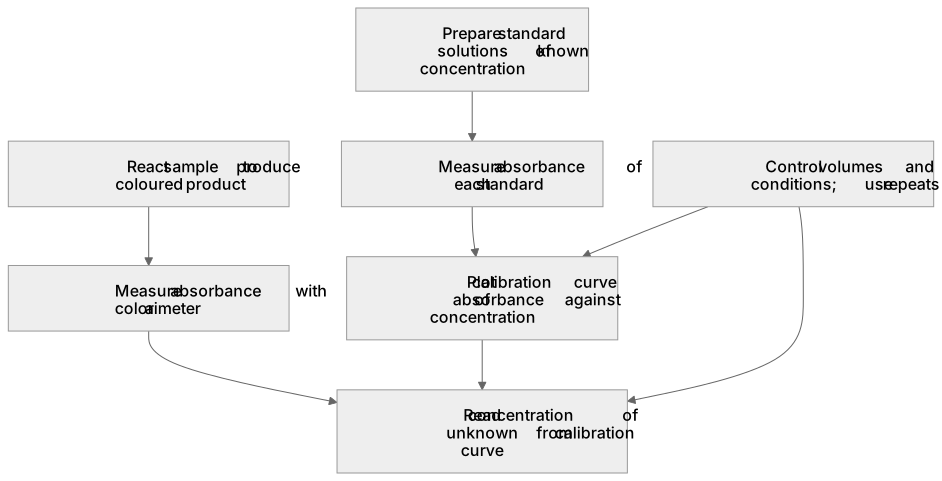
Quantitative methods measure how much of a substance is present, not merely whether it is present. A common approach is colorimetry: react the sample with a reagent that produces a coloured product, then measure absorbance with a colorimeter. Prepare a series of known concentrations (standard solutions), measure each absorbance, and plot a calibration curve of absorbance against concentration. Measure the absorbance of the unknown and read its concentration from the curve. Other quantitative methods include titration (for example determining reducing sugar concentration) and using a biosensor or a quantitative Benedict's series comparing precipitate with known standards. Reliable results require controlled volumes, consistent conditions and repeats to reduce error.
What earns the marks
- Quantitative methods determine the amount or concentration of a substance, not just its presence.
- Colorimetry: react the sample to produce a coloured product and measure absorbance with a colorimeter.
- Prepare standard solutions of known concentration, measure their absorbance and plot a calibration curve.
- Measure the unknown's absorbance and read its concentration from the calibration curve.
- Other quantitative approaches include titration and comparison against a series of known standards.
- Control variables such as volumes and conditions, and use repeats, to improve reliability.
Common mistakes and how to put them right
Confusing qualitative and quantitative tests.
Put it right: A colour change alone is qualitative; quantitative methods measure how much is present.
Reading concentration directly from a single absorbance without a calibration curve.
Put it right: The unknown must be compared with a curve built from standard solutions.
Ignoring controlled volumes and conditions.
Put it right: Consistent reagent volumes and conditions are needed for valid comparison.
Assuming one measurement is sufficient.
Put it right: Repeats and averaging reduce random error.
Exam tips
- Describe the full colorimetry sequence: standards, calibration curve, then read the unknown.
- State clearly that a calibration curve links absorbance to known concentrations.
- Mention controlling variables and repeats when explaining how to obtain reliable quantitative results.
Try the lesson
The start of the Biological molecules: (r) quantitative methods to determine the concentration of a chemical substance in a solution lesson, made from checked teaching notes for this specification point.
Have a go first
A student makes a standard solution by dissolving 0.50 moles of sodium chloride in enough distilled water to make 250 cm³ of solution. What is the concentration of the solution in mol dm⁻³?
Listen
Quantitative methods measure how much of a substance is present, not merely whether it is present. A common approach is colorimetry: react the sample with a reagent that produces a coloured product, then measure absorbance with a colorimeter. Prepare a series of known concentrations (standard solutions), measure each absorbance, and plot a calibration curve of absorbance against concentration. Measure the absorbance of the unknown and read its concentration from the curve. Other quantitative methods include titration (for example determining reducing sugar concentration) and using a biosensor or a quantitative Benedict's series comparing precipitate with known standards. Reliable results require controlled volumes, consistent conditions and repeats to reduce error. A strong answer earns marks for these points. Quantitative methods determine the amount or concentration of a substance, not just its presence. Colorimetry: react the sample to produce a coloured product and measure absorbance with a colorimeter. Prepare standard solutions of known concentration, measure their absorbance and plot a calibration curve. Measure the unknown's absorbance and read its concentration from the calibration curve. A common slip: Confusing qualitative and quantitative tests. Instead, a colour change alone is qualitative; quantitative methods measure how much is present. Exam tip: Describe the full colorimetry sequence: standards, calibration curve, then read the unknown.
See it
Key words
Say what each word means before you turn the card.
Quantitative versus qualitative measurement
Try answering aloud or in your head before turning the card.
Colorimetry and calibration curves
Try answering aloud or in your head before turning the card.
Standard solutions
Try answering aloud or in your head before turning the card.
Reliability through control and repeats
Try answering aloud or in your head before turning the card.
See every definition
- Quantitative versus qualitative measurement
- Quantitative methods determine the amount or concentration of a substance, not just its presence, whereas a colour change alone is qualitative.
- Colorimetry and calibration curves
- React the sample to produce a coloured product, measure absorbance with a colorimeter, and plot absorbance against concentration for standard solutions to link absorbance to known concentrations.
- Standard solutions
- A series of known concentrations is prepared, each measured for absorbance, so the unknown can be compared with a curve built from them.
- Reliability through control and repeats
- Control variables such as volumes and conditions, and use repeats, to reduce error and improve reliability.
Label the diagram
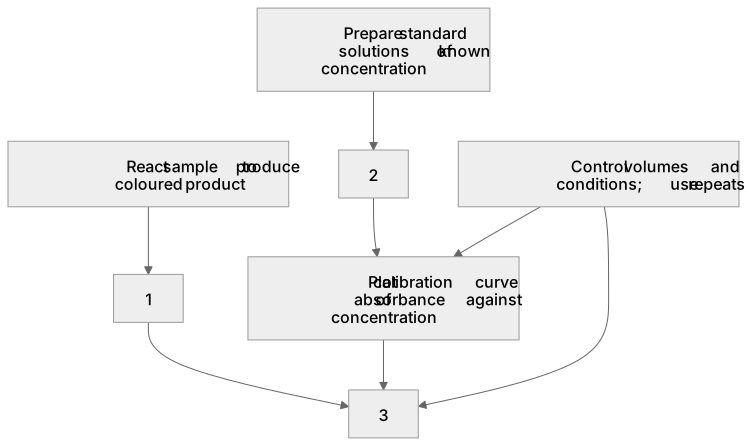
Some boxes have lost their names. Pick the right name for each number.
1Box 1
2Box 2
3Box 3
There is more to this lesson
The full lesson goes on to check your understanding and help you earn the marks. Create a free account to carry on, with your progress saved.
A week of Premium from your first lesson · Then the free plan continues · No card, no charge
Test your understanding of Biological molecules: (r) quantitative methods to determine the concentration of a chemical substance in a solution
Active recall beats re-reading. Take an instant quiz now to test what you’ve learned and lock it into long-term memory.
A week of Premium from your first lesson · Then the free plan continues · No card, no charge