OCR · A-Level · Biology
Course version: H420 · Version from Sept 2025
(g) the main stages of meiosis
Full specification wording
Cell division, cell diversity and cellular organisation: (g) the main stages of meiosis
Meiosis has two divisions after one round of DNA replication.
Checked against the OCR H420 specification (opens in a new tab) on .
- Point 7 of 13
- 4 key terms
Study notes
From the checked teaching notes for this specification point.
The idea
Meiosis has two divisions after one round of DNA replication. In prophase I homologous chromosomes pair as bivalents and crossing over occurs at chiasmata. In metaphase I bivalents line up on the equator and independent assortment occurs. In anaphase I homologous chromosomes separate to opposite poles. Telophase I and cytokinesis give two haploid cells. In prophase II the nuclear envelope breaks down; in metaphase II chromosomes line up singly on the equator; in anaphase II sister chromatids separate; telophase II and cytokinesis give four haploid cells. Each product is genetically different.
What earns the marks
- Prophase I: homologous chromosomes pair as bivalents and crossing over occurs at chiasmata.
- Metaphase I: bivalents line up on the equator and independent assortment of homologues occurs.
- Anaphase I: homologous chromosomes separate to opposite poles; telophase I and cytokinesis give two haploid cells.
- Metaphase II: chromosomes line up singly on the equator; anaphase II separates sister chromatids.
- Telophase II and cytokinesis produce four haploid cells that are genetically different.
Common mistakes and how to put them right
Confusing the two divisions.
Put it right: Is that homologues separate in anaphase I and sister chromatids separate in anaphase II.
Placing crossing over in the wrong stage.
Put it right: Is that it occurs in prophase I at chiasmata.
Saying four identical cells result.
Put it right: Is that four haploid cells form and they are genetically different.
Exam tips
- Use the division number (I or II) with each stage name so the sequence is unambiguous.
- State what separates at each anaphase: homologues in anaphase I, sister chromatids in anaphase II.
- Track the chromosome number through the stages to show where the halving happens.
Try the lesson
The start of the Cell division, cell diversity and cellular organisation: (g) the main stages of meiosis lesson, made from checked teaching notes for this specification point.
Have a go first
During which stage of meiosis do homologous chromosomes separate and move to opposite poles of the cell?
Listen
Meiosis has two divisions after one round of DNA replication. In prophase I homologous chromosomes pair as bivalents and crossing over occurs at chiasmata. In metaphase I bivalents line up on the equator and independent assortment occurs. In anaphase I homologous chromosomes separate to opposite poles. Telophase I and cytokinesis give two haploid cells. In prophase II the nuclear envelope breaks down; in metaphase II chromosomes line up singly on the equator; in anaphase II sister chromatids separate; telophase II and cytokinesis give four haploid cells. Each product is genetically different. A strong answer earns marks for these points. Prophase I: homologous chromosomes pair as bivalents and crossing over occurs at chiasmata. Metaphase I: bivalents line up on the equator and independent assortment of homologues occurs. Anaphase I: homologous chromosomes separate to opposite poles; telophase I and cytokinesis give two haploid cells. Metaphase II: chromosomes line up singly on the equator; anaphase II separates sister chromatids. A common slip: Confusing the two divisions. Instead, is that homologues separate in anaphase I and sister chromatids separate in anaphase II. Exam tip: Use the division number (I or II) with each stage name so the sequence is unambiguous.
See it
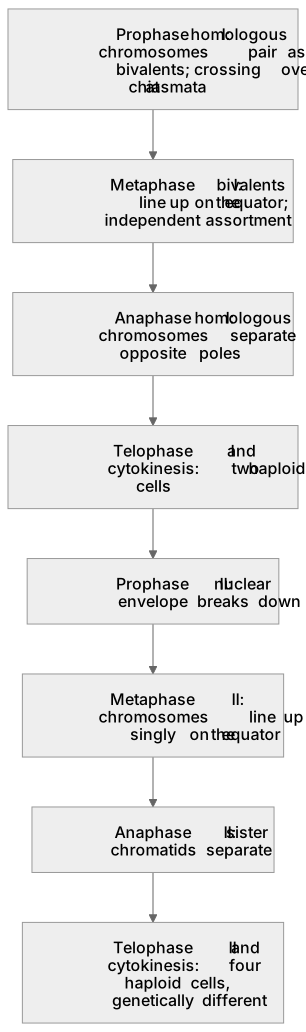
Put it in order
Put these steps in the order they happen.
- 1. Prophase II: nuclear envelope breaks down
- 2. Telophase II and cytokinesis: four haploid cells, genetically different
- 3. Metaphase II: chromosomes line up singly on the equator
- 4. Prophase I: homologous chromosomes pair as bivalents; crossing over at chiasmata
- 5. Metaphase I: bivalents line up on the equator; independent assortment
- 6. Anaphase II: sister chromatids separate
- 7. Anaphase I: homologous chromosomes separate to opposite poles
- 8. Telophase I and cytokinesis: two haploid cells
Key words
Say what each word means before you turn the card.
Two divisions after one replication
Try answering aloud or in your head before turning the card.
Bivalents and chiasmata
Try answering aloud or in your head before turning the card.
Independent assortment
Try answering aloud or in your head before turning the card.
Separation of homologues then chromatids
Try answering aloud or in your head before turning the card.
See every definition
- Two divisions after one replication
- Meiosis has two divisions after one round of DNA replication, giving four haploid cells.
- Bivalents and chiasmata
- In prophase I homologous chromosomes pair as bivalents and crossing over occurs at chiasmata.
- Independent assortment
- In metaphase I bivalents line up on the equator and independent assortment of homologues occurs.
- Separation of homologues then chromatids
- Homologous chromosomes separate in anaphase I and sister chromatids separate in anaphase II.
Label the diagram
Some boxes have lost their names. Pick the right name for each number.
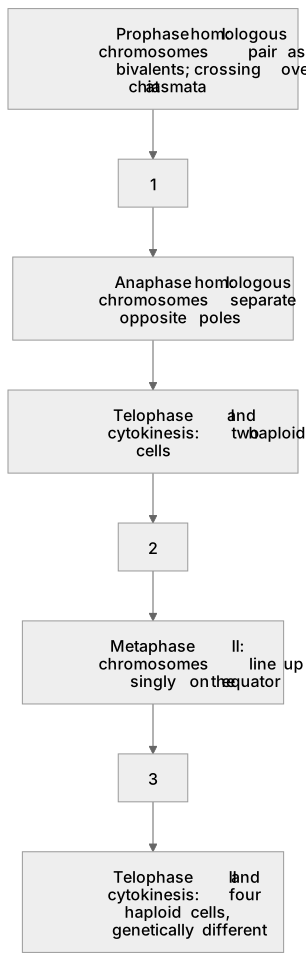
1Box 1
2Box 2
3Box 3
There is more to this lesson
The full lesson goes on to check your understanding and help you earn the marks. Create a free account to carry on, with your progress saved.
A week of Premium from your first lesson · Then the free plan continues · No card, no charge
Test your understanding of Cell division, cell diversity and cellular organisation: (g) the main stages of meiosis
Active recall beats re-reading. Take an instant quiz now to test what you’ve learned and lock it into long-term memory.
A week of Premium from your first lesson · Then the free plan continues · No card, no charge