OCR · A-Level · Biology
Course version: H420 · Version from Sept 2025
(h) how cells of multicellular organisms are specialised for particular…
Full specification wording
Cell division, cell diversity and cellular organisation: (h) how cells of multicellular organisms are specialised for particular functions
Multicellular organisms build many cell types from one fertilised egg.
Checked against the OCR H420 specification (opens in a new tab) on .
- Point 8 of 13
- 4 key terms
Study notes
From the checked teaching notes for this specification point.
The idea
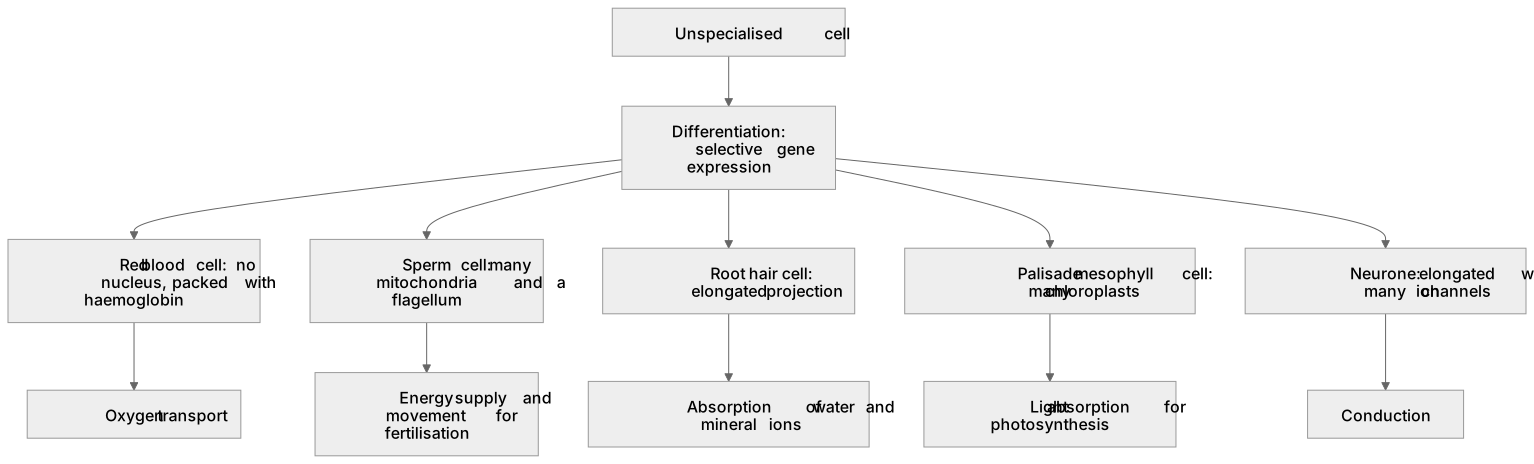
Multicellular organisms build many cell types from one fertilised egg. Specialisation means a cell becomes adapted, in shape, organelle content and membrane features, to carry out one function efficiently. Differentiation is the process producing these adaptations, usually through selective gene expression rather than loss of genes. Learn to link structure to function: a red blood cell loses its nucleus and packs haemoglobin for oxygen transport; a sperm cell keeps many mitochondria and a flagellum for motility; a root hair cell extends a long projection to increase surface area for water and mineral uptake; a palisade mesophyll cell holds many chloroplasts near the leaf surface for photosynthesis; a neurone is elongated with many ion channels for conduction.
What earns the marks
- Specialisation is an adaptation of cell structure, including shape, organelle number and membrane features, that suits a particular function.
- Differentiation is the process by which unspecialised cells develop these adaptations, typically through selective gene expression.
- Red blood cells lose their nucleus and are packed with haemoglobin, increasing capacity for oxygen transport.
- Sperm cells retain many mitochondria and a flagellum, supporting the energy supply and movement needed for fertilisation.
- Root hair cells have an elongated projection that increases surface area for absorption of water and mineral ions.
- Palisade mesophyll cells contain many chloroplasts positioned to absorb light for photosynthesis.
- A correct option must link the named structural feature directly to the function stated in the question stem.
Common mistakes and how to put them right
Assuming specialised cells lose genes they no longer use.
Put it right: They generally retain the full genome and express different genes selectively.
Choosing an option that names a real adaptation but does not serve the function asked about.
Put it right: Check the feature against the specific function in the stem.
Treating all cells in an organism as identical.
Put it right: Recognise that differentiation produces many distinct cell types with different structures.
Exam tips
- Read the stem to identify the exact cell and function before looking at the options.
- Eliminate options where the structural feature cannot plausibly support the stated function.
- For each remaining option, state the structure-to-function link in one sentence to confirm it holds.
Try the lesson
The start of the Cell division, cell diversity and cellular organisation: (h) how cells of multicellular organisms are specialised for particular functions lesson, made from checked teaching notes for this specification point.
Have a go first
A mature red blood cell loses its nucleus during development. Which feature of this cell most directly increases the amount of oxygen it can carry?
Listen
Multicellular organisms build many cell types from one fertilised egg. Specialisation means a cell becomes adapted, in shape, organelle content and membrane features, to carry out one function efficiently. Differentiation is the process producing these adaptations, usually through selective gene expression rather than loss of genes. Learn to link structure to function: a red blood cell loses its nucleus and packs haemoglobin for oxygen transport; a sperm cell keeps many mitochondria and a flagellum for motility; a root hair cell extends a long projection to increase surface area for water and mineral uptake; a palisade mesophyll cell holds many chloroplasts near the leaf surface for photosynthesis; a neurone is elongated with many ion channels for conduction. A strong answer earns marks for these points. Specialisation is an adaptation of cell structure, including shape, organelle number and membrane features, that suits a particular function. Differentiation is the process by which unspecialised cells develop these adaptations, typically through selective gene expression. Red blood cells lose their nucleus and are packed with haemoglobin, increasing capacity for oxygen transport. Sperm cells retain many mitochondria and a flagellum, supporting the energy supply and movement needed for fertilisation. A common slip: Assuming specialised cells lose genes they no longer use. Instead, they generally retain the full genome and express different genes selectively. Exam tip: Read the stem to identify the exact cell and function before looking at the options.
See it
Key words
Say what each word means before you turn the card.
Specialisation
Try answering aloud or in your head before turning the card.
Differentiation
Try answering aloud or in your head before turning the card.
Selective gene expression
Try answering aloud or in your head before turning the card.
Structure related to function
Try answering aloud or in your head before turning the card.
See every definition
- Specialisation
- An adaptation of cell structure, including shape, organelle number and membrane features, that suits a particular function.
- Differentiation
- The process by which unspecialised cells develop these adaptations, typically through selective gene expression.
- Selective gene expression
- The means by which differentiation usually produces adaptations, rather than loss of genes.
- Structure related to function
- Linking a named structural feature directly to the function stated in the question stem.
Label the diagram
Some boxes have lost their names. Pick the right name for each number.
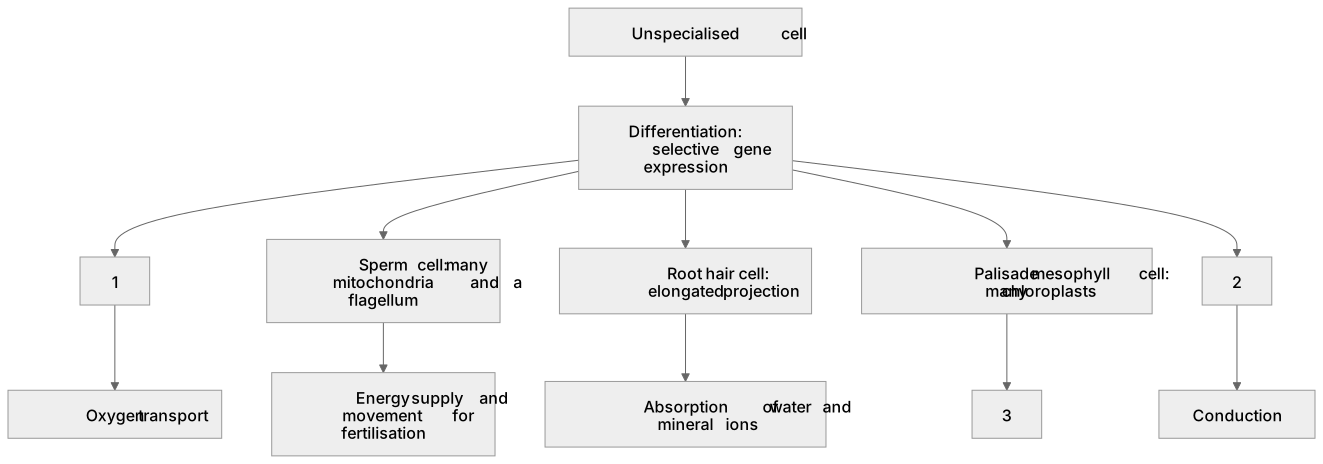
1Box 1
2Box 2
3Box 3
There is more to this lesson
The full lesson goes on to check your understanding and help you earn the marks. Create a free account to carry on, with your progress saved.
A week of Premium from your first lesson · Then the free plan continues · No card, no charge
Test your understanding of Cell division, cell diversity and cellular organisation: (h) how cells of multicellular organisms are specialised for particular functions
Active recall beats re-reading. Take an instant quiz now to test what you’ve learned and lock it into long-term memory.
A week of Premium from your first lesson · Then the free plan continues · No card, no charge