OCR · A-Level · Biology
Course version: H420 · Version from Sept 2025
(j) the features and differentiation of stem cells
Full specification wording
Cell division, cell diversity and cellular organisation: (j) the features and differentiation of stem cells
Stem cells are unspecialised cells that can divide repeatedly and can differentiate into other cell types.
Checked against the OCR H420 specification (opens in a new tab) on .
- Point 10 of 13
- 4 key terms
Study notes
From the checked teaching notes for this specification point.
The idea
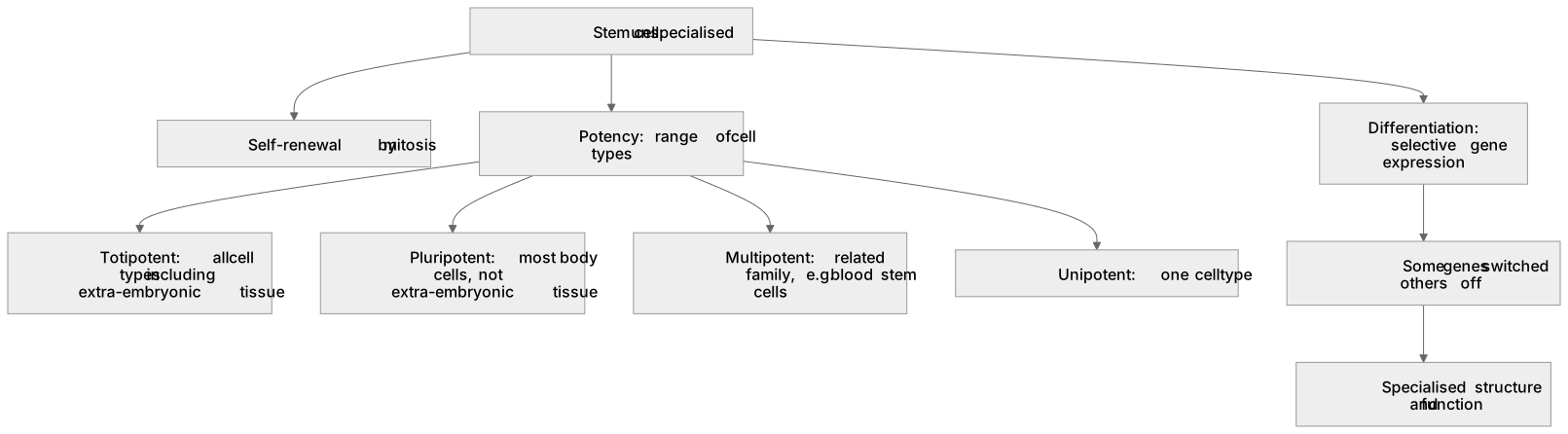
Stem cells are unspecialised cells that can divide repeatedly and can differentiate into other cell types. Their key features are the ability to self-renew by mitosis, so the stem cell population is maintained, and potency, the range of cell types they can become. Totipotent cells can form any cell type including extra-embryonic tissue; pluripotent cells can form most body cells but not extra-embryonic tissue; multipotent cells are restricted to a related family of cells, such as blood stem cells forming red and white blood cells; unipotent cells form one cell type. Differentiation occurs when a cell expresses particular genes, switching on some and off others, so it develops the structure and proteins suited to a specialised function. In multiple-choice questions, match the potency term to the described capability and link differentiation to selective gene expression.
What earns the marks
- Stem cells are unspecialised cells that can divide by mitosis to self-renew and can differentiate into specialised cells.
- Potency describes the range of cell types a stem cell can become: totipotent, pluripotent, multipotent and unipotent.
- Totipotent cells can form all cell types including extra-embryonic tissue; pluripotent cells form most body cells but not extra-embryonic tissue.
- Multipotent cells are limited to a related family of cells, for example blood stem cells producing red and white blood cells; unipotent cells form a single cell type.
- Differentiation involves selective gene expression: some genes are switched on and others off, giving the cell its specialised structure and function.
- Self-renewal maintains the stem cell population while some daughter cells differentiate.
Common mistakes and how to put them right
Treating pluripotent and totipotent as the same.
Put it right: Totipotent cells can also form extra-embryonic tissue, whereas pluripotent cells cannot.
Thinking differentiation involves loss of genes.
Put it right: The genes remain but are selectively expressed, with some switched on and others off.
Assuming all stem cells can become any cell type.
Put it right: Multipotent and unipotent cells are restricted in the cell types they can form.
Exam tips
- Match the potency word in the stem to its precise definition before choosing an option.
- Look for 'selective gene expression' or 'genes switched on and off' as the correct description of differentiation.
- Reject options that say differentiation removes genes or that stem cells cannot self-renew.
Try the lesson
The start of the Cell division, cell diversity and cellular organisation: (j) the features and differentiation of stem cells lesson, made from checked teaching notes for this specification point.
Have a go first
Which feature is characteristic of a stem cell rather than of a fully differentiated cell such as a mature neurone?
Listen
Stem cells are unspecialised cells that can divide repeatedly and can differentiate into other cell types. Their key features are the ability to self-renew by mitosis, so the stem cell population is maintained, and potency, the range of cell types they can become. Totipotent cells can form any cell type including extra-embryonic tissue; pluripotent cells can form most body cells but not extra-embryonic tissue; multipotent cells are restricted to a related family of cells, such as blood stem cells forming red and white blood cells; unipotent cells form one cell type. Differentiation occurs when a cell expresses particular genes, switching on some and off others, so it develops the structure and proteins suited to a specialised function. In multiple-choice questions, match the potency term to the described capability and link differentiation to selective gene expression. A strong answer earns marks for these points. Stem cells are unspecialised cells that can divide by mitosis to self-renew and can differentiate into specialised cells. Potency describes the range of cell types a stem cell can become: totipotent, pluripotent, multipotent and unipotent. Totipotent cells can form all cell types including extra-embryonic tissue; pluripotent cells form most body cells but not extra-embryonic tissue. Multipotent cells are limited to a related family of cells, for example blood stem cells producing red and white blood cells; unipotent cells form a single cell type. Exam tip: Match the potency word in the stem to its precise definition before choosing an option.
See it
Key words
Say what each word means before you turn the card.
Stem cell self-renewal
Try answering aloud or in your head before turning the card.
Levels of potency
Try answering aloud or in your head before turning the card.
Selective gene expression in differentiation
Try answering aloud or in your head before turning the card.
Specialised cell structure and function
Try answering aloud or in your head before turning the card.
See every definition
- Stem cell self-renewal
- Stem cells can divide by mitosis to self-renew, so the stem cell population is maintained while some daughter cells differentiate.
- Levels of potency
- The range of cell types a stem cell can become: totipotent, pluripotent, multipotent and unipotent.
- Selective gene expression in differentiation
- A cell expresses particular genes, switching some on and others off, so it develops the structure and proteins suited to a specialised function.
- Specialised cell structure and function
- The structure and proteins suited to a specialised function that a cell develops through selective gene expression.
Label the diagram
Some boxes have lost their names. Pick the right name for each number.
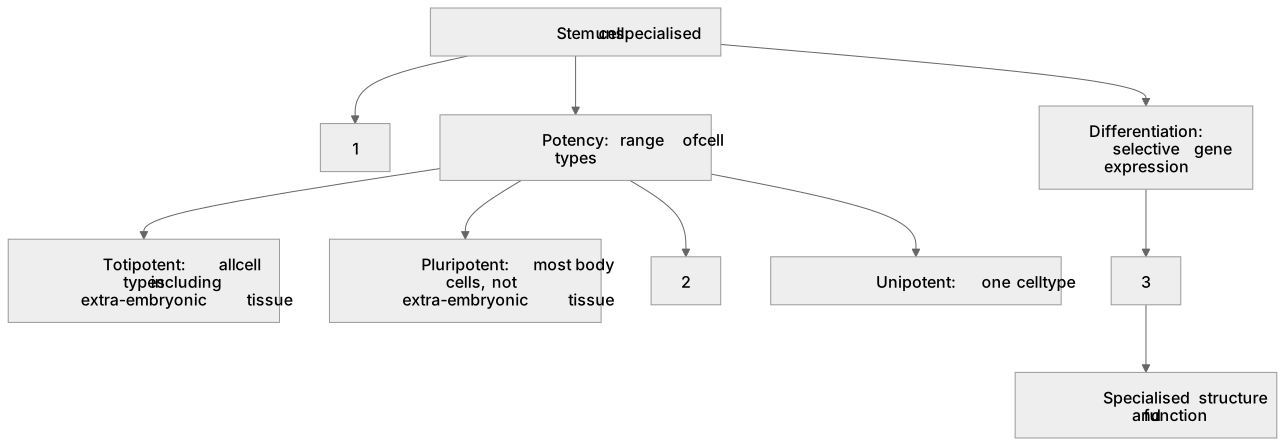
1Box 1
2Box 2
3Box 3
There is more to this lesson
The full lesson goes on to check your understanding and help you earn the marks. Create a free account to carry on, with your progress saved.
A week of Premium from your first lesson · Then the free plan continues · No card, no charge
Test your understanding of Cell division, cell diversity and cellular organisation: (j) the features and differentiation of stem cells
Active recall beats re-reading. Take an instant quiz now to test what you’ve learned and lock it into long-term memory.
A week of Premium from your first lesson · Then the free plan continues · No card, no charge