OCR · A-Level · Biology
Course version: H420 · Version from Sept 2025
(k) the production of erythrocytes and neutrophils as examples of…
Full specification wording
Cell division, cell diversity and cellular organisation: (k) the production of erythrocytes and neutrophils as examples of distinct, differentiated cells derived from a common stem cell in bone marrow
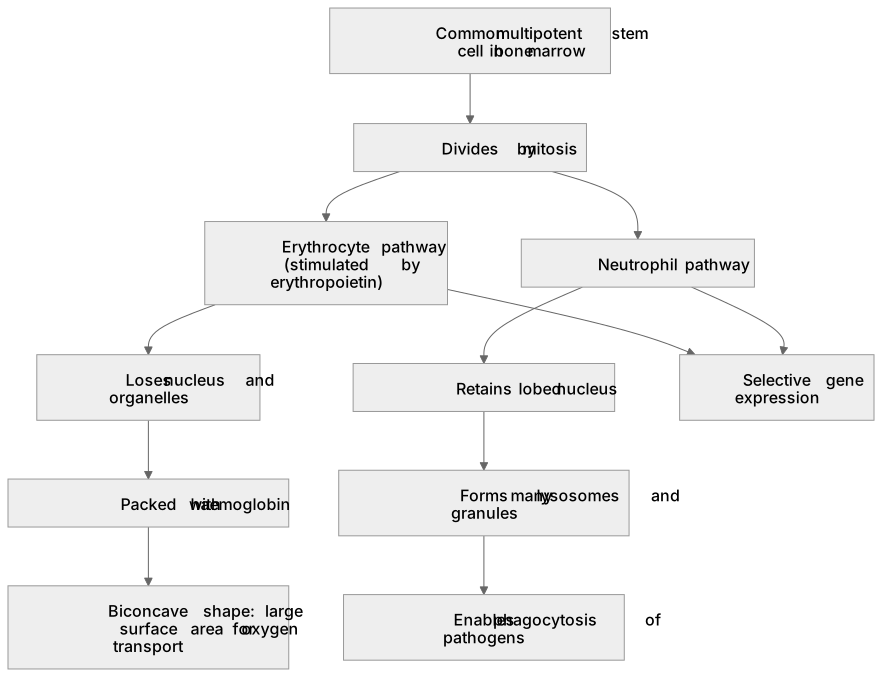
In bone marrow, multipotent stem cells divide by mitosis and differentiate along different pathways to produce distinct blood cells.
Checked against the OCR H420 specification (opens in a new tab) on .
- Point 11 of 13
- 4 key terms
Study notes
From the checked teaching notes for this specification point.
The idea
In bone marrow, multipotent stem cells divide by mitosis and differentiate along different pathways to produce distinct blood cells. Erythrocyte production (erythropoiesis) is stimulated by erythropoietin: the cell loses its nucleus and organelles, becomes packed with haemoglobin and adopts a biconcave shape, giving a large surface area for oxygen transport. Neutrophil production involves retaining a lobed nucleus and forming many lysosomes and granules, enabling phagocytosis of pathogens. Both cell types therefore arise from the same common stem cell but express different genes, producing different structures suited to different functions — a clear illustration of differentiation.
What earns the marks
- Erythrocytes and neutrophils both derive from a common multipotent stem cell in bone marrow.
- Erythrocytes lose their nucleus and organelles and become packed with haemoglobin.
- The biconcave shape of erythrocytes increases surface area for oxygen transport.
- Neutrophils retain a lobed nucleus and contain many lysosomes/granules for phagocytosis.
- Differentiation of the same stem cell along different pathways results from selective gene expression.
- Erythropoietin stimulates erythrocyte production in bone marrow.
Common mistakes and how to put them right
Claiming erythrocytes and neutrophils come from different stem cells.
Put it right: Both derive from a common stem cell in bone marrow.
Stating that erythrocytes keep their nucleus.
Put it right: Mature erythrocytes lose their nucleus and organelles.
Describing neutrophils as having no nucleus.
Put it right: Neutrophils retain a lobed nucleus and many granules.
Exam tips
- Link each cell's structure to its function (haemoglobin/biconcave shape for oxygen; granules for phagocytosis).
- Use the term 'common stem cell' to emphasise shared origin.
- Check MCQ options for swapped features between erythrocytes and neutrophils.
Try the lesson
The start of the Cell division, cell diversity and cellular organisation: (k) the production of erythrocytes and neutrophils as examples of distinct, differentiated cells derived from a common stem cell in bone marrow lesson, made from checked teaching notes for this specification point.
Have a go first
Erythrocytes and neutrophils are both produced in bone marrow. Which feature distinguishes a mature erythrocyte from a mature neutrophil?
Listen
In bone marrow, multipotent stem cells divide by mitosis and differentiate along different pathways to produce distinct blood cells. Erythrocyte production (erythropoiesis) is stimulated by erythropoietin: the cell loses its nucleus and organelles, becomes packed with haemoglobin and adopts a biconcave shape, giving a large surface area for oxygen transport. Neutrophil production involves retaining a lobed nucleus and forming many lysosomes and granules, enabling phagocytosis of pathogens. Both cell types therefore arise from the same common stem cell but express different genes, producing different structures suited to different functions — a clear illustration of differentiation. A strong answer earns marks for these points. Erythrocytes and neutrophils both derive from a common multipotent stem cell in bone marrow. Erythrocytes lose their nucleus and organelles and become packed with haemoglobin. The biconcave shape of erythrocytes increases surface area for oxygen transport. Neutrophils retain a lobed nucleus and contain many lysosomes/granules for phagocytosis. A common slip: Claiming erythrocytes and neutrophils come from different stem cells. Instead, both derive from a common stem cell in bone marrow. Exam tip: Link each cell's structure to its function (haemoglobin/biconcave shape for oxygen; granules for phagocytosis).
See it
Key words
Say what each word means before you turn the card.
Common stem cell origin
Try answering aloud or in your head before turning the card.
Erythrocyte structure and function
Try answering aloud or in your head before turning the card.
Neutrophil structure and function
Try answering aloud or in your head before turning the card.
Selective gene expression in differentiation
Try answering aloud or in your head before turning the card.
See every definition
- Common stem cell origin
- Erythrocytes and neutrophils both derive from a common multipotent stem cell in bone marrow.
- Erythrocyte structure and function
- The cell loses its nucleus and organelles, becomes packed with haemoglobin and adopts a biconcave shape, giving a large surface area for oxygen transport.
- Neutrophil structure and function
- Production involves retaining a lobed nucleus and forming many lysosomes and granules, enabling phagocytosis of pathogens.
- Selective gene expression in differentiation
- Both cell types arise from the same common stem cell but express different genes, producing different structures suited to different functions.
Label the diagram
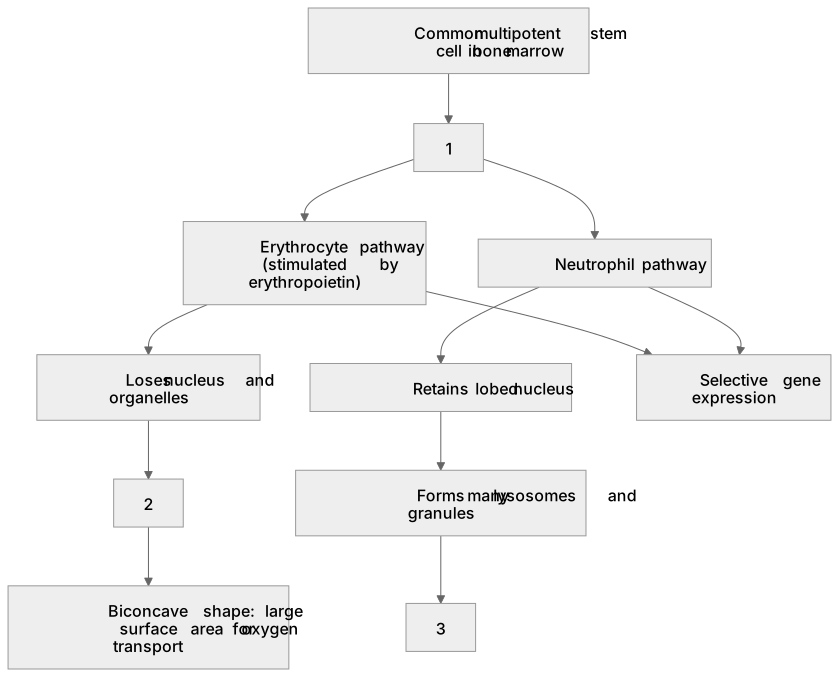
Some boxes have lost their names. Pick the right name for each number.
1Box 1
2Box 2
3Box 3
There is more to this lesson
The full lesson goes on to check your understanding and help you earn the marks. Create a free account to carry on, with your progress saved.
A week of Premium from your first lesson · Then the free plan continues · No card, no charge
Test your understanding of Cell division, cell diversity and cellular organisation: (k) the production of erythrocytes and neutrophils as examples of distinct, differentiated cells derived from a common stem cell in bone marrow
Active recall beats re-reading. Take an instant quiz now to test what you’ve learned and lock it into long-term memory.
A week of Premium from your first lesson · Then the free plan continues · No card, no charge