OCR · A-Level · Biology
Course version: H420 · Version from Sept 2025
(c) the genetic control of the development of body plans in different…
Full specification wording
Cellular control: (c) the genetic control of the development of body plans in different organisms
Body plans are the arrangement of body regions and structures along an organism's axes.
Checked against the OCR H420 specification (opens in a new tab) on .
- Point 3 of 4
- 4 key terms
Study notes
From the checked teaching notes for this specification point.
The idea
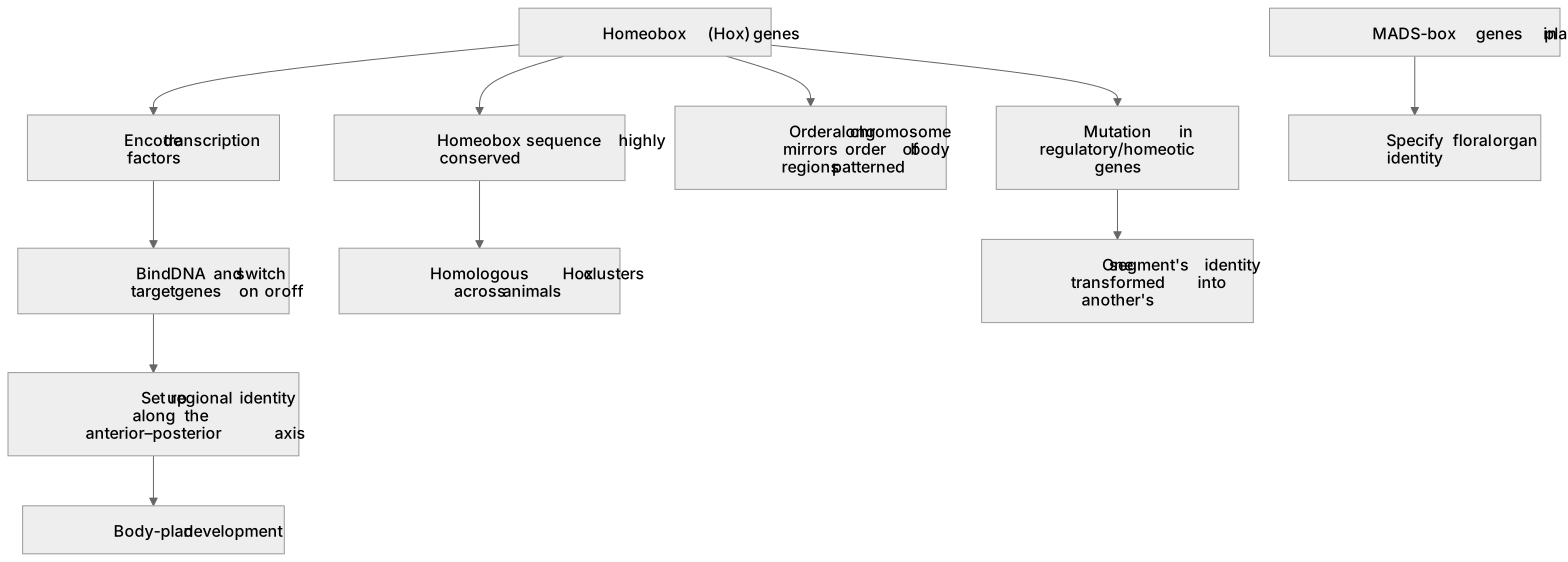
Body plans are the arrangement of body regions and structures along an organism's axes. Their development is controlled by genes that regulate where and when other genes are expressed. Homeobox (Hox) genes encode transcription factors that bind DNA and switch target genes on or off, setting up regional identity along the anterior–posterior axis. Because the same homeobox sequence is highly conserved, homologous Hox clusters are found across animals, and their order along the chromosome often mirrors the order of body regions they pattern. Mutations in these regulatory genes can transform one segment's identity into another's, showing that control is about regulating development rather than building structures directly. In plants, MADS-box genes help specify floral organ identity. Questions test whether you can link gene regulation to pattern formation across different organisms.
What earns the marks
- Homeobox (Hox) genes encode transcription factors that regulate the expression of other genes controlling body-plan development.
- Hox genes are highly conserved across different organisms, so homologous sequences are found in many animal groups.
- The order of Hox genes along the chromosome often corresponds to the order of the body regions they pattern along the axis.
- Mutations in regulatory/homeotic genes can alter segment identity, demonstrating genetic control of body-plan development.
- Gene regulation (switching target genes on or off) underlies pattern formation rather than genes directly building structures.
- MADS-box genes in plants specify floral organ identity, showing genetic control of body plans in different organisms.
Common mistakes and how to put them right
Thinking Hox genes build body parts directly.
Put it right by explaining they encode transcription factors that regulate other genes.
Assuming body-plan genes are unique to each species.
Put it right by noting the homeobox sequence is highly conserved across organisms.
Confusing a homeotic mutation with a simple loss of a structure.
Put it right by explaining it can change one segment's identity into another's.
Exam tips
- Read the stem carefully to identify whether it asks about gene identity, gene regulation or the consequence of mutation.
- Eliminate options that claim Hox genes directly construct structures; regulation of target genes is the key idea.
- Link any option about conservation or chromosomal order to the idea of controlling body-plan development across organisms.
Try the lesson
The start of the Cellular control: (c) the genetic control of the development of body plans in different organisms lesson, made from checked teaching notes for this specification point.
Have a go first
What is the role of homeobox (Hox) genes in the development of an organism's body plan?
Listen
Body plans are the arrangement of body regions and structures along an organism's axes. Their development is controlled by genes that regulate where and when other genes are expressed. Homeobox (Hox) genes encode transcription factors that bind DNA and switch target genes on or off, setting up regional identity along the anterior–posterior axis. Because the same homeobox sequence is highly conserved, homologous Hox clusters are found across animals, and their order along the chromosome often mirrors the order of body regions they pattern. Mutations in these regulatory genes can transform one segment's identity into another's, showing that control is about regulating development rather than building structures directly. In plants, MADS-box genes help specify floral organ identity. Questions test whether you can link gene regulation to pattern formation across different organisms. A strong answer earns marks for these points. Homeobox (Hox) genes encode transcription factors that regulate the expression of other genes controlling body-plan development. Hox genes are highly conserved across different organisms, so homologous sequences are found in many animal groups. The order of Hox genes along the chromosome often corresponds to the order of the body regions they pattern along the axis. Mutations in regulatory/homeotic genes can alter segment identity, demonstrating genetic control of body-plan development. A common slip: Thinking Hox genes build body parts directly. Instead, explaining they encode transcription factors that regulate other genes. Exam tip: Read the stem carefully to identify whether it asks about gene identity, gene regulation or the consequence of mutation.
See it
Key words
Say what each word means before you turn the card.
Homeobox (Hox) genes
Try answering aloud or in your head before turning the card.
Transcription factors
Try answering aloud or in your head before turning the card.
Conservation
Try answering aloud or in your head before turning the card.
Pattern formation
Try answering aloud or in your head before turning the card.
See every definition
- Homeobox (Hox) genes
- Genes that encode transcription factors which bind DNA and switch target genes on or off, setting up regional identity along the anterior–posterior axis.
- Transcription factors
- Proteins encoded by homeobox genes that bind DNA and switch target genes on or off.
- Conservation
- The same homeobox sequence is highly conserved, so homologous Hox clusters are found across animals.
- Pattern formation
- Underlying process in which gene regulation, switching target genes on or off, controls where and when other genes are expressed.
Label the diagram
Some boxes have lost their names. Pick the right name for each number.
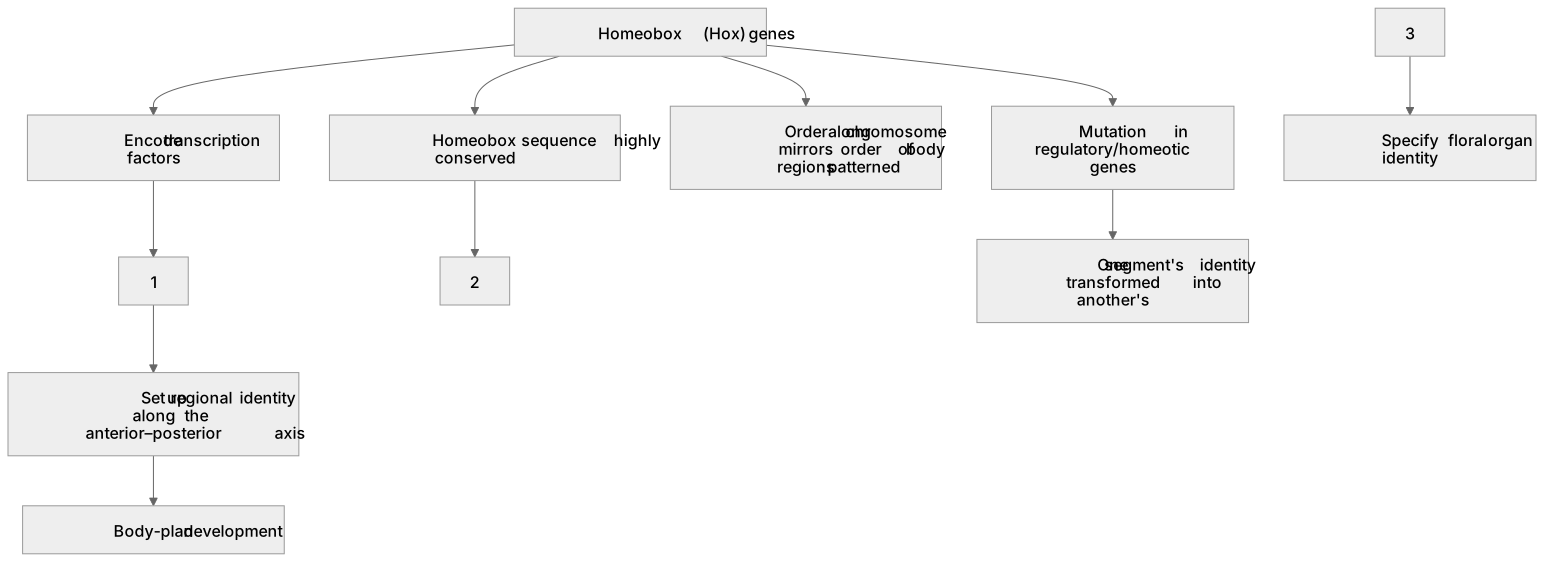
1Box 1
2Box 2
3Box 3
There is more to this lesson
The full lesson goes on to check your understanding and help you earn the marks. Create a free account to carry on, with your progress saved.
A week of Premium from your first lesson · Then the free plan continues · No card, no charge
Test your understanding of Cellular control: (c) the genetic control of the development of body plans in different organisms
Active recall beats re-reading. Take an instant quiz now to test what you’ve learned and lock it into long-term memory.
A week of Premium from your first lesson · Then the free plan continues · No card, no charge