OCR · A-Level · Biology
Course version: H420 · Version from Sept 2025
(d) the importance of mitosis and apoptosis as mechanisms controlling the…
Full specification wording
Cellular control: (d) the importance of mitosis and apoptosis as mechanisms controlling the development of body form.
Body form arises because cells divide and die in controlled patterns.
Checked against the OCR H420 specification (opens in a new tab) on .
- Point 4 of 4
- 4 key terms
Study notes
From the checked teaching notes for this specification point.
The idea
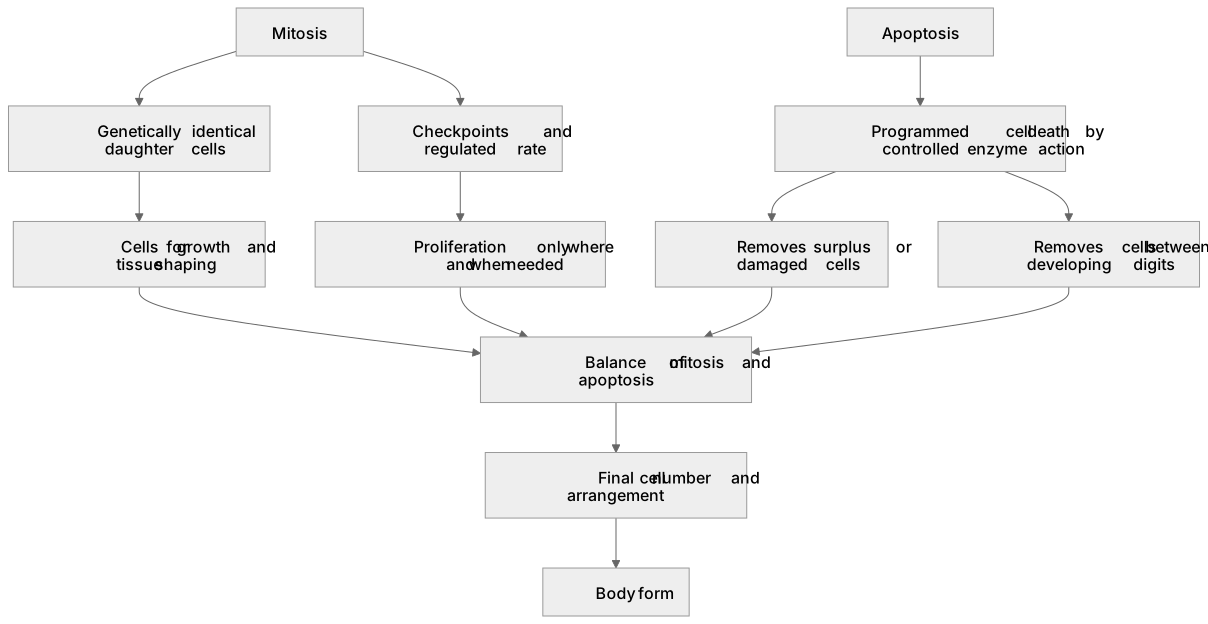
Body form arises because cells divide and die in controlled patterns. Mitosis produces genetically identical daughter cells, so it supplies the new cells needed for growth and for shaping tissues; its checkpoints and controlled rate prevent uncontrolled proliferation. Apoptosis is programmed cell death: enzymes dismantle the cell in a regulated sequence, removing surplus or damaged cells without inflammation. Together they sculpt structures — for example, separation of digits in a developing limb involves apoptosis of cells between the digits, while mitosis builds the limb bud. The balance between division and death determines final cell numbers and arrangement, so loss of control of either mechanism alters body form.
What earns the marks
- Mitosis produces genetically identical daughter cells, providing cells for growth and tissue shaping.
- Mitosis is controlled by checkpoints and regulated rates, so proliferation occurs only where and when needed.
- Apoptosis is programmed cell death carried out by controlled enzyme action, removing surplus or damaged cells.
- Apoptosis shapes structures, for example removing cells between developing digits so they separate.
- The balance between mitosis and apoptosis determines final cell number and arrangement, hence body form.
- Failure of control of either mechanism leads to abnormal development or uncontrolled cell division.
Common mistakes and how to put them right
Treating apoptosis as accidental cell damage or necrosis.
Put it right: Apoptosis is a regulated, programmed sequence of events.
Assuming mitosis alone determines body form.
Put it right: Apoptosis also removes cells to sculpt structures.
Claiming mitosis produces genetically varied cells.
Put it right: Mitosis produces genetically identical daughter cells.
Exam tips
- Link each mechanism to a named developmental outcome rather than describing it in isolation.
- Use the phrase 'programmed cell death' and state that it is controlled when defining apoptosis.
- When asked about body form, explicitly compare the roles of division and death in determining cell number and arrangement.
Try the lesson
The start of the Cellular control: (d) the importance of mitosis and apoptosis as mechanisms controlling the development of body form. lesson, made from checked teaching notes for this specification point.
Have a go first
During the development of a vertebrate limb, which process increases the number of cells so that the limb bud can grow longer?
Listen
Body form arises because cells divide and die in controlled patterns. Mitosis produces genetically identical daughter cells, so it supplies the new cells needed for growth and for shaping tissues; its checkpoints and controlled rate prevent uncontrolled proliferation. Apoptosis is programmed cell death: enzymes dismantle the cell in a regulated sequence, removing surplus or damaged cells without inflammation. Together they sculpt structures — for example, separation of digits in a developing limb involves apoptosis of cells between the digits, while mitosis builds the limb bud. The balance between division and death determines final cell numbers and arrangement, so loss of control of either mechanism alters body form. A strong answer earns marks for these points. Mitosis produces genetically identical daughter cells, providing cells for growth and tissue shaping. Mitosis is controlled by checkpoints and regulated rates, so proliferation occurs only where and when needed. Apoptosis is programmed cell death carried out by controlled enzyme action, removing surplus or damaged cells. Apoptosis shapes structures, for example removing cells between developing digits so they separate. A common slip: Treating apoptosis as accidental cell damage or necrosis. Instead, apoptosis is a regulated, programmed sequence of events. Exam tip: Link each mechanism to a named developmental outcome rather than describing it in isolation.
See it
Key words
Say what each word means before you turn the card.
Control of cell division
Try answering aloud or in your head before turning the card.
Programmed cell death
Try answering aloud or in your head before turning the card.
Development of body form
Try answering aloud or in your head before turning the card.
Balance of cell gain and loss
Try answering aloud or in your head before turning the card.
See every definition
- Control of cell division
- Mitosis is controlled by checkpoints and regulated rates, so proliferation occurs only where and when needed.
- Programmed cell death
- Apoptosis is carried out by controlled enzyme action, removing surplus or damaged cells in a regulated sequence without inflammation.
- Development of body form
- Body form arises because cells divide and die in controlled patterns, with mitosis supplying new cells and apoptosis sculpting structures.
- Balance of cell gain and loss
- The balance between mitosis and apoptosis determines final cell number and arrangement, so loss of control of either mechanism alters body form.
Label the diagram
Some boxes have lost their names. Pick the right name for each number.
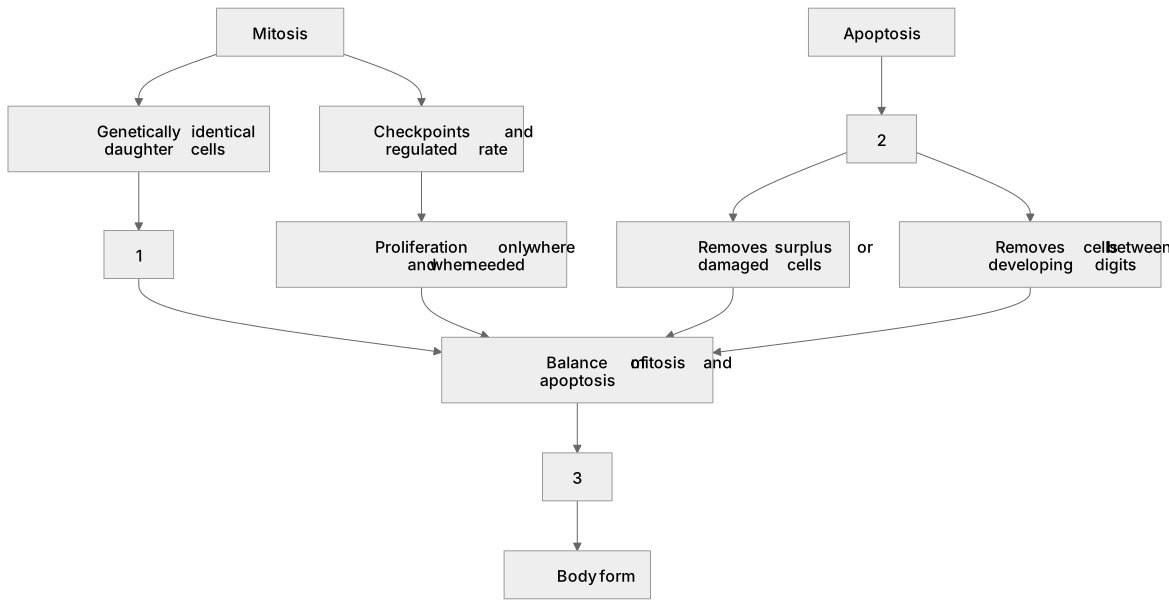
1Box 1
2Box 2
3Box 3
There is more to this lesson
The full lesson goes on to check your understanding and help you earn the marks. Create a free account to carry on, with your progress saved.
A week of Premium from your first lesson · Then the free plan continues · No card, no charge
Test your understanding of Cellular control: (d) the importance of mitosis and apoptosis as mechanisms controlling the development of body form.
Active recall beats re-reading. Take an instant quiz now to test what you’ve learned and lock it into long-term memory.
A week of Premium from your first lesson · Then the free plan continues · No card, no charge