OCR · A-Level · Biology
Course version: H420 · Version from Sept 2025
(a) (i) natural clones in plants and the production of natural clones for…
Full specification wording
Cloning and biotechnology: (a) (i) natural clones in plants and the production of natural clones for use in horticulture
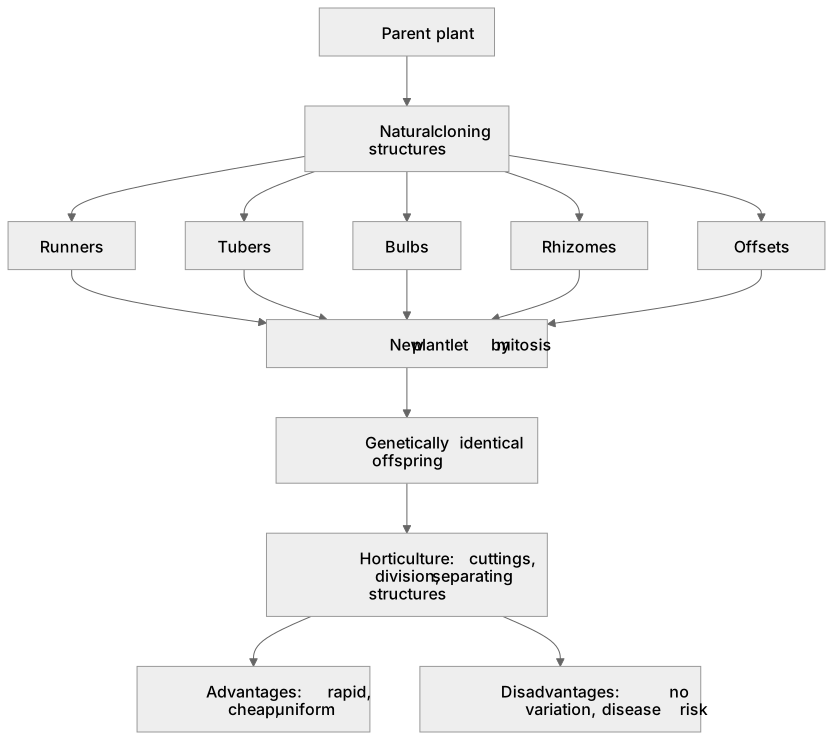
Natural cloning in plants is asexual reproduction producing genetically identical offspring from one parent.
Checked against the OCR H420 specification (opens in a new tab) on .
- Point 1 of 10
- 4 key terms
Study notes
From the checked teaching notes for this specification point.
The idea
Natural cloning in plants is asexual reproduction producing genetically identical offspring from one parent. Structures include runners (strawberry), tubers (potato), bulbs (onion), rhizomes (couch grass) and offsets. Each new plantlet arises by mitosis from the parent, so it carries the same alleles. Horticulturists exploit this by taking cuttings, dividing clumps, or separating runners and tubers to propagate desirable varieties cheaply and quickly while preserving the genotype. Advantages include speed, low cost and identical, uniform crops; disadvantages include no genetic variation, so a single pest or disease can devastate a whole clone, and the accumulation of pathogens over generations. Understanding natural cloning underpins vegetative propagation techniques used in commercial horticulture.
What earns the marks
- Defines a natural clone as genetically identical offspring produced asexually by mitosis from one parent plant.
- Names plant structures used in natural cloning, such as runners, tubers, bulbs or rhizomes.
- Explains that horticulturists propagate desirable varieties by cuttings, division or separating these structures.
- States advantages: rapid, cheap, uniform offspring preserving a favourable genotype.
- States disadvantages: lack of genetic variation and vulnerability to a single disease or pest.
Common mistakes and how to put them right
Confusing natural cloning with sexual reproduction.
Put it right: Natural clones arise asexually by mitosis, giving identical genotypes.
Assuming clones are always identical in appearance.
Put it right: Genotype is identical, but environment can alter phenotype.
Thinking horticultural propagation creates new varieties.
Put it right: It preserves an existing genotype rather than generating variation.
Ignoring disease risk: correction — genetic uniformity means one pathogen can affect the entire clone.
Exam tips
- Name a specific plant and its cloning structure to gain credit.
- Contrast natural cloning with sexual reproduction in terms of genetic variation.
- Give one advantage and one disadvantage of using clones in horticulture.
Try the lesson
The start of the Cloning and biotechnology: (a) (i) natural clones in plants and the production of natural clones for use in horticulture lesson, made from checked teaching notes for this specification point.
Have a go first
Which of the following is an example of a natural clone in plants?
Listen
Natural cloning in plants is asexual reproduction producing genetically identical offspring from one parent. Structures include runners (strawberry), tubers (potato), bulbs (onion), rhizomes (couch grass) and offsets. Each new plantlet arises by mitosis from the parent, so it carries the same alleles. Horticulturists exploit this by taking cuttings, dividing clumps, or separating runners and tubers to propagate desirable varieties cheaply and quickly while preserving the genotype. Advantages include speed, low cost and identical, uniform crops; disadvantages include no genetic variation, so a single pest or disease can devastate a whole clone, and the accumulation of pathogens over generations. Understanding natural cloning underpins vegetative propagation techniques used in commercial horticulture. A strong answer earns marks for these points. Defines a natural clone as genetically identical offspring produced asexually by mitosis from one parent plant. Names plant structures used in natural cloning, such as runners, tubers, bulbs or rhizomes. Explains that horticulturists propagate desirable varieties by cuttings, division or separating these structures. States advantages: rapid, cheap, uniform offspring preserving a favourable genotype. A common slip: Confusing natural cloning with sexual reproduction. Instead, natural clones arise asexually by mitosis, giving identical genotypes. Exam tip: Name a specific plant and its cloning structure to gain credit.
See it
Key words
Say what each word means before you turn the card.
Natural clones in plants
Try answering aloud or in your head before turning the card.
Plant cloning structures
Try answering aloud or in your head before turning the card.
Vegetative propagation in horticulture
Try answering aloud or in your head before turning the card.
Genetic uniformity and its consequences
Try answering aloud or in your head before turning the card.
See every definition
- Natural clones in plants
- Asexual reproduction producing genetically identical offspring from one parent, each new plantlet arising by mitosis so it carries the same alleles.
- Plant cloning structures
- Runners, tubers, bulbs, rhizomes and offsets from which new plantlets arise by mitosis from the parent.
- Vegetative propagation in horticulture
- Horticulturists take cuttings, divide clumps, or separate runners and tubers to propagate desirable varieties cheaply and quickly while preserving the genotype.
- Genetic uniformity and its consequences
- Identical, uniform crops with no genetic variation, so a single pest or disease can devastate a whole clone, and pathogens accumulate over generations.
Label the diagram
Some boxes have lost their names. Pick the right name for each number.
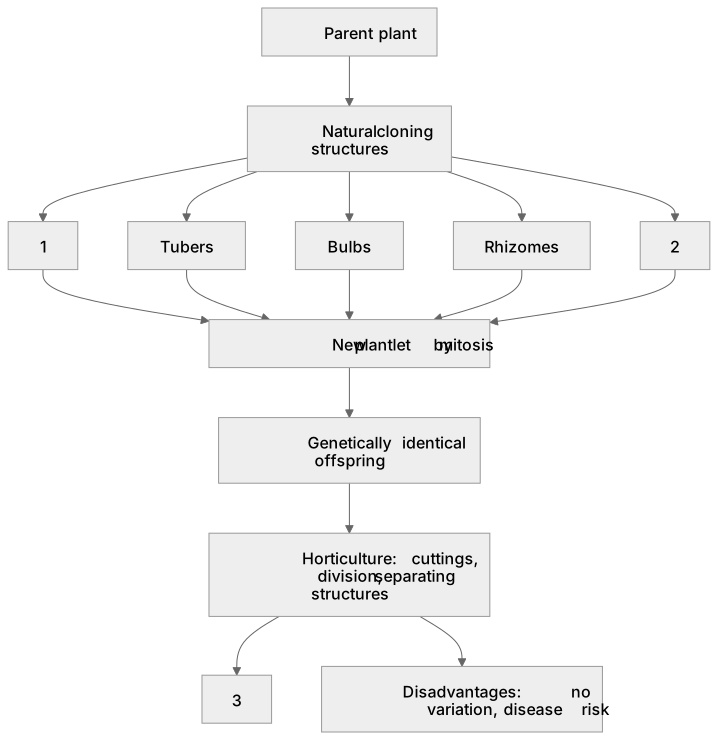
1Box 1
2Box 2
3Box 3
There is more to this lesson
The full lesson goes on to check your understanding and help you earn the marks. Create a free account to carry on, with your progress saved.
A week of Premium from your first lesson · Then the free plan continues · No card, no charge
Test your understanding of Cloning and biotechnology: (a) (i) natural clones in plants and the production of natural clones for use in horticulture
Active recall beats re-reading. Take an instant quiz now to test what you’ve learned and lock it into long-term memory.
A week of Premium from your first lesson · Then the free plan continues · No card, no charge