OCR · A-Level · Biology
Course version: H420 · Version from Sept 2025
(ii) how to take plant cuttings as an example of a simple cloning technique
Full specification wording
Cloning and biotechnology: (ii) how to take plant cuttings as an example of a simple cloning technique
Taking cuttings is a simple cloning technique because the new plant is genetically identical to its parent.
Checked against the OCR H420 specification (opens in a new tab) on .
- Point 2 of 10
- 4 key terms
Study notes
From the checked teaching notes for this specification point.
The idea
Taking cuttings is a simple cloning technique because the new plant is genetically identical to its parent. A shoot or stem cutting is removed from a healthy parent plant with a clean, sharp blade, cutting just below a node. Lower leaves are stripped so the stem can be inserted into a rooting medium such as compost or water. The cut end may be dipped in rooting powder containing auxin to encourage root formation. The cutting is kept warm and humid, often under a plastic bag or propagator, to reduce water loss by transpiration while roots develop. Once roots form, the cutting is potted on. Because no meiosis or fertilisation occurs, the offspring retains the parent's genotype, which is why cuttings are used to propagate desirable varieties quickly and reliably.
What earns the marks
- Cuttings are a cloning technique because the offspring is genetically identical to the parent plant, produced without meiosis or fertilisation.
- A shoot or stem cutting is taken from a healthy parent plant using a clean, sharp blade, cut just below a node.
- Lower leaves are removed and the cut end may be treated with rooting powder containing auxin to promote root growth.
- The cutting is kept warm and humid (for example under a plastic bag or in a propagator) to reduce transpiration while roots form, then potted on once rooted.
Common mistakes and how to put them right
Thinking cuttings involve fertilisation or seeds.
Put it right: Cuttings are vegetative, so no gamete fusion occurs and the offspring is a genetic clone.
Believing rooting powder supplies all nutrients.
Put it right: Rooting powder contains auxin to stimulate root formation, not a nutrient supply.
Assuming any part of the plant can be used without care.
Put it right: A healthy shoot cut just below a node with a clean blade gives the best chance of rooting.
Exam tips
- Link the technique explicitly to the definition of a clone: genetically identical offspring.
- Name the role of auxin in rooting powder rather than describing it vaguely as a 'growth hormone'.
- Explain why humidity is maintained — to reduce water loss by transpiration while roots are absent.
Try the lesson
The start of the Cloning and biotechnology: (ii) how to take plant cuttings as an example of a simple cloning technique lesson, made from checked teaching notes for this specification point.
Have a go first
Why does taking a stem cutting produce a new plant that is genetically identical to the parent plant?
Listen
Taking cuttings is a simple cloning technique because the new plant is genetically identical to its parent. A shoot or stem cutting is removed from a healthy parent plant with a clean, sharp blade, cutting just below a node. Lower leaves are stripped so the stem can be inserted into a rooting medium such as compost or water. The cut end may be dipped in rooting powder containing auxin to encourage root formation. The cutting is kept warm and humid, often under a plastic bag or propagator, to reduce water loss by transpiration while roots develop. Once roots form, the cutting is potted on. Because no meiosis or fertilisation occurs, the offspring retains the parent's genotype, which is why cuttings are used to propagate desirable varieties quickly and reliably. A strong answer earns marks for these points. Cuttings are a cloning technique because the offspring is genetically identical to the parent plant, produced without meiosis or fertilisation. A shoot or stem cutting is taken from a healthy parent plant using a clean, sharp blade, cut just below a node. Lower leaves are removed and the cut end may be treated with rooting powder containing auxin to promote root growth. The cutting is kept warm and humid (for example under a plastic bag or in a propagator) to reduce transpiration while roots form, then potted on once rooted. A common slip: Thinking cuttings involve fertilisation or seeds. Instead, cuttings are vegetative, so no gamete fusion occurs and the offspring is a genetic clone. Exam tip: Link the technique explicitly to the definition of a clone: genetically identical offspring.
See it
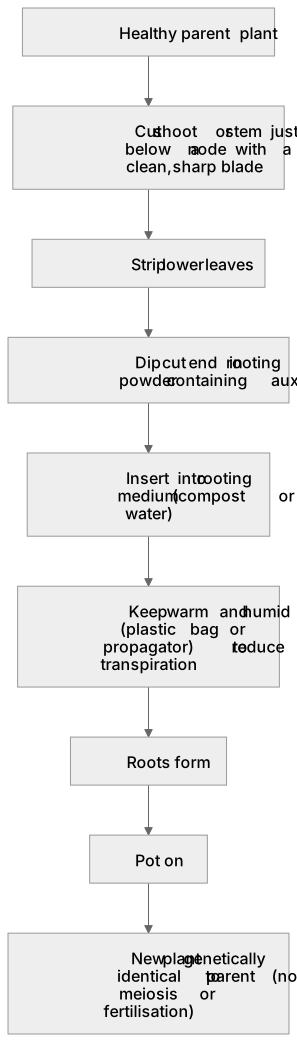
Key words
Say what each word means before you turn the card.
Cloning technique
Try answering aloud or in your head before turning the card.
Rooting powder
Try answering aloud or in your head before turning the card.
Humid conditions
Try answering aloud or in your head before turning the card.
Node
Try answering aloud or in your head before turning the card.
See every definition
- Cloning technique
- A method in which the new plant is genetically identical to its parent, produced without meiosis or fertilisation.
- Rooting powder
- A powder containing auxin that the cut end may be dipped in to encourage root formation.
- Humid conditions
- Warm and humid surroundings, often under a plastic bag or propagator, that reduce water loss by transpiration while roots develop.
- Node
- The point on a healthy parent plant just below which a shoot or stem cutting is taken with a clean, sharp blade.
Label the diagram
Some boxes have lost their names. Pick the right name for each number.
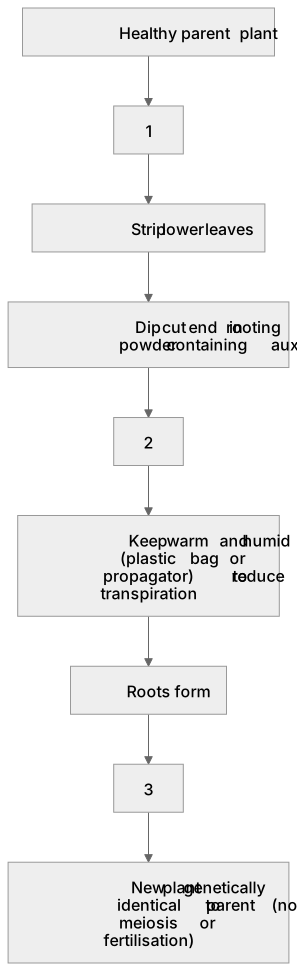
1Box 1
2Box 2
3Box 3
There is more to this lesson
The full lesson goes on to check your understanding and help you earn the marks. Create a free account to carry on, with your progress saved.
A week of Premium from your first lesson · Then the free plan continues · No card, no charge
Test your understanding of Cloning and biotechnology: (ii) how to take plant cuttings as an example of a simple cloning technique
Active recall beats re-reading. Take an instant quiz now to test what you’ve learned and lock it into long-term memory.
A week of Premium from your first lesson · Then the free plan continues · No card, no charge