OCR · A-Level · Biology
Course version: H420 · Version from Sept 2025
(b) (i) the production of artificial clones of plants by micropropagation…
Full specification wording
Cloning and biotechnology: (b) (i) the production of artificial clones of plants by micropropagation and tissue culture
Micropropagation uses tissue culture to produce many genetically identical plantlets from a small piece of tissue.
Checked against the OCR H420 specification (opens in a new tab) on .
- Point 3 of 10
- 4 key terms
Study notes
From the checked teaching notes for this specification point.
The idea
Micropropagation uses tissue culture to produce many genetically identical plantlets from a small piece of tissue. A small explant, such as a shoot tip or meristem, is taken from a healthy parent plant and sterilised to remove microorganisms. It is placed on a sterile nutrient agar containing sugars, minerals, vitamins and plant hormones. Auxin and cytokinin are adjusted to promote shoot formation, then roots. The cultures are kept sterile and under controlled light and temperature. Because the explant is grown by mitosis, all plantlets are clones of the parent. Meristem tissue is often used because it is usually virus-free, giving disease-free offspring. Micropropagation allows rapid, large-scale production of uniform plants, including rare or endangered species.
What earns the marks
- Micropropagation is tissue culture producing many genetically identical plantlets from a small explant by mitosis.
- The explant (often a shoot tip or meristem) is sterilised and placed on sterile nutrient agar containing sugars, minerals, vitamins and plant hormones.
- Auxin and cytokinin concentrations are adjusted to stimulate shoot formation and then root formation.
- Using meristem tissue helps produce virus-free plantlets, and the method allows rapid, large-scale production of uniform clones.
Common mistakes and how to put them right
Confusing micropropagation with cuttings.
Put it right: Micropropagation uses sterile tissue culture of an explant on nutrient agar, not a whole shoot placed in compost.
Thinking plantlets arise by meiosis.
Put it right: They arise by mitosis, so they are genetically identical clones.
Ignoring sterility: correction — sterilising the explant and using sterile agar prevents microbial contamination that would ruin the culture.
Exam tips
- State that plantlets are produced by mitosis to justify calling them clones.
- Name both auxin and cytokinin and explain that their balance controls shoot and root formation.
- Explain the advantage of using meristem tissue — it is usually free of virus.
Try the lesson
The start of the Cloning and biotechnology: (b) (i) the production of artificial clones of plants by micropropagation and tissue culture lesson, made from checked teaching notes for this specification point.
Have a go first
In micropropagation, what is the small piece of plant tissue used to start the culture called?
Listen
Micropropagation uses tissue culture to produce many genetically identical plantlets from a small piece of tissue. A small explant, such as a shoot tip or meristem, is taken from a healthy parent plant and sterilised to remove microorganisms. It is placed on a sterile nutrient agar containing sugars, minerals, vitamins and plant hormones. Auxin and cytokinin are adjusted to promote shoot formation, then roots. The cultures are kept sterile and under controlled light and temperature. Because the explant is grown by mitosis, all plantlets are clones of the parent. Meristem tissue is often used because it is usually virus-free, giving disease-free offspring. Micropropagation allows rapid, large-scale production of uniform plants, including rare or endangered species. A strong answer earns marks for these points. Micropropagation is tissue culture producing many genetically identical plantlets from a small explant by mitosis. The explant (often a shoot tip or meristem) is sterilised and placed on sterile nutrient agar containing sugars, minerals, vitamins and plant hormones. Auxin and cytokinin concentrations are adjusted to stimulate shoot formation and then root formation. Using meristem tissue helps produce virus-free plantlets, and the method allows rapid, large-scale production of uniform clones. A common slip: Confusing micropropagation with cuttings. Instead, micropropagation uses sterile tissue culture of an explant on nutrient agar, not a whole shoot placed in compost. Exam tip: State that plantlets are produced by mitosis to justify calling them clones.
See it
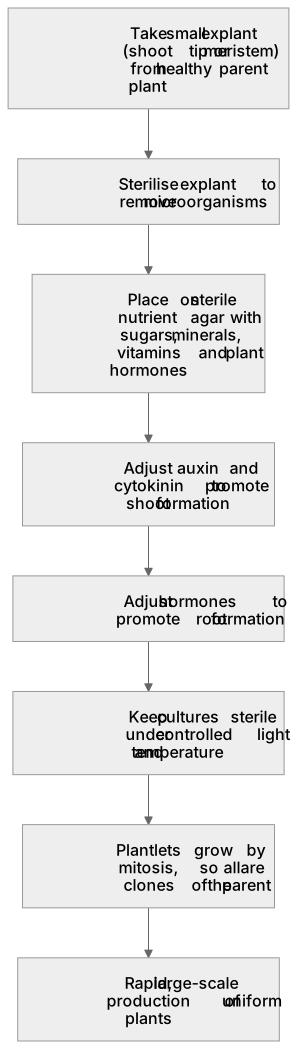
Put it in order
Put these steps in the order they happen.
- 1. Adjust hormones to promote root formation
- 2. Rapid, large-scale production of uniform plants
- 3. Keep cultures sterile under controlled light and temperature
- 4. Take small explant (shoot tip or meristem) from healthy parent plant
- 5. Sterilise explant to remove microorganisms
- 6. Plantlets grow by mitosis, so all are clones of the parent
- 7. Place on sterile nutrient agar with sugars, minerals, vitamins and plant hormones
- 8. Adjust auxin and cytokinin to promote shoot formation
Key words
Say what each word means before you turn the card.
Micropropagation
Try answering aloud or in your head before turning the card.
Role of plant hormones in differentiation
Try answering aloud or in your head before turning the card.
Sterile technique in culture
Try answering aloud or in your head before turning the card.
Advantages of cloning plants artificially
Try answering aloud or in your head before turning the card.
See every definition
- Micropropagation
- Tissue culture producing many genetically identical plantlets from a small explant by mitosis.
- Role of plant hormones in differentiation
- Auxin and cytokinin concentrations are adjusted to stimulate shoot formation and then root formation.
- Sterile technique in culture
- The explant is sterilised and placed on sterile nutrient agar to prevent microbial contamination that would ruin the culture.
- Advantages of cloning plants artificially
- Rapid, large-scale production of uniform plants, including rare or endangered species, and meristem tissue gives virus-free plantlets.
Label the diagram
Some boxes have lost their names. Pick the right name for each number.
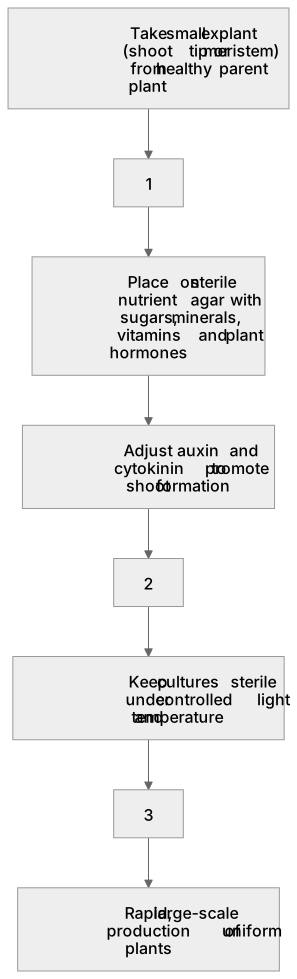
1Box 1
2Box 2
3Box 3
There is more to this lesson
The full lesson goes on to check your understanding and help you earn the marks. Create a free account to carry on, with your progress saved.
A week of Premium from your first lesson · Then the free plan continues · No card, no charge
Test your understanding of Cloning and biotechnology: (b) (i) the production of artificial clones of plants by micropropagation and tissue culture
Active recall beats re-reading. Take an instant quiz now to test what you’ve learned and lock it into long-term memory.
A week of Premium from your first lesson · Then the free plan continues · No card, no charge