OCR · A-Level · Biology
Course version: H420 · Version from Sept 2025
(g) (i) how to culture microorganisms effectively, using aseptic techniques
Full specification wording
Cloning and biotechnology: (g) (i) how to culture microorganisms effectively, using aseptic techniques
Culturing microorganisms means providing a suitable nutrient medium, the right temperature and oxygen availability so that a population grows predictably, while excluding unwanted contaminants.
Checked against the OCR H420 specification (opens in a new tab) on .
- Point 7 of 10
- 4 key terms
Study notes
From the checked teaching notes for this specification point.
The idea
Culturing microorganisms means providing a suitable nutrient medium, the right temperature and oxygen availability so that a population grows predictably, while excluding unwanted contaminants. Aseptic technique is the set of precautions that keeps the culture pure: sterilising apparatus and media before use, working close to a lit Bunsen flame so rising air carries contaminants away, flaming the neck of the vessel, using sterile loops and keeping lids on when not inoculating. Effectiveness also depends on choosing the medium, controlling temperature in an incubator and not opening plates unnecessarily.
What earns the marks
- Sterilise glassware, media and loops before use, for example in an autoclave or by flaming, so that contaminants are killed before inoculation.
- Work near a lit Bunsen flame because the upward convection current reduces the chance of airborne microorganisms landing in the vessel.
- Flame the neck of the culture vessel or bottle when opening and closing it to prevent entry of contaminants.
- Use a sterile inoculating loop and replace or re-sterilise it between transfers so that a pure culture is maintained.
- Keep lids or caps on vessels when not actively inoculating, and minimise the time a plate is open.
- Incubate at a controlled, appropriate temperature so that growth is effective and the culture is not exposed to unnecessary contamination.
Common mistakes and how to put them right
Thinking aseptic technique means killing all microorganisms in the finished culture.
Put it right: The aim is to exclude contaminants while allowing the desired microorganism to grow.
Believing the Bunsen flame sterilises the medium.
Put it right: The flame creates an upward air current and is used to flame loops and necks, not to treat the agar.
Assuming any clean-looking bench is sterile.
Put it right: Surfaces and equipment must be treated with a suitable disinfectant or sterilised, not simply wiped dry.
Exam tips
- Read each option and ask whether it directly reduces contamination or merely sounds hygienic.
- Link each aseptic step to its purpose, such as the convection current from the flame or the killing of contaminants by sterilisation.
- Eliminate options that describe leaving vessels open, reusing unsterilised loops or incubating without temperature control.
Try the lesson
The start of the Cloning and biotechnology: (g) (i) how to culture microorganisms effectively, using aseptic techniques lesson, made from checked teaching notes for this specification point.
Have a go first
Before transferring microorganisms to an agar plate, why is the inoculating loop passed through a flame?
Listen
Culturing microorganisms means providing a suitable nutrient medium, the right temperature and oxygen availability so that a population grows predictably, while excluding unwanted contaminants. Aseptic technique is the set of precautions that keeps the culture pure: sterilising apparatus and media before use, working close to a lit Bunsen flame so rising air carries contaminants away, flaming the neck of the vessel, using sterile loops and keeping lids on when not inoculating. Effectiveness also depends on choosing the medium, controlling temperature in an incubator and not opening plates unnecessarily. A strong answer earns marks for these points. Sterilise glassware, media and loops before use, for example in an autoclave or by flaming, so that contaminants are killed before inoculation. Work near a lit Bunsen flame because the upward convection current reduces the chance of airborne microorganisms landing in the vessel. Flame the neck of the culture vessel or bottle when opening and closing it to prevent entry of contaminants. Use a sterile inoculating loop and replace or re-sterilise it between transfers so that a pure culture is maintained. Exam tip: Read each option and ask whether it directly reduces contamination or merely sounds hygienic.
See it
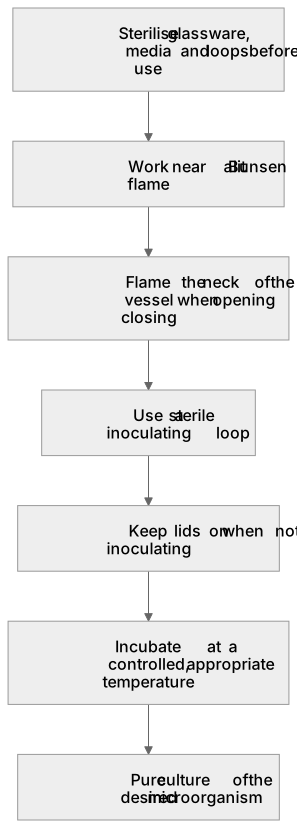
Put it in order
Put these steps in the order they happen.
- 1. Pure culture of the desired microorganism
- 2. Incubate at a controlled, appropriate temperature
- 3. Flame the neck of the vessel when opening and closing
- 4. Keep lids on when not inoculating
- 5. Sterilise glassware, media and loops before use
- 6. Work near a lit Bunsen flame
- 7. Use a sterile inoculating loop
Key words
Say what each word means before you turn the card.
Aseptic technique
Try answering aloud or in your head before turning the card.
Sterilisation
Try answering aloud or in your head before turning the card.
Bunsen flame
Try answering aloud or in your head before turning the card.
Controlled incubation
Try answering aloud or in your head before turning the card.
See every definition
- Aseptic technique
- The set of precautions that keeps a culture pure by excluding unwanted contaminants while allowing the desired microorganism to grow.
- Sterilisation
- Treating glassware, media and loops before use, for example in an autoclave or by flaming, so that contaminants are killed before inoculation.
- Bunsen flame
- A lit flame worked close to because its upward convection current reduces the chance of airborne microorganisms landing in the vessel.
- Controlled incubation
- Incubating at a controlled, appropriate temperature so that growth is effective and the culture is not exposed to unnecessary contamination.
Label the diagram
Some boxes have lost their names. Pick the right name for each number.
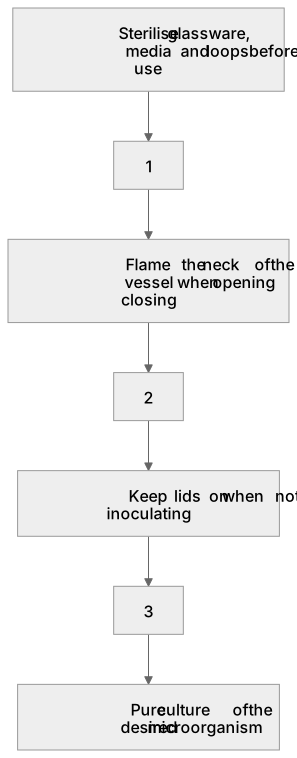
1Box 1
2Box 2
3Box 3
There is more to this lesson
The full lesson goes on to check your understanding and help you earn the marks. Create a free account to carry on, with your progress saved.
A week of Premium from your first lesson · Then the free plan continues · No card, no charge
Test your understanding of Cloning and biotechnology: (g) (i) how to culture microorganisms effectively, using aseptic techniques
Active recall beats re-reading. Take an instant quiz now to test what you’ve learned and lock it into long-term memory.
A week of Premium from your first lesson · Then the free plan continues · No card, no charge