OCR · A-Level · Biology
Course version: H420 · Version from Sept 2025
(ii) the importance of manipulating the growing conditions in batch and…
Full specification wording
Cloning and biotechnology: (ii) the importance of manipulating the growing conditions in batch and continuous fermentation in order to maximise the yield of product required
Fermentation uses microorganisms to make a product, and yield depends on controlling conditions such as temperature, pH, oxygen supply and nutrient concentration.
Checked against the OCR H420 specification (opens in a new tab) on .
- Point 8 of 10
- 3 key terms
Study notes
From the checked teaching notes for this specification point.
The idea
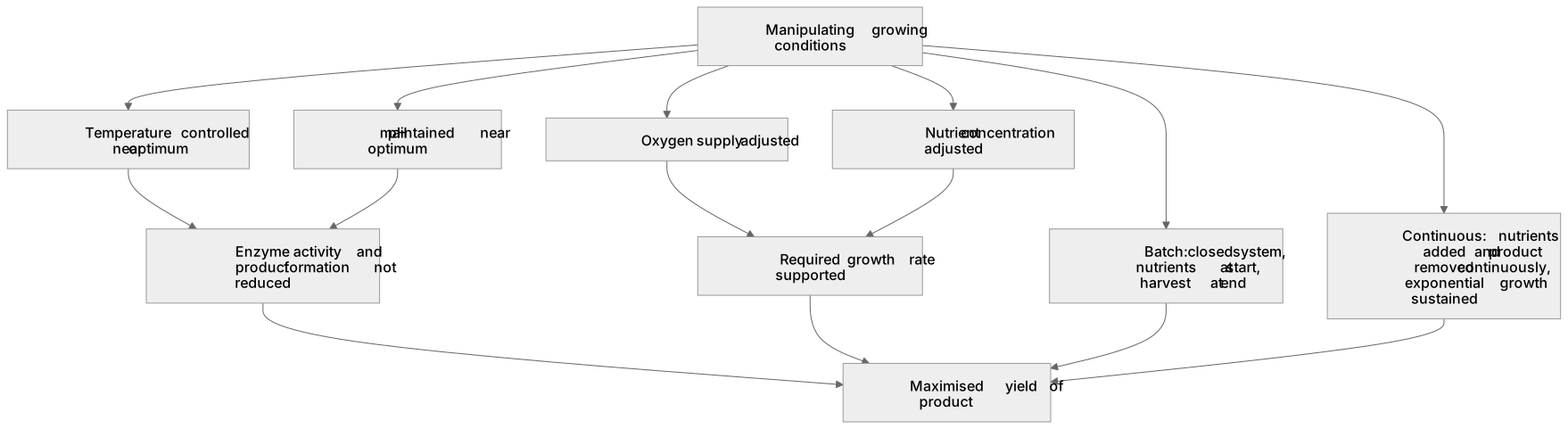
Fermentation uses microorganisms to make a product, and yield depends on controlling conditions such as temperature, pH, oxygen supply and nutrient concentration. In batch fermentation the culture is closed: nutrients are added at the start, the microorganism grows through lag, exponential and stationary phases, and the product is harvested at the end before the culture is emptied and restarted. In continuous fermentation nutrients are added and product removed continuously, keeping the culture in exponential growth so product forms steadily over a long period. Manipulating conditions matters because too high a temperature or wrong pH reduces enzyme activity and product formation, while oxygen and nutrient levels control growth rate. An MCQ may ask which change would raise yield in a given system.
What earns the marks
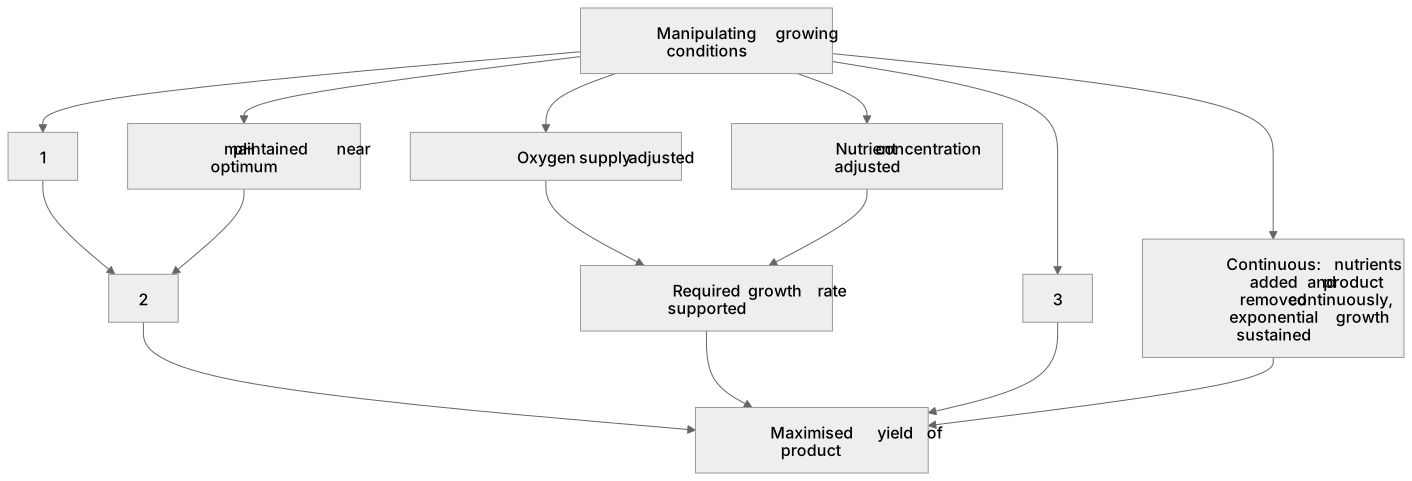
- Batch fermentation runs as a closed system: nutrients are provided at the start and the product is harvested at the end of the run.
- Continuous fermentation keeps the culture in exponential growth by continuously adding nutrients and removing product, giving sustained output.
- Temperature must be controlled because enzymes involved in product formation work best within an optimum range and are denatured above it.
- pH must be maintained near the optimum so that enzyme activity and therefore product yield are not reduced.
- Oxygen supply and nutrient concentration are adjusted to support the required growth rate and maximise formation of the desired product.
- Manipulating these conditions increases yield by keeping the microorganism growing efficiently rather than being limited by a depleted nutrient or a harmful condition.
Common mistakes and how to put them right
Confusing the two systems.
Put it right: Batch fermentation is closed with a single harvest, whereas continuous fermentation has continuous input and output.
Assuming higher temperature always increases yield.
Put it right: Above the optimum, enzymes denature and product formation falls.
Thinking continuous fermentation always gives a higher total yield regardless of conditions.
Put it right: Yield still depends on controlling temperature, pH, oxygen and nutrients.
Exam tips
- Identify whether the scenario describes a closed batch system or a continuous system before judging the effect of a change.
- Link each manipulated condition to its effect on enzyme activity or growth rate and hence on yield.
- Reject options that ignore an optimum, such as raising temperature indefinitely or removing all nutrients.
Try the lesson
The start of the Cloning and biotechnology: (ii) the importance of manipulating the growing conditions in batch and continuous fermentation in order to maximise the yield of product required lesson, made from checked teaching notes for this specification point.
Have a go first
In a continuous fermentation, which growing condition is adjusted to keep the microorganisms growing at a steady rate over a long period?
Listen
Fermentation uses microorganisms to make a product, and yield depends on controlling conditions such as temperature, pH, oxygen supply and nutrient concentration. In batch fermentation the culture is closed: nutrients are added at the start, the microorganism grows through lag, exponential and stationary phases, and the product is harvested at the end before the culture is emptied and restarted. In continuous fermentation nutrients are added and product removed continuously, keeping the culture in exponential growth so product forms steadily over a long period. Manipulating conditions matters because too high a temperature or wrong pH reduces enzyme activity and product formation, while oxygen and nutrient levels control growth rate. An MCQ may ask which change would raise yield in a given system. A strong answer earns marks for these points. Batch fermentation runs as a closed system: nutrients are provided at the start and the product is harvested at the end of the run. Continuous fermentation keeps the culture in exponential growth by continuously adding nutrients and removing product, giving sustained output. Temperature must be controlled because enzymes involved in product formation work best within an optimum range and are denatured above it. pH must be maintained near the optimum so that enzyme activity and therefore product yield are not reduced. Exam tip: Identify whether the scenario describes a closed batch system or a continuous system before judging the effect of a change.
See it
Key words
Say what each word means before you turn the card.
Batch versus continuous fermentation
Try answering aloud or in your head before turning the card.
Oxygen and nutrient supply in fermentation
Try answering aloud or in your head before turning the card.
Maximising product yield
Try answering aloud or in your head before turning the card.
See every definition
- Batch versus continuous fermentation
- In batch fermentation the culture is closed, with nutrients added at the start and product harvested at the end, whereas continuous fermentation adds nutrients and removes product continuously.
- Oxygen and nutrient supply in fermentation
- Oxygen supply and nutrient concentration are adjusted to support the required growth rate and maximise formation of the desired product.
- Maximising product yield
- Manipulating growing conditions keeps the microorganism growing efficiently rather than being limited by a depleted nutrient or a harmful condition, increasing the yield of product required.
Label the diagram
Some boxes have lost their names. Pick the right name for each number.
1Box 1
2Box 2
3Box 3
There is more to this lesson
The full lesson goes on to check your understanding and help you earn the marks. Create a free account to carry on, with your progress saved.
A week of Premium from your first lesson · Then the free plan continues · No card, no charge
Test your understanding of Cloning and biotechnology: (ii) the importance of manipulating the growing conditions in batch and continuous fermentation in order to maximise the yield of product required
Active recall beats re-reading. Take an instant quiz now to test what you’ve learned and lock it into long-term memory.
A week of Premium from your first lesson · Then the free plan continues · No card, no charge