OCR · A-Level · Biology
Course version: H420 · Version from Sept 2025
(c) plant defences against pathogens
Full specification wording
Communicable diseases, disease prevention and the immune system: (c) plant defences against pathogens
Plants defend against pathogens with physical and chemical barriers.
Checked against the OCR H420 specification (opens in a new tab) on .
- Point 3 of 14
- 4 key terms
Study notes
From the checked teaching notes for this specification point.
The idea
Plants defend against pathogens with physical and chemical barriers. Physical defences include the waxy cuticle, cellulose cell walls, bark, and stomatal closure or guard-cell responses that limit entry. Chemical defences include antimicrobial compounds such as tannins, alkaloids and terpenoids, plus enzymes and the oxidative burst. Some tissues respond to infection by producing callose to thicken walls and block spread, and by localised cell death (hypersensitive response) that isolates the pathogen. Teach learners to separate prevention of entry (barriers) from responses after entry (chemicals, callose, cell death), and to avoid importing animal immune ideas such as antibodies or phagocytes as plant defences. A useful example is the thickened cuticle and antimicrobial compounds of many leaves.
What earns the marks
- Names a physical plant defence (waxy cuticle, cellulose cell wall, bark, stomatal closure) and explains how it limits pathogen entry.
- Names a chemical plant defence (tannins, alkaloids, terpenoids, antimicrobial enzymes) and explains its role against pathogens.
- Explains callose deposition thickening cell walls to block pathogen spread.
- Explains the hypersensitive response as localised cell death that isolates the pathogen.
- Rejects animal immune features such as antibodies or phagocytes presented as plant defences.
Common mistakes and how to put them right
Describing antibodies as a plant defence.
Put it right: Plants rely on physical barriers and antimicrobial chemicals, not antibody-mediated immunity.
Treating the cuticle as a response to infection.
Put it right: The waxy cuticle is a pre-existing physical barrier.
Confusing callose with a chemical toxin.
Put it right: Callose is a polysaccharide deposited to thicken and block cell walls.
Assuming stomata cannot respond to pathogens.
Put it right: Stomatal closure is a recognised physical defence limiting entry.
Exam tips
- Sort each option into physical barrier, chemical defence or post-entry response before choosing.
- Eliminate options that name animal immune cells or antibodies, which do not apply to plants.
- Look for the mechanism in the option, not just the name of a substance, since a correct term with a wrong role is a distractor.
Try the lesson
The start of the Communicable diseases, disease prevention and the immune system: (c) plant defences against pathogens lesson, made from checked teaching notes for this specification point.
Have a go first
Which feature of a plant's surface acts as a physical barrier that prevents many pathogens from entering?
Listen
Plants defend against pathogens with physical and chemical barriers. Physical defences include the waxy cuticle, cellulose cell walls, bark, and stomatal closure or guard-cell responses that limit entry. Chemical defences include antimicrobial compounds such as tannins, alkaloids and terpenoids, plus enzymes and the oxidative burst. Some tissues respond to infection by producing callose to thicken walls and block spread, and by localised cell death (hypersensitive response) that isolates the pathogen. Teach learners to separate prevention of entry (barriers) from responses after entry (chemicals, callose, cell death), and to avoid importing animal immune ideas such as antibodies or phagocytes as plant defences. A useful example is the thickened cuticle and antimicrobial compounds of many leaves. A strong answer earns marks for these points. Names a physical plant defence (waxy cuticle, cellulose cell wall, bark, stomatal closure) and explains how it limits pathogen entry. Names a chemical plant defence (tannins, alkaloids, terpenoids, antimicrobial enzymes) and explains its role against pathogens. Explains callose deposition thickening cell walls to block pathogen spread. Explains the hypersensitive response as localised cell death that isolates the pathogen. A common slip: Describing antibodies as a plant defence. Instead, plants rely on physical barriers and antimicrobial chemicals, not antibody-mediated immunity. Exam tip: Sort each option into physical barrier, chemical defence or post-entry response before choosing.
See it

Key words
Say what each word means before you turn the card.
Physical barriers to pathogen entry
Try answering aloud or in your head before turning the card.
Antimicrobial chemical defences
Try answering aloud or in your head before turning the card.
Callose deposition and cell-wall thickening
Try answering aloud or in your head before turning the card.
Hypersensitive response and localised cell death
Try answering aloud or in your head before turning the card.
See every definition
- Physical barriers to pathogen entry
- Defences such as the waxy cuticle, cellulose cell walls, bark, and stomatal closure or guard-cell responses that limit entry.
- Antimicrobial chemical defences
- Compounds such as tannins, alkaloids and terpenoids, plus enzymes and the oxidative burst, that act against pathogens.
- Callose deposition and cell-wall thickening
- Production of callose by some tissues in response to infection to thicken walls and block spread.
- Hypersensitive response and localised cell death
- Localised cell death that isolates the pathogen after entry.
Label the diagram
Some boxes have lost their names. Pick the right name for each number.
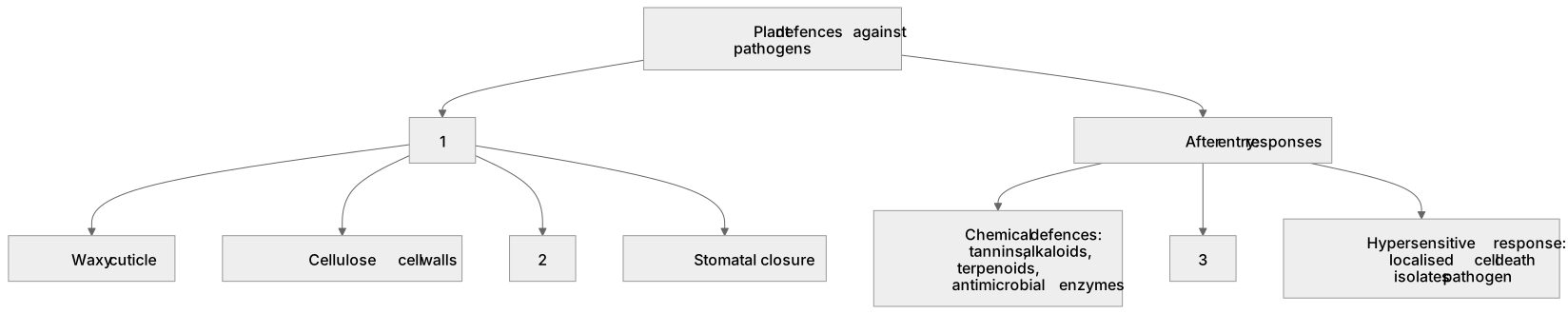
1Box 1
2Box 2
3Box 3
There is more to this lesson
The full lesson goes on to check your understanding and help you earn the marks. Create a free account to carry on, with your progress saved.
A week of Premium from your first lesson · Then the free plan continues · No card, no charge
Test your understanding of Communicable diseases, disease prevention and the immune system: (c) plant defences against pathogens
Active recall beats re-reading. Take an instant quiz now to test what you’ve learned and lock it into long-term memory.
A week of Premium from your first lesson · Then the free plan continues · No card, no charge