OCR · A-Level · Biology
Course version: H420 · Version from Sept 2025
(d) the primary non-specific defences against pathogens in animals
Full specification wording
Communicable diseases, disease prevention and the immune system: (d) the primary non-specific defences against pathogens in animals
Teach the primary non-specific defences that prevent pathogen entry: skin, mucous membranes, expulsive reflexes, blood clotting, wound repair and inflammation.
Checked against the OCR H420 specification (opens in a new tab) on .
- Point 4 of 14
- 4 key terms
Study notes
From the checked teaching notes for this specification point.
The idea
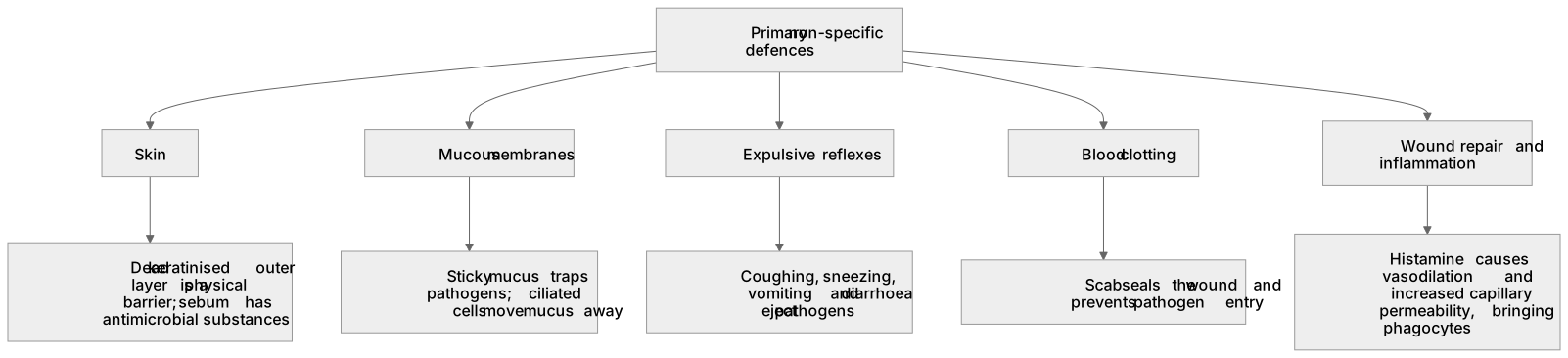
Teach the primary non-specific defences that prevent pathogen entry: skin, mucous membranes, expulsive reflexes, blood clotting, wound repair and inflammation. The skin is a physical barrier; its outer layer of dead keratinised cells and sebum inhibit microbial growth. Mucous membranes line body openings and trap pathogens in mucus, which is then removed by cilia. Expulsive reflexes such as coughing, sneezing, vomiting and diarrhoea eject pathogens. Blood clotting seals wounds to prevent entry. Wound repair involves inflammation, which increases blood flow and brings phagocytes to destroy pathogens. Learners must be able to name each defence and explain how it acts non-specifically against a range of pathogens.
What earns the marks
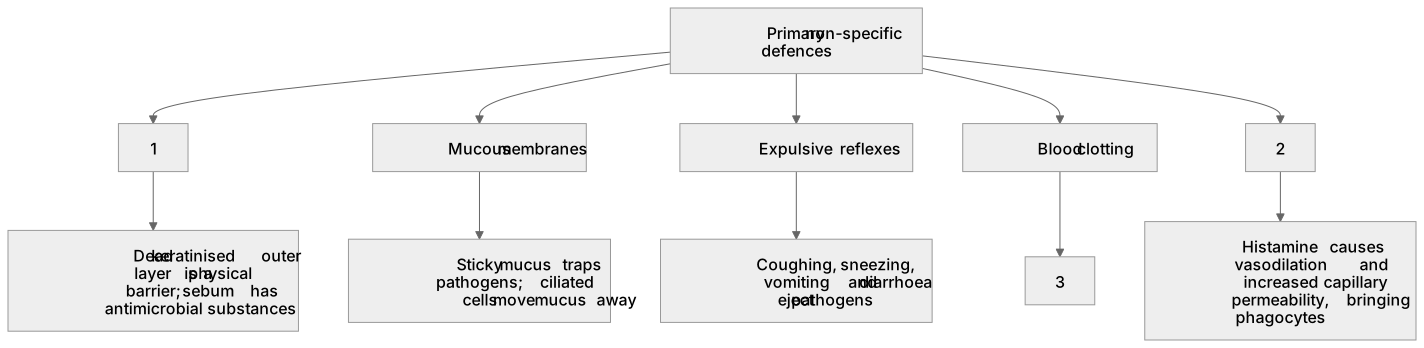
- Skin acts as a physical barrier; the outer layer of dead keratinised cells is difficult for pathogens to penetrate, and sebum contains antimicrobial substances.
- Mucous membranes secrete sticky mucus that traps pathogens; ciliated cells then move the mucus away from the lungs or other surfaces.
- Expulsive reflexes include coughing, sneezing, vomiting and diarrhoea, which forcibly remove pathogens from the respiratory or digestive tract.
- Blood clotting forms a scab that seals a wound, preventing pathogen entry and providing a temporary barrier while repair occurs.
- Wound repair involves inflammation: damaged cells release histamine, causing vasodilation and increased permeability of capillaries, so more phagocytes reach the site.
- Inflammation also causes redness, heat, swelling and pain, which are signs of the non-specific response to infection or injury.
Common mistakes and how to put them right
Omitting expulsive reflexes such as coughing and sneezing.
Put it right: These are primary non-specific defences required by the specification.
Omitting wound repair and inflammation.
Put it right: These are part of the primary non-specific defences, not just secondary responses.
Stating that skin is a chemical barrier only.
Put it right: It is primarily a physical barrier, with chemical secretions such as sebum as an additional feature.
Confusing primary non-specific defences with the specific immune response.
Put it right: Primary defences act against all pathogens, not a particular pathogen.
Exam tips
- List all primary non-specific defences: skin, mucous membranes, expulsive reflexes, blood clotting, wound repair and inflammation.
- For each defence, state how it prevents pathogen entry or removes pathogens, using precise biological terms such as 'keratinised', 'ciliated' and 'phagocytes'.
- When a question asks for a primary defence, do not give secondary responses such as antibody production or phagocytosis alone; phagocytosis is part of the secondary non-specific response.
- Use examples: coughing removes pathogens from the trachea, vomiting removes pathogens from the stomach, and blood clotting seals a cut.
Try the lesson
The start of the Communicable diseases, disease prevention and the immune system: (d) the primary non-specific defences against pathogens in animals lesson, made from checked teaching notes for this specification point.
Have a go first
Which of these is a chemical primary non-specific defence found in the eyes?
Listen
Teach the primary non-specific defences that prevent pathogen entry: skin, mucous membranes, expulsive reflexes, blood clotting, wound repair and inflammation. The skin is a physical barrier; its outer layer of dead keratinised cells and sebum inhibit microbial growth. Mucous membranes line body openings and trap pathogens in mucus, which is then removed by cilia. Expulsive reflexes such as coughing, sneezing, vomiting and diarrhoea eject pathogens. Blood clotting seals wounds to prevent entry. Wound repair involves inflammation, which increases blood flow and brings phagocytes to destroy pathogens. Learners must be able to name each defence and explain how it acts non-specifically against a range of pathogens. A strong answer earns marks for these points. Skin acts as a physical barrier; the outer layer of dead keratinised cells is difficult for pathogens to penetrate, and sebum contains antimicrobial substances. Mucous membranes secrete sticky mucus that traps pathogens; ciliated cells then move the mucus away from the lungs or other surfaces. Expulsive reflexes include coughing, sneezing, vomiting and diarrhoea, which forcibly remove pathogens from the respiratory or digestive tract. Blood clotting forms a scab that seals a wound, preventing pathogen entry and providing a temporary barrier while repair occurs. Exam tip: List all primary non-specific defences: skin, mucous membranes, expulsive reflexes, blood clotting, wound repair and inflammation.
See it
Key words
Say what each word means before you turn the card.
Primary non-specific defences
Try answering aloud or in your head before turning the card.
Mucous membranes
Try answering aloud or in your head before turning the card.
Expulsive reflexes
Try answering aloud or in your head before turning the card.
Inflammation
Try answering aloud or in your head before turning the card.
See every definition
- Primary non-specific defences
- Physical, chemical and mechanical barriers that prevent pathogen entry and act immediately without distinguishing between different pathogens.
- Mucous membranes
- Membranes that line body openings and secrete sticky mucus that traps pathogens, which ciliated cells then move away from the lungs or other surfaces.
- Expulsive reflexes
- Active processes such as coughing, sneezing, vomiting and diarrhoea that forcibly remove pathogens from the respiratory or digestive tract.
- Inflammation
- Part of wound repair in which damaged cells release histamine, causing vasodilation and increased permeability of capillaries so more phagocytes reach the site.
Label the diagram
Some boxes have lost their names. Pick the right name for each number.
1Box 1
2Box 2
3Box 3
There is more to this lesson
The full lesson goes on to check your understanding and help you earn the marks. Create a free account to carry on, with your progress saved.
A week of Premium from your first lesson · Then the free plan continues · No card, no charge
Test your understanding of Communicable diseases, disease prevention and the immune system: (d) the primary non-specific defences against pathogens in animals
Active recall beats re-reading. Take an instant quiz now to test what you’ve learned and lock it into long-term memory.
A week of Premium from your first lesson · Then the free plan continues · No card, no charge