OCR · A-Level · Biology
Course version: H420 · Version from Sept 2025
(i) an outline of the action of opsonins, agglutinins and anti-toxins
Full specification wording
Communicable diseases, disease prevention and the immune system: (i) an outline of the action of opsonins, agglutinins and anti-toxins
This outcome requires an outline of three ways antibodies act.
Checked against the OCR H420 specification (opens in a new tab) on .
- Point 9 of 14
- 4 key terms
Study notes
From the checked teaching notes for this specification point.
The idea
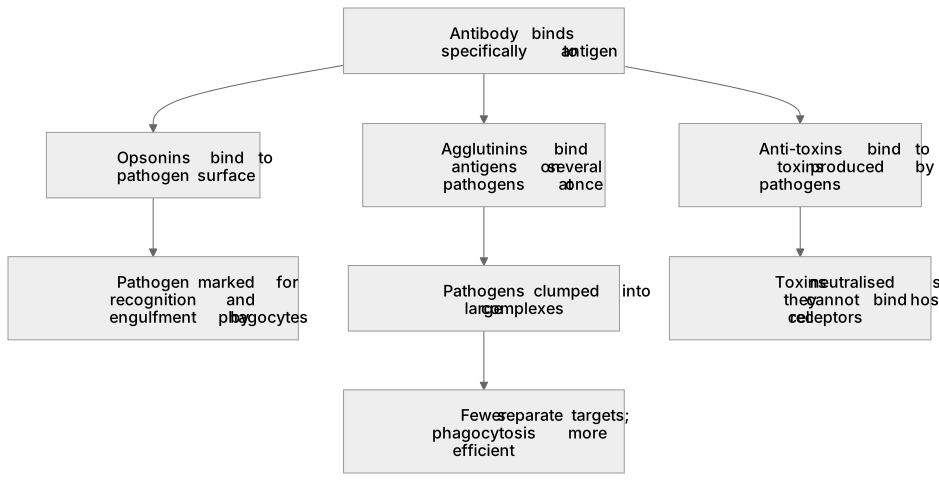
This outcome requires an outline of three ways antibodies act. Opsonins are antibodies (or complement proteins) that bind to the surface of a pathogen, marking it so phagocytes can recognise and engulf it more readily — opsonisation. Agglutinins are antibodies that bind to antigens on several pathogens at once, clumping them together so large complexes form; this reduces the number of separate targets and makes phagocytosis more efficient. Anti-toxins are antibodies that bind to toxins produced by pathogens, neutralising them so they cannot bind to host cell receptors and cause harm. In each case the antibody binds specifically to its antigen; the difference lies in the consequence of binding — enhanced phagocytosis, clumping, or toxin neutralisation.
What earns the marks
- Opsonins bind to pathogen surfaces and mark them for recognition and engulfment by phagocytes (opsonisation).
- Agglutinins bind antigens on multiple pathogens, clumping them into complexes that are more easily phagocytosed.
- Anti-toxins bind to and neutralise toxins so they cannot affect host cells.
- All three are antibodies acting by specific binding to antigen; they differ in the consequence of binding.
- Opsonisation enhances phagocytosis; agglutination reduces the number of separate targets; anti-toxin action prevents toxin damage.
Common mistakes and how to put them right
Confusing agglutinins with opsonins.
Put it right: Correct that agglutinins clump pathogens while opsonins mark single pathogens for phagocytosis.
Stating anti-toxins destroy toxins enzymatically.
Put it right: Correct that they bind and neutralise toxins.
Describing these as non-specific defences.
Put it right: Correct that they involve specific antibody–antigen binding.
Exam tips
- Use a one-line definition for each term then a consequence: mark, clump, neutralise.
- Link each to phagocytosis where relevant, since opsonins and agglutinins both aid engulfment.
- Keep answers to an outline — a clear definition plus effect is enough for this command word.
Try the lesson
The start of the Communicable diseases, disease prevention and the immune system: (i) an outline of the action of opsonins, agglutinins and anti-toxins lesson, made from checked teaching notes for this specification point.
Have a go first
What is the main effect of an opsonin on a pathogen?
Listen
This outcome requires an outline of three ways antibodies act. Opsonins are antibodies (or complement proteins) that bind to the surface of a pathogen, marking it so phagocytes can recognise and engulf it more readily — opsonisation. Agglutinins are antibodies that bind to antigens on several pathogens at once, clumping them together so large complexes form; this reduces the number of separate targets and makes phagocytosis more efficient. Anti-toxins are antibodies that bind to toxins produced by pathogens, neutralising them so they cannot bind to host cell receptors and cause harm. In each case the antibody binds specifically to its antigen; the difference lies in the consequence of binding — enhanced phagocytosis, clumping, or toxin neutralisation. A strong answer earns marks for these points. Opsonins bind to pathogen surfaces and mark them for recognition and engulfment by phagocytes (opsonisation). Agglutinins bind antigens on multiple pathogens, clumping them into complexes that are more easily phagocytosed. Anti-toxins bind to and neutralise toxins so they cannot affect host cells. All three are antibodies acting by specific binding to antigen; they differ in the consequence of binding. Exam tip: Use a one-line definition for each term then a consequence: mark, clump, neutralise.
See it
Key words
Say what each word means before you turn the card.
Opsonisation
Try answering aloud or in your head before turning the card.
Agglutination
Try answering aloud or in your head before turning the card.
Toxin neutralisation
Try answering aloud or in your head before turning the card.
Antibody specificity
Try answering aloud or in your head before turning the card.
See every definition
- Opsonisation
- Antibodies or complement proteins bind to the surface of a pathogen, marking it so phagocytes can recognise and engulf it more readily.
- Agglutination
- Antibodies bind to antigens on several pathogens at once, clumping them together so large complexes form and phagocytosis is more efficient.
- Toxin neutralisation
- Antibodies bind to toxins produced by pathogens, neutralising them so they cannot bind to host cell receptors and cause harm.
- Antibody specificity
- Each antibody binds specifically to its antigen, and the difference between antibodies lies in the consequence of binding.
Label the diagram
Some boxes have lost their names. Pick the right name for each number.
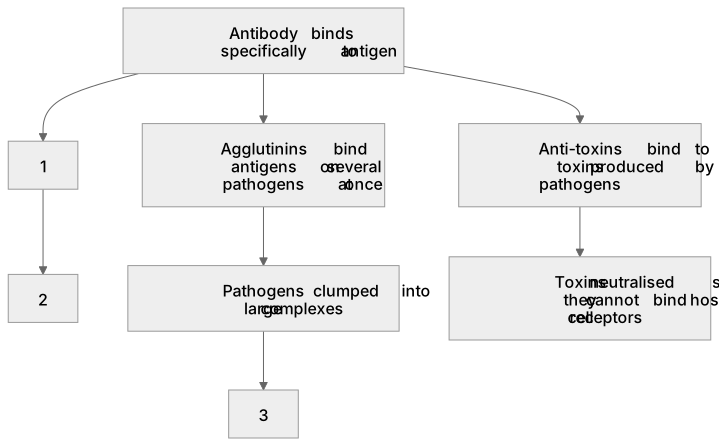
1Box 1
2Box 2
3Box 3
There is more to this lesson
The full lesson goes on to check your understanding and help you earn the marks. Create a free account to carry on, with your progress saved.
A week of Premium from your first lesson · Then the free plan continues · No card, no charge
Test your understanding of Communicable diseases, disease prevention and the immune system: (i) an outline of the action of opsonins, agglutinins and anti-toxins
Active recall beats re-reading. Take an instant quiz now to test what you’ve learned and lock it into long-term memory.
A week of Premium from your first lesson · Then the free plan continues · No card, no charge