OCR · A-Level · Biology
Course version: H420 · Version from Sept 2025
(h) the structure and general functions of antibodies
Full specification wording
Communicable diseases, disease prevention and the immune system: (h) the structure and general functions of antibodies
Antibodies are globular glycoproteins of the immunoglobulin family, secreted by plasma cells (differentiated B lymphocytes) in response to a specific antigen.
Checked against the OCR H420 specification (opens in a new tab) on .
- Point 8 of 14
- 4 key terms
Study notes
From the checked teaching notes for this specification point.
The idea
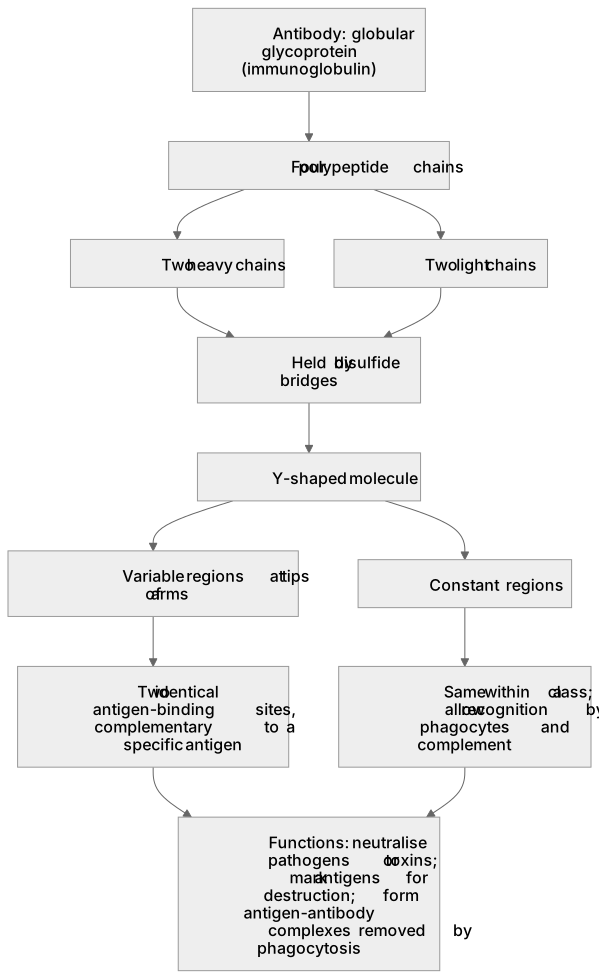
Antibodies are globular glycoproteins of the immunoglobulin family, secreted by plasma cells (differentiated B lymphocytes) in response to a specific antigen. Each antibody is a Y-shaped molecule of four polypeptide chains: two identical heavy chains and two identical light chains, held by disulfide bridges. The variable regions at the tips of the two arms form the antigen-binding sites, giving each antibody two identical binding sites and a shape complementary to one specific antigen. The constant regions are the same within a class and allow recognition by phagocytes and complement. General functions: binding to antigen to neutralise pathogens or toxins, marking them for destruction, and forming antigen–antibody complexes that can be destroyed by phagocytosis. Binding is specific and reversible.
What earns the marks
- Antibodies are proteins (globular glycoproteins/immunoglobulins) secreted by plasma cells derived from B lymphocytes.
- Each antibody has four polypeptide chains: two heavy and two light chains, joined by disulfide bridges.
- The Y-shaped molecule has two variable regions forming two identical antigen-binding sites.
- The binding site shape is complementary to a specific antigen, so binding is specific.
- Constant regions are the same within a class and allow recognition by phagocytes/complement.
- General functions include neutralising pathogens or toxins, marking antigens for destruction and forming complexes removed by phagocytosis.
Common mistakes and how to put them right
Saying antibodies are produced by phagocytes or T cells.
Put it right: Correct that they are secreted by plasma cells (from B lymphocytes).
Describing the binding site as complementary to the antibody rather than to the antigen.
Put it right: Correct that the variable region is complementary to a specific antigen.
Claiming antibodies directly kill pathogens.
Put it right: Correct that they bind, neutralise and mark antigens for destruction by phagocytosis or complement.
Exam tips
- Learn the four-chain Y structure with two heavy and two light chains and label the variable and constant regions.
- Always link structure to function: variable region gives specificity, constant region gives recognition by phagocytes.
- Use the term 'complementary' when describing antigen–antibody binding rather than 'matching' loosely.
Try the lesson
The start of the Communicable diseases, disease prevention and the immune system: (h) the structure and general functions of antibodies lesson, made from checked teaching notes for this specification point.
Have a go first
Which class of biological molecule are antibodies made from?
Listen
Antibodies are globular glycoproteins of the immunoglobulin family, secreted by plasma cells (differentiated B lymphocytes) in response to a specific antigen. Each antibody is a Y-shaped molecule of four polypeptide chains: two identical heavy chains and two identical light chains, held by disulfide bridges. The variable regions at the tips of the two arms form the antigen-binding sites, giving each antibody two identical binding sites and a shape complementary to one specific antigen. The constant regions are the same within a class and allow recognition by phagocytes and complement. General functions: binding to antigen to neutralise pathogens or toxins, marking them for destruction, and forming antigen–antibody complexes that can be destroyed by phagocytosis. Binding is specific and reversible. A strong answer earns marks for these points. Antibodies are proteins (globular glycoproteins/immunoglobulins) secreted by plasma cells derived from B lymphocytes. Each antibody has four polypeptide chains: two heavy and two light chains, joined by disulfide bridges. The Y-shaped molecule has two variable regions forming two identical antigen-binding sites. The binding site shape is complementary to a specific antigen, so binding is specific. Exam tip: Learn the four-chain Y structure with two heavy and two light chains and label the variable and constant regions.
See it
Key words
Say what each word means before you turn the card.
Antibody structure
Try answering aloud or in your head before turning the card.
Specificity of antigen binding
Try answering aloud or in your head before turning the card.
Role of plasma cells
Try answering aloud or in your head before turning the card.
Antibody function in immune defence
Try answering aloud or in your head before turning the card.
See every definition
- Antibody structure
- A Y-shaped molecule of four polypeptide chains: two identical heavy chains and two identical light chains, held by disulfide bridges.
- Specificity of antigen binding
- The variable regions at the tips of the two arms form the antigen-binding sites, giving a shape complementary to one specific antigen.
- Role of plasma cells
- Differentiated B lymphocytes that secrete antibodies in response to a specific antigen.
- Antibody function in immune defence
- Binding to antigen to neutralise pathogens or toxins, marking them for destruction, and forming antigen–antibody complexes destroyed by phagocytosis.
Label the diagram
Some boxes have lost their names. Pick the right name for each number.
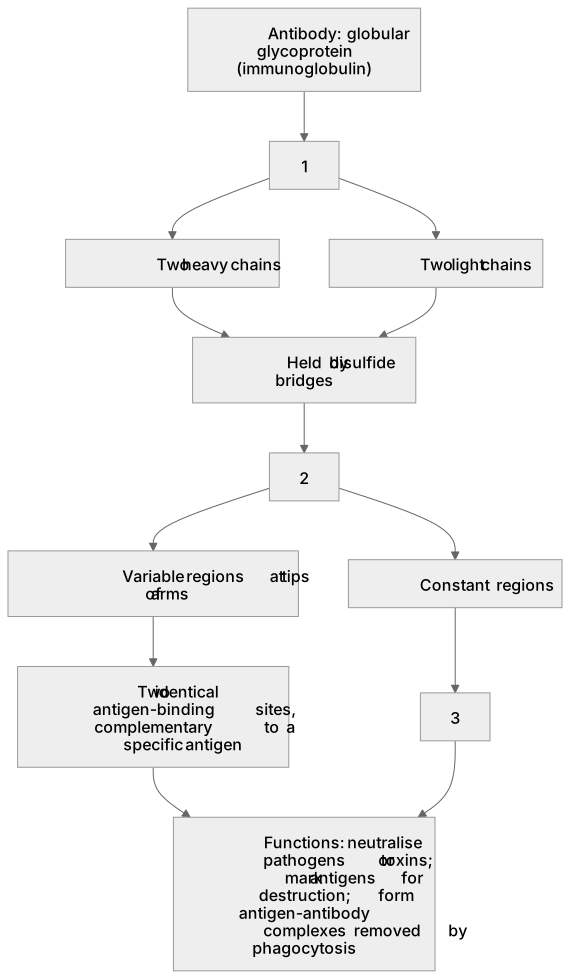
1Box 1
2Box 2
3Box 3
There is more to this lesson
The full lesson goes on to check your understanding and help you earn the marks. Create a free account to carry on, with your progress saved.
A week of Premium from your first lesson · Then the free plan continues · No card, no charge
Test your understanding of Communicable diseases, disease prevention and the immune system: (h) the structure and general functions of antibodies
Active recall beats re-reading. Take an instant quiz now to test what you’ve learned and lock it into long-term memory.
A week of Premium from your first lesson · Then the free plan continues · No card, no charge