OCR · A-Level · Biology
Course version: H420 · Version from Sept 2025
(k) autoimmune diseases
Full specification wording
Communicable diseases, disease prevention and the immune system: (k) autoimmune diseases
An autoimmune disease occurs when the immune system fails to distinguish self from non-self and mounts an immune response against the body's own tissues.
Checked against the OCR H420 specification (opens in a new tab) on .
- Point 11 of 14
- 4 key terms
Study notes
From the checked teaching notes for this specification point.
The idea
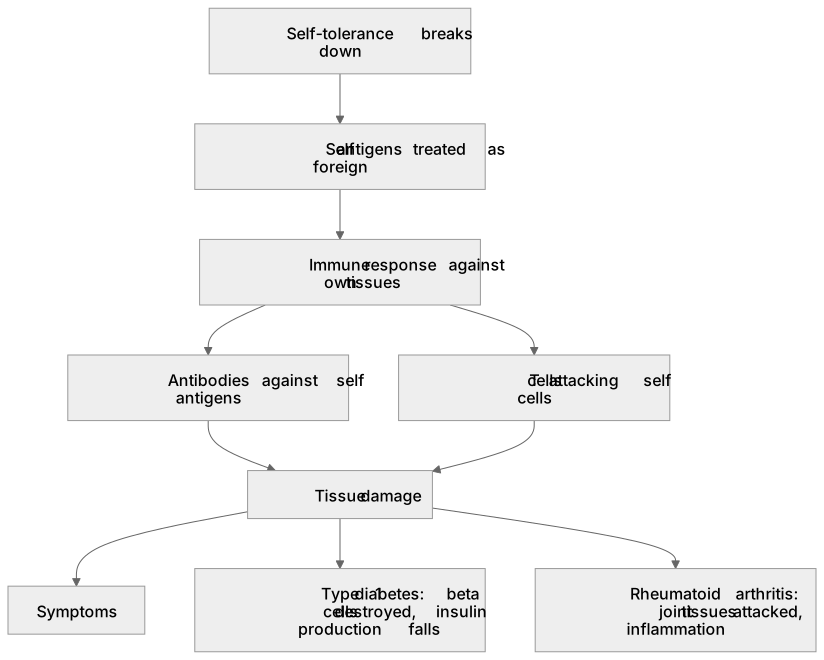
An autoimmune disease occurs when the immune system fails to distinguish self from non-self and mounts an immune response against the body's own tissues. Self-tolerance normally prevents this, so autoimmunity reflects a breakdown in that recognition. The immune attack may involve antibodies directed at self antigens or T cells attacking self cells, and the resulting damage produces the symptoms. Examples include type 1 diabetes, in which beta cells of the pancreas are destroyed so insulin production falls, and rheumatoid arthritis, in which the immune system attacks joint tissues causing inflammation. A question may ask for the definition, a named example, the mechanism of self-recognition failure, or the consequence for a specific tissue, so identify which is being tested.
What earns the marks
- Definition: an autoimmune disease is one in which the immune system attacks the body's own tissues because self is not distinguished from non-self.
- Mechanism: self-tolerance breaks down, so self antigens are treated as foreign and provoke an immune response.
- The response may involve antibodies against self antigens or T cells attacking self cells, leading to tissue damage and symptoms.
- A valid named example with its consequence, such as type 1 diabetes where pancreatic beta cells are destroyed and insulin production is reduced.
- A second valid example such as rheumatoid arthritis, where immune attack on joint tissues causes inflammation.
- The symptoms arise from damage to the specific tissue targeted, so linking the affected tissue to the resulting effect is essential.
Common mistakes and how to put them right
Confusing autoimmune disease with immunodeficiency.
Put it right by noting that autoimmunity is an overactive misdirected response against self, not a failure to respond to pathogens.
Describing an autoimmune disease as caused by a pathogen directly attacking tissue.
Put it right by identifying the immune system itself as the agent of damage.
Giving an example without its mechanism or consequence.
Put it right by stating which tissue is attacked and what effect follows, such as beta cell destruction reducing insulin production.
Exam tips
- Check whether the question asks for a definition, a mechanism or an example, and answer that specific demand.
- When using an example, always pair it with the tissue attacked and the resulting effect.
- Eliminate options that describe immunodeficiency or pathogen-driven damage rather than immune attack on self.
Try the lesson
The start of the Communicable diseases, disease prevention and the immune system: (k) autoimmune diseases lesson, made from checked teaching notes for this specification point.
Have a go first
What is meant by an autoimmune disease?
Listen
An autoimmune disease occurs when the immune system fails to distinguish self from non-self and mounts an immune response against the body's own tissues. Self-tolerance normally prevents this, so autoimmunity reflects a breakdown in that recognition. The immune attack may involve antibodies directed at self antigens or T cells attacking self cells, and the resulting damage produces the symptoms. Examples include type 1 diabetes, in which beta cells of the pancreas are destroyed so insulin production falls, and rheumatoid arthritis, in which the immune system attacks joint tissues causing inflammation. A question may ask for the definition, a named example, the mechanism of self-recognition failure, or the consequence for a specific tissue, so identify which is being tested. A strong answer earns marks for these points. Definition: an autoimmune disease is one in which the immune system attacks the body's own tissues because self is not distinguished from non-self. Mechanism: self-tolerance breaks down, so self antigens are treated as foreign and provoke an immune response. The response may involve antibodies against self antigens or T cells attacking self cells, leading to tissue damage and symptoms. A valid named example with its consequence, such as type 1 diabetes where pancreatic beta cells are destroyed and insulin production is reduced. A common slip: Confusing autoimmune disease with immunodeficiency. Instead, noting that autoimmunity is an overactive misdirected response against self, not a failure to respond to pathogens. Exam tip: Check whether the question asks for a definition, a mechanism or an example, and answer that specific demand.
See it
Key words
Say what each word means before you turn the card.
Autoimmune disease
Try answering aloud or in your head before turning the card.
Self-tolerance
Try answering aloud or in your head before turning the card.
Breakdown of self-tolerance
Try answering aloud or in your head before turning the card.
Type 1 diabetes
Try answering aloud or in your head before turning the card.
See every definition
- Autoimmune disease
- A condition in which the immune system attacks the body's own tissues because self is not distinguished from non-self.
- Self-tolerance
- The normal process that prevents the immune system from attacking the body's own tissues, and whose breakdown underlies autoimmunity.
- Breakdown of self-tolerance
- Failure of self-tolerance, so self antigens are treated as foreign and provoke an immune response.
- Type 1 diabetes
- An example in which pancreatic beta cells are destroyed and insulin production is reduced.
Label the diagram
Some boxes have lost their names. Pick the right name for each number.
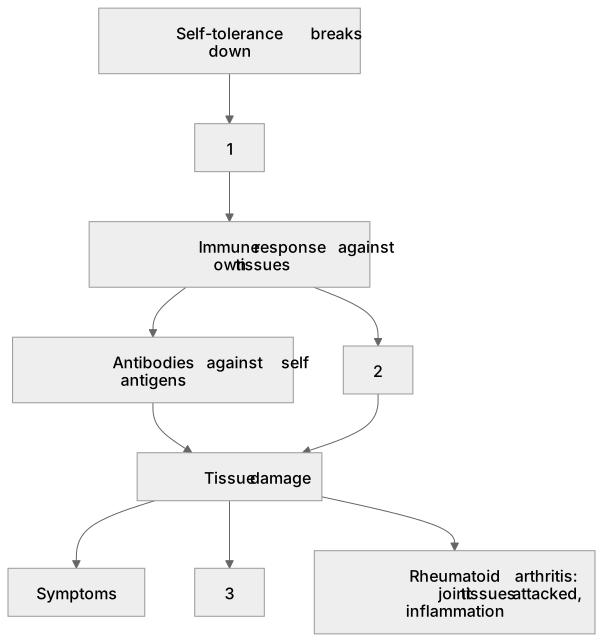
1Box 1
2Box 2
3Box 3
There is more to this lesson
The full lesson goes on to check your understanding and help you earn the marks. Create a free account to carry on, with your progress saved.
A week of Premium from your first lesson · Then the free plan continues · No card, no charge
Test your understanding of Communicable diseases, disease prevention and the immune system: (k) autoimmune diseases
Active recall beats re-reading. Take an instant quiz now to test what you’ve learned and lock it into long-term memory.
A week of Premium from your first lesson · Then the free plan continues · No card, no charge