OCR · A-Level · Biology
Course version: H420 · Version from Sept 2025
(l) the principles of vaccination and the role of vaccination programmes…
Full specification wording
Communicable diseases, disease prevention and the immune system: (l) the principles of vaccination and the role of vaccination programmes in the prevention of epidemics
Vaccination works by introducing a harmless form of an antigen so the adaptive immune system makes a primary response and, crucially, memory B and T cells.
Checked against the OCR H420 specification (opens in a new tab) on .
- Point 12 of 14
- 4 key terms
Study notes
From the checked teaching notes for this specification point.
The idea
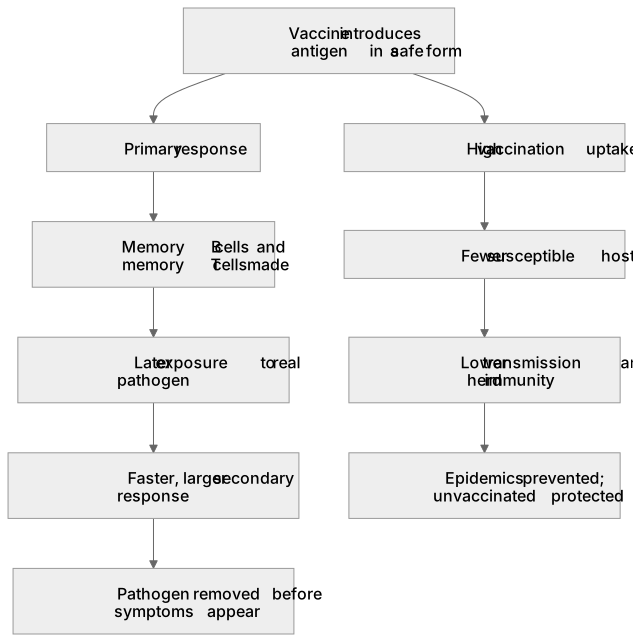
Vaccination works by introducing a harmless form of an antigen so the adaptive immune system makes a primary response and, crucially, memory B and T cells. On later exposure to the real pathogen, memory cells give a faster, stronger secondary response that destroys the pathogen before symptoms develop. Vaccines may contain killed pathogens, attenuated live pathogens, toxoids, isolated antigens or subunit components. A vaccination programme protects a population, not just individuals: high uptake reduces the number of susceptible hosts so the pathogen cannot spread easily, giving herd immunity. This can prevent epidemics and protect people who cannot be vaccinated, such as the very young, immunocompromised patients or those with allergies. Low uptake or antigenic variation can allow outbreaks.
What earns the marks
- Vaccination introduces antigens from a pathogen in a safe form, stimulating an immune response without causing the disease.
- The primary response produces memory B cells and memory T cells specific to the antigen.
- On re-exposure the memory cells produce a faster, larger secondary response that removes the pathogen before symptoms appear.
- Vaccines can be based on killed pathogens, attenuated pathogens, toxoids, isolated antigens or subunits.
- High vaccination uptake reduces susceptible hosts, lowering transmission and providing herd immunity that protects unvaccinated individuals.
- Vaccination programmes can prevent epidemics by keeping pathogen spread below the level needed for an outbreak.
Common mistakes and how to put them right
Thinking a vaccine directly kills pathogens in the body.
Put it right: A vaccine stimulates the immune system to make memory cells, and the secondary response destroys the pathogen on later exposure.
Assuming vaccination only protects the individual.
Put it right: High uptake also reduces transmission and protects the wider population through herd immunity.
Believing a vaccine causes the disease it prevents.
Put it right: Vaccines use killed, attenuated or subunit antigens that do not cause the disease in a healthy recipient.
Exam tips
- Read each option and decide whether it describes the primary response, memory cells or population-level protection; only one will match the principle tested.
- Eliminate options that claim vaccines provide immediate passive immunity or antibodies rather than active immunity.
- When an option mentions herd immunity, check it correctly links reduced susceptible hosts to lower transmission.
Try the lesson
The start of the Communicable diseases, disease prevention and the immune system: (l) the principles of vaccination and the role of vaccination programmes in the prevention of epidemics lesson, made from checked teaching notes for this specification point.
Have a go first
A vaccine is given to a person to protect them against a disease. Which description best explains how a vaccine produces protection?
Listen
Vaccination works by introducing a harmless form of an antigen so the adaptive immune system makes a primary response and, crucially, memory B and T cells. On later exposure to the real pathogen, memory cells give a faster, stronger secondary response that destroys the pathogen before symptoms develop. Vaccines may contain killed pathogens, attenuated live pathogens, toxoids, isolated antigens or subunit components. A vaccination programme protects a population, not just individuals: high uptake reduces the number of susceptible hosts so the pathogen cannot spread easily, giving herd immunity. This can prevent epidemics and protect people who cannot be vaccinated, such as the very young, immunocompromised patients or those with allergies. Low uptake or antigenic variation can allow outbreaks. A strong answer earns marks for these points. Vaccination introduces antigens from a pathogen in a safe form, stimulating an immune response without causing the disease. The primary response produces memory B cells and memory T cells specific to the antigen. On re-exposure the memory cells produce a faster, larger secondary response that removes the pathogen before symptoms appear. Vaccines can be based on killed pathogens, attenuated pathogens, toxoids, isolated antigens or subunits. A common slip: Thinking a vaccine directly kills pathogens in the body. Instead, a vaccine stimulates the immune system to make memory cells, and the secondary response destroys the pathogen on later exposure. Exam tip: Read each option and decide whether it describes the primary response, memory cells or population-level protection; only one will match the principle tested.
See it
Key words
Say what each word means before you turn the card.
Active immunity and memory cells
Try answering aloud or in your head before turning the card.
Primary versus secondary immune response
Try answering aloud or in your head before turning the card.
Types of vaccine antigen
Try answering aloud or in your head before turning the card.
Herd immunity and epidemic prevention
Try answering aloud or in your head before turning the card.
See every definition
- Active immunity and memory cells
- Vaccination introduces a harmless form of an antigen so the adaptive immune system makes a primary response and memory B and T cells.
- Primary versus secondary immune response
- On later exposure to the real pathogen, memory cells give a faster, stronger secondary response that destroys the pathogen before symptoms develop.
- Types of vaccine antigen
- Vaccines may contain killed pathogens, attenuated live pathogens, toxoids, isolated antigens or subunit components.
- Herd immunity and epidemic prevention
- High uptake reduces the number of susceptible hosts so the pathogen cannot spread easily, which can prevent epidemics and protect people who cannot be vaccinated.
Label the diagram
Some boxes have lost their names. Pick the right name for each number.
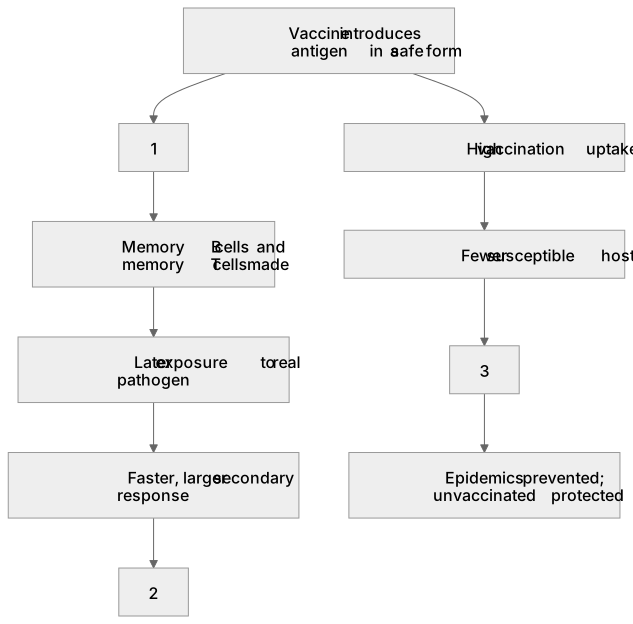
1Box 1
2Box 2
3Box 3
There is more to this lesson
The full lesson goes on to check your understanding and help you earn the marks. Create a free account to carry on, with your progress saved.
A week of Premium from your first lesson · Then the free plan continues · No card, no charge
Test your understanding of Communicable diseases, disease prevention and the immune system: (l) the principles of vaccination and the role of vaccination programmes in the prevention of epidemics
Active recall beats re-reading. Take an instant quiz now to test what you’ve learned and lock it into long-term memory.
A week of Premium from your first lesson · Then the free plan continues · No card, no charge