OCR · A-Level · Biology
Course version: H420 · Version from Sept 2025
Ecosystems: (b) biomass transfers through ecosystems
Biomass transfer means following the mass of living material as it moves from producers into consumers along a food chain.
Checked against the OCR H420 specification (opens in a new tab) on .
- Point 2 of 6
- 4 key terms
Study notes
From the checked teaching notes for this specification point.
The idea
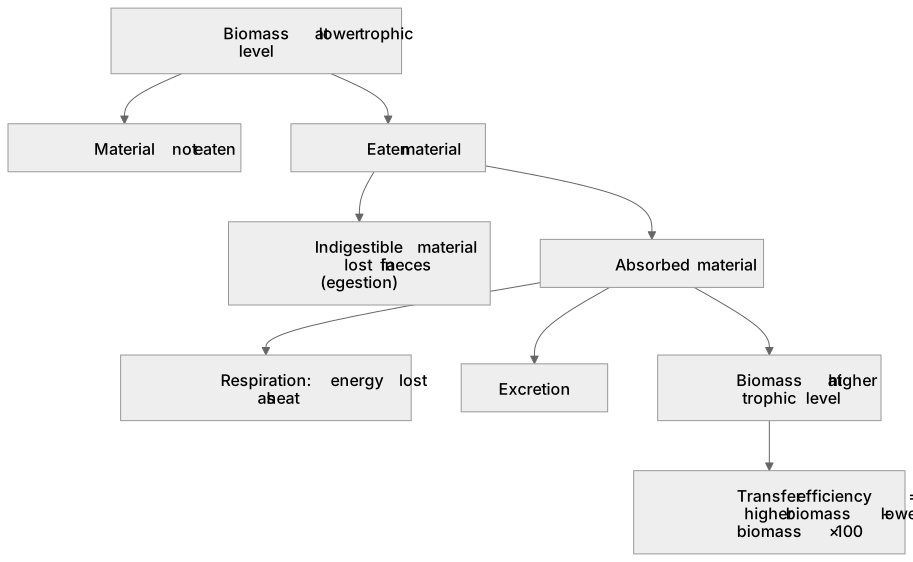
Biomass transfer means following the mass of living material as it moves from producers into consumers along a food chain. Learners should treat biomass as the mass of biological material present, usually measured as dry mass per unit area or volume over a stated time, and should recognise that only a fraction of the energy and matter in one trophic level becomes biomass in the next. The rest is lost through respiration, egestion, excretion and material not eaten, and some is lost as heat. A useful method is to compare dry mass at successive trophic levels and calculate transfer efficiency as biomass at the higher level divided by biomass at the lower level, multiplied by 100. A pyramid of biomass represents standing crop at each level, which can differ from a pyramid of numbers.
What earns the marks
- Biomass is the mass of living material, commonly measured as dry mass per unit area or volume over a stated period.
- Transfer between trophic levels is inefficient because energy and matter are lost through respiration, egestion, excretion and parts not consumed.
- Respiration releases energy, much of which is lost as heat, so it is not available to form biomass at the next level.
- Transfer efficiency can be calculated as biomass at the higher trophic level divided by biomass at the lower trophic level, multiplied by 100.
- A pyramid of biomass shows standing crop at each trophic level and may differ from a pyramid of numbers.
- Not all material at one level is eaten, and some eaten material is indigestible and lost in faeces.
Common mistakes and how to put them right
Assuming all biomass at one level is passed to the next.
Put it right: Only a fraction becomes biomass in the next level because of losses.
Confusing biomass with energy.
Put it right: Biomass is a mass of material, while energy flow is a separate measure, though the two are linked.
Treating a pyramid of numbers as identical to a pyramid of biomass.
Put it right: A single large producer can support many consumers, so the shapes can differ.
Ignoring egestion and excretion as losses.
Put it right: Material not absorbed or excreted is not converted into consumer biomass.
Exam tips
- Read the question carefully to see whether it asks about biomass, energy or numbers, and use the correct term in your answer.
- When calculating efficiency, show the division and multiplication by 100 clearly, and check units are consistent.
- Link each loss to a named process such as respiration, egestion or excretion rather than saying vaguely that energy is lost.
Try the lesson
The start of the Ecosystems: (b) biomass transfers through ecosystems lesson, made from checked teaching notes for this specification point.
Have a go first
In a food chain, what does the biomass of a trophic level represent?
Listen
Biomass transfer means following the mass of living material as it moves from producers into consumers along a food chain. Learners should treat biomass as the mass of biological material present, usually measured as dry mass per unit area or volume over a stated time, and should recognise that only a fraction of the energy and matter in one trophic level becomes biomass in the next. The rest is lost through respiration, egestion, excretion and material not eaten, and some is lost as heat. A useful method is to compare dry mass at successive trophic levels and calculate transfer efficiency as biomass at the higher level divided by biomass at the lower level, multiplied by 100. A pyramid of biomass represents standing crop at each level, which can differ from a pyramid of numbers. A strong answer earns marks for these points. Biomass is the mass of living material, commonly measured as dry mass per unit area or volume over a stated period. Transfer between trophic levels is inefficient because energy and matter are lost through respiration, egestion, excretion and parts not consumed. Respiration releases energy, much of which is lost as heat, so it is not available to form biomass at the next level. Transfer efficiency can be calculated as biomass at the higher trophic level divided by biomass at the lower trophic level, multiplied by 100. A common slip: Assuming all biomass at one level is passed to the next. Instead, only a fraction becomes biomass in the next level because of losses. Exam tip: Read the question carefully to see whether it asks about biomass, energy or numbers, and use the correct term in your answer.
See it
Key words
Say what each word means before you turn the card.
Biomass
Try answering aloud or in your head before turning the card.
Transfer efficiency
Try answering aloud or in your head before turning the card.
Pyramid of biomass
Try answering aloud or in your head before turning the card.
Losses between trophic levels
Try answering aloud or in your head before turning the card.
See every definition
- Biomass
- The mass of living material, commonly measured as dry mass per unit area or volume over a stated period.
- Transfer efficiency
- Biomass at the higher trophic level divided by biomass at the lower trophic level, multiplied by 100.
- Pyramid of biomass
- A representation of standing crop at each trophic level, which may differ from a pyramid of numbers.
- Losses between trophic levels
- Energy and matter lost through respiration, egestion, excretion and parts not consumed, with much energy lost as heat.
Label the diagram
Some boxes have lost their names. Pick the right name for each number.
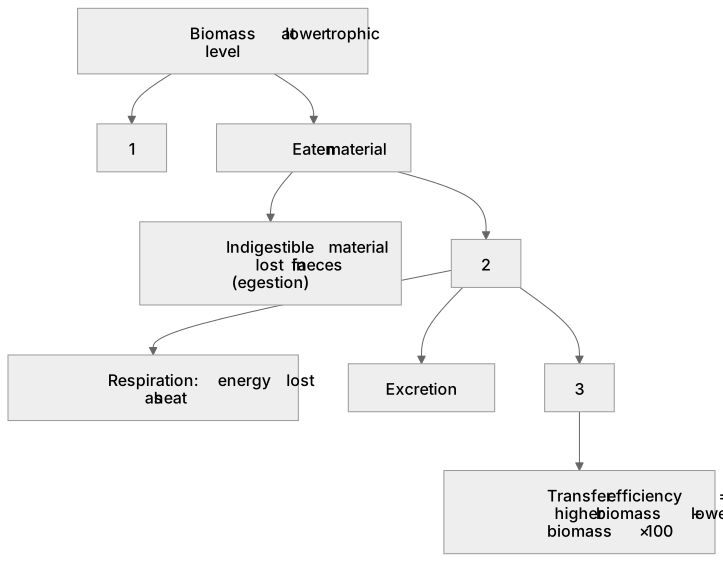
1Box 1
2Box 2
3Box 3
There is more to this lesson
The full lesson goes on to check your understanding and help you earn the marks. Create a free account to carry on, with your progress saved.
A week of Premium from your first lesson · Then the free plan continues · No card, no charge
Test your understanding of Ecosystems: (b) biomass transfers through ecosystems
Active recall beats re-reading. Take an instant quiz now to test what you’ve learned and lock it into long-term memory.
A week of Premium from your first lesson · Then the free plan continues · No card, no charge