OCR · A-Level · Biology
Course version: H420 · Version from Sept 2025
Ecosystems: (c) recycling within ecosystems
Recycling within ecosystems means the return of elements such as carbon, nitrogen and phosphorus from dead organisms and waste back into usable forms.
Checked against the OCR H420 specification (opens in a new tab) on .
- Point 3 of 6
- 4 key terms
Study notes
From the checked teaching notes for this specification point.
The idea
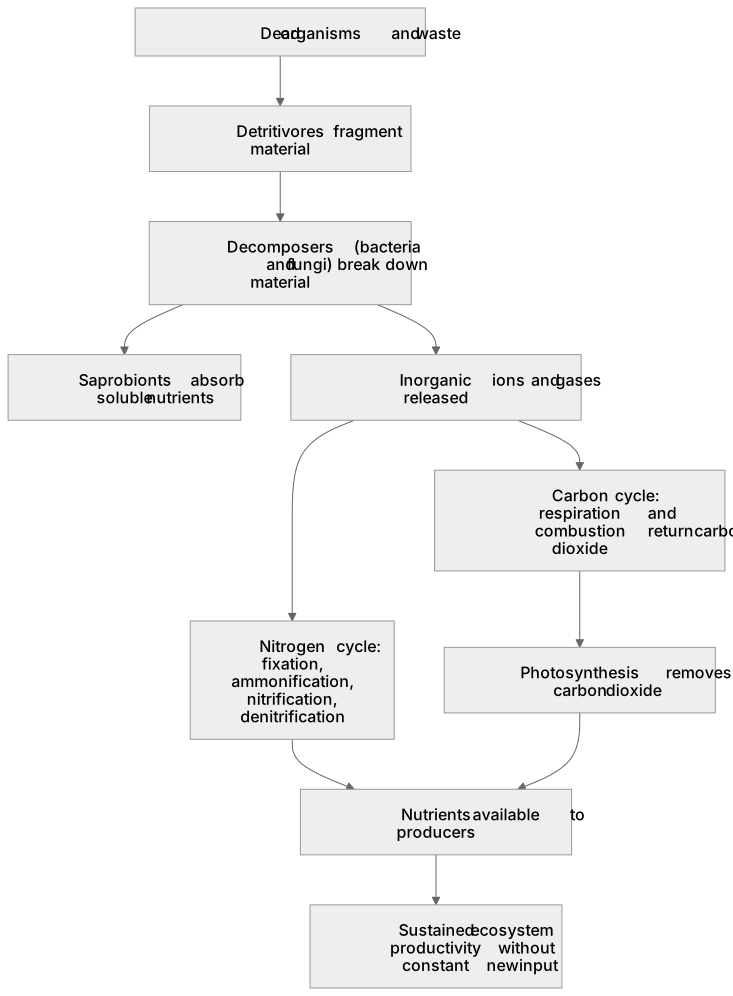
Recycling within ecosystems means the return of elements such as carbon, nitrogen and phosphorus from dead organisms and waste back into usable forms. Decomposers, including bacteria and fungi, break down dead material and release inorganic ions and gases. Saprobionts absorb soluble nutrients from decaying matter, and detritivores fragment material to increase surface area for microbial action. The carbon cycle returns carbon dioxide to the atmosphere through respiration and combustion, while photosynthesis removes it. The nitrogen cycle involves nitrogen fixation, ammonification, nitrification and denitrification. Recycling keeps nutrients available for producers, so ecosystems can continue to function without constant new input. Learners should be able to describe these pathways, identify the organisms involved and explain why recycling is essential for sustained productivity.
What earns the marks
- Decomposers such as bacteria and fungi break down dead organisms and waste, releasing inorganic nutrients.
- Saprobionts absorb soluble nutrients from decaying material, while detritivores fragment it to increase surface area.
- The carbon cycle returns carbon dioxide to the atmosphere by respiration and combustion, and removes it by photosynthesis.
- The nitrogen cycle includes nitrogen fixation, ammonification, nitrification and denitrification.
- Recycling makes nutrients available to producers, sustaining ecosystem productivity without constant new input.
- Microorganisms are central to recycling because they convert organic matter into inorganic forms usable by plants.
Common mistakes and how to put them right
Thinking decomposers are the same as detritivores.
Put it right: Detritivores are animals that ingest and fragment dead material, while decomposers are microorganisms that break it down chemically.
Believing nutrients disappear when organisms die.
Put it right: Elements are recycled into inorganic forms and reused by producers.
Confusing nitrification with nitrogen fixation.
Put it right: Fixation converts atmospheric nitrogen into ammonia or ammonium compounds, while nitrification converts ammonium into nitrite then nitrate.
Assuming recycling only involves carbon.
Put it right: Nitrogen, phosphorus and other elements are also recycled.
Exam tips
- Name the specific organism group and process for each step, for example nitrifying bacteria for nitrification.
- Use a flow diagram or cycle to show inputs, outputs and transformations clearly.
- Explain the significance of recycling for producers, not just list the processes.
Try the lesson
The start of the Ecosystems: (c) recycling within ecosystems lesson, made from checked teaching notes for this specification point.
Have a go first
What is the main role of decomposers in recycling within an ecosystem?
Listen
Recycling within ecosystems means the return of elements such as carbon, nitrogen and phosphorus from dead organisms and waste back into usable forms. Decomposers, including bacteria and fungi, break down dead material and release inorganic ions and gases. Saprobionts absorb soluble nutrients from decaying matter, and detritivores fragment material to increase surface area for microbial action. The carbon cycle returns carbon dioxide to the atmosphere through respiration and combustion, while photosynthesis removes it. The nitrogen cycle involves nitrogen fixation, ammonification, nitrification and denitrification. Recycling keeps nutrients available for producers, so ecosystems can continue to function without constant new input. Learners should be able to describe these pathways, identify the organisms involved and explain why recycling is essential for sustained productivity. A strong answer earns marks for these points. Decomposers such as bacteria and fungi break down dead organisms and waste, releasing inorganic nutrients. Saprobionts absorb soluble nutrients from decaying material, while detritivores fragment it to increase surface area. The carbon cycle returns carbon dioxide to the atmosphere by respiration and combustion, and removes it by photosynthesis. The nitrogen cycle includes nitrogen fixation, ammonification, nitrification and denitrification. A common slip: Thinking decomposers are the same as detritivores. Instead, detritivores are animals that ingest and fragment dead material, while decomposers are microorganisms that break it down chemically. Exam tip: Name the specific organism group and process for each step, for example nitrifying bacteria for nitrification.
See it
Key words
Say what each word means before you turn the card.
Decomposers
Try answering aloud or in your head before turning the card.
Saprobionts
Try answering aloud or in your head before turning the card.
Detritivores
Try answering aloud or in your head before turning the card.
Nitrogen cycle
Try answering aloud or in your head before turning the card.
See every definition
- Decomposers
- Bacteria and fungi that break down dead organisms and waste, releasing inorganic nutrients.
- Saprobionts
- Organisms that absorb soluble nutrients from decaying material.
- Detritivores
- Organisms that fragment dead material to increase surface area for microbial action.
- Nitrogen cycle
- The cycle involving nitrogen fixation, ammonification, nitrification and denitrification.
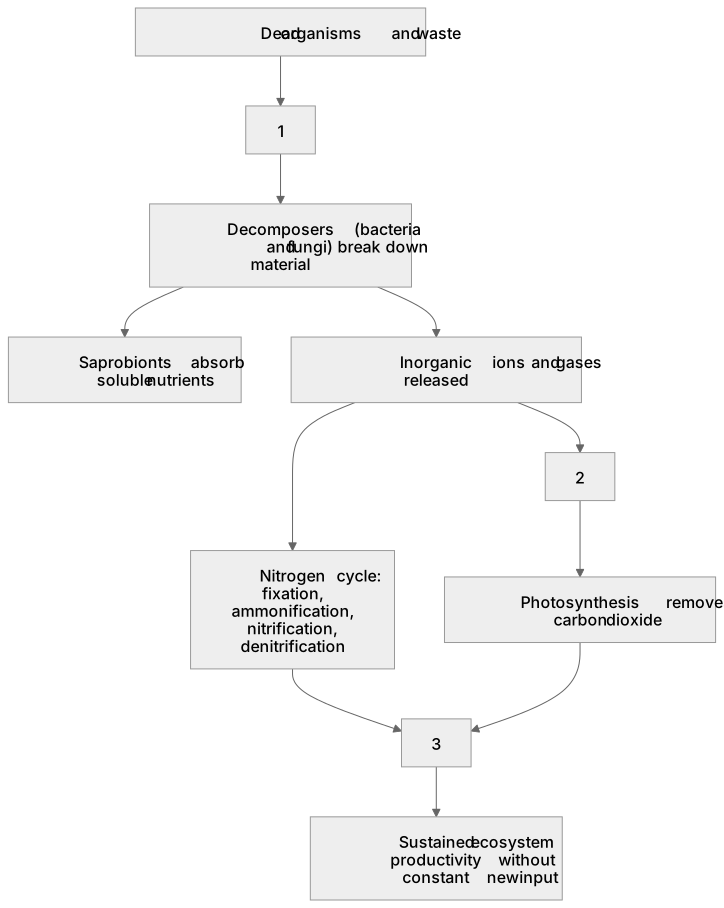
Label the diagram
Some boxes have lost their names. Pick the right name for each number.
1Box 1
2Box 2
3Box 3
There is more to this lesson
The full lesson goes on to check your understanding and help you earn the marks. Create a free account to carry on, with your progress saved.
A week of Premium from your first lesson · Then the free plan continues · No card, no charge
Test your understanding of Ecosystems: (c) recycling within ecosystems
Active recall beats re-reading. Take an instant quiz now to test what you’ve learned and lock it into long-term memory.
A week of Premium from your first lesson · Then the free plan continues · No card, no charge