OCR · A-Level · Biology
Course version: H420 · Version from Sept 2025
(a) the role of enzymes in catalysing reactions that affect metabolism at…
Full specification wording
Enzymes: (a) the role of enzymes in catalysing reactions that affect metabolism at a cellular and whole organism level
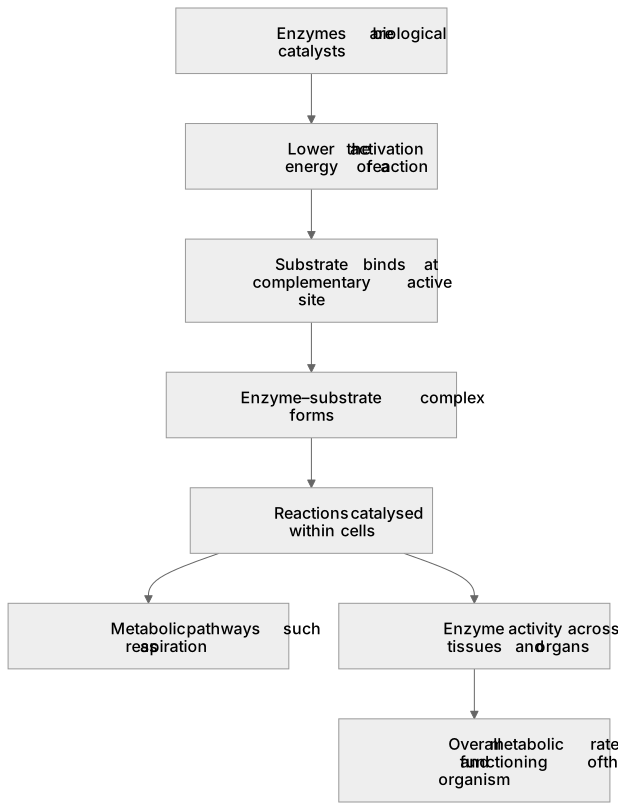
Enzymes are biological catalysts that lower the activation energy of a reaction, allowing metabolic reactions to proceed at a rate sufficient for life.
Checked against the OCR H420 specification (opens in a new tab) on .
- Point 1 of 6
- 4 key terms
Study notes
From the checked teaching notes for this specification point.
The idea
Enzymes are biological catalysts that lower the activation energy of a reaction, allowing metabolic reactions to proceed at a rate sufficient for life. Teach learners that enzymes act by binding substrate at an active site to form an enzyme–substrate complex, and that the active site is complementary to the substrate. At the cellular level, enzymes catalyse reactions such as those of respiration and photosynthesis, controlling the metabolic pathways inside cells. At the whole organism level, the combined activity of enzymes across tissues and organs determines the organism's overall metabolic rate and its ability to function. A concrete example: intracellular enzymes catalyse the steps of glycolysis, while the summed activity of enzymes throughout the body sets the organism's metabolic rate.
What earns the marks
- States that enzymes are biological catalysts that lower the activation energy of a reaction.
- Explains that enzymes bind substrate at a complementary active site to form an enzyme–substrate complex.
- Describes how enzymes catalyse reactions within cells, for example in metabolic pathways such as respiration.
- Explains that enzyme activity across tissues and organs affects metabolism at the whole organism level.
- Links enzyme-controlled reactions to the overall metabolic rate and functioning of the organism.
Common mistakes and how to put them right
Thinking enzymes are used up in the reaction.
Put it right by stating that enzymes are catalysts and are not consumed.
Believing enzymes raise activation energy.
Put it right by stating that they lower it.
Treating cellular and whole organism effects as unrelated.
Put it right by explaining that summed enzyme activity across cells determines whole organism metabolism.
Assuming the active site has a fixed shape unrelated to the substrate.
Put it right by stating that the active site is complementary to the substrate.
Exam tips
- Use the phrase 'lowers activation energy' precisely when describing enzyme action.
- Give a named cellular example, such as a step in respiration, to show catalysis at the cellular level.
- Distinguish clearly between cellular-level and whole organism-level effects of enzyme activity.
Try the lesson
The start of the Enzymes: (a) the role of enzymes in catalysing reactions that affect metabolism at a cellular and whole organism level lesson, made from checked teaching notes for this specification point.
Have a go first
How does an enzyme increase the rate of a metabolic reaction?
Listen
Enzymes are biological catalysts that lower the activation energy of a reaction, allowing metabolic reactions to proceed at a rate sufficient for life. Teach learners that enzymes act by binding substrate at an active site to form an enzyme–substrate complex, and that the active site is complementary to the substrate. At the cellular level, enzymes catalyse reactions such as those of respiration and photosynthesis, controlling the metabolic pathways inside cells. At the whole organism level, the combined activity of enzymes across tissues and organs determines the organism's overall metabolic rate and its ability to function. A concrete example: intracellular enzymes catalyse the steps of glycolysis, while the summed activity of enzymes throughout the body sets the organism's metabolic rate. A strong answer earns marks for these points. States that enzymes are biological catalysts that lower the activation energy of a reaction. Explains that enzymes bind substrate at a complementary active site to form an enzyme–substrate complex. Describes how enzymes catalyse reactions within cells, for example in metabolic pathways such as respiration. Explains that enzyme activity across tissues and organs affects metabolism at the whole organism level. A common slip: Thinking enzymes are used up in the reaction. Instead, stating that enzymes are catalysts and are not consumed. Exam tip: Use the phrase 'lowers activation energy' precisely when describing enzyme action.
See it
Key words
Say what each word means before you turn the card.
Enzymes as biological catalysts
Try answering aloud or in your head before turning the card.
Activation energy and enzyme–substrate complexes
Try answering aloud or in your head before turning the card.
Cellular metabolism
Try answering aloud or in your head before turning the card.
Whole organism metabolism
Try answering aloud or in your head before turning the card.
See every definition
- Enzymes as biological catalysts
- Biological catalysts that lower the activation energy of a reaction, allowing metabolic reactions to proceed at a rate sufficient for life.
- Activation energy and enzyme–substrate complexes
- Enzymes lower the activation energy of a reaction and bind substrate at a complementary active site to form an enzyme–substrate complex.
- Cellular metabolism
- Enzymes catalyse reactions such as those of respiration and photosynthesis, controlling the metabolic pathways inside cells.
- Whole organism metabolism
- The combined activity of enzymes across tissues and organs determines the organism's overall metabolic rate and its ability to function.
Label the diagram
Some boxes have lost their names. Pick the right name for each number.
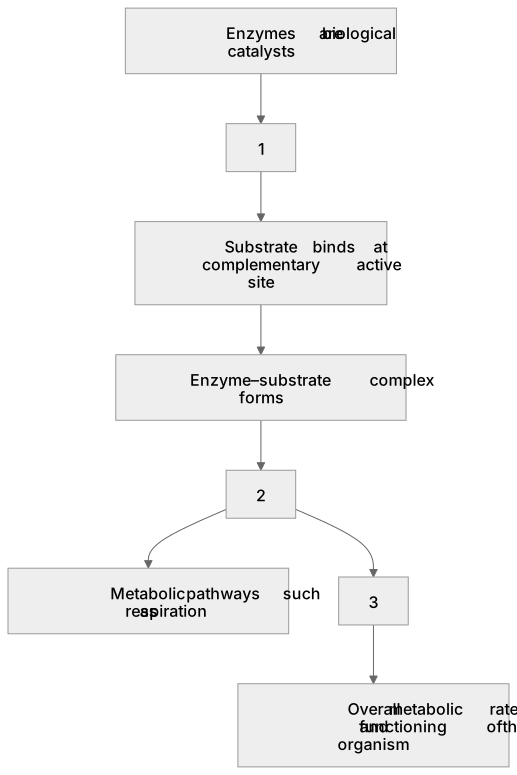
1Box 1
2Box 2
3Box 3
There is more to this lesson
The full lesson goes on to check your understanding and help you earn the marks. Create a free account to carry on, with your progress saved.
A week of Premium from your first lesson · Then the free plan continues · No card, no charge
Test your understanding of Enzymes: (a) the role of enzymes in catalysing reactions that affect metabolism at a cellular and whole organism level
Active recall beats re-reading. Take an instant quiz now to test what you’ve learned and lock it into long-term memory.
A week of Premium from your first lesson · Then the free plan continues · No card, no charge