OCR · A-Level · Biology
Course version: H420 · Version from Sept 2025
(b) the role of enzymes in catalysing both intracellular and extracellular…
Full specification wording
Enzymes: (b) the role of enzymes in catalysing both intracellular and extracellular reactions
Enzymes catalyse reactions both inside cells and outside them.
Checked against the OCR H420 specification (opens in a new tab) on .
- Point 2 of 6
- 4 key terms
Study notes
From the checked teaching notes for this specification point.
The idea
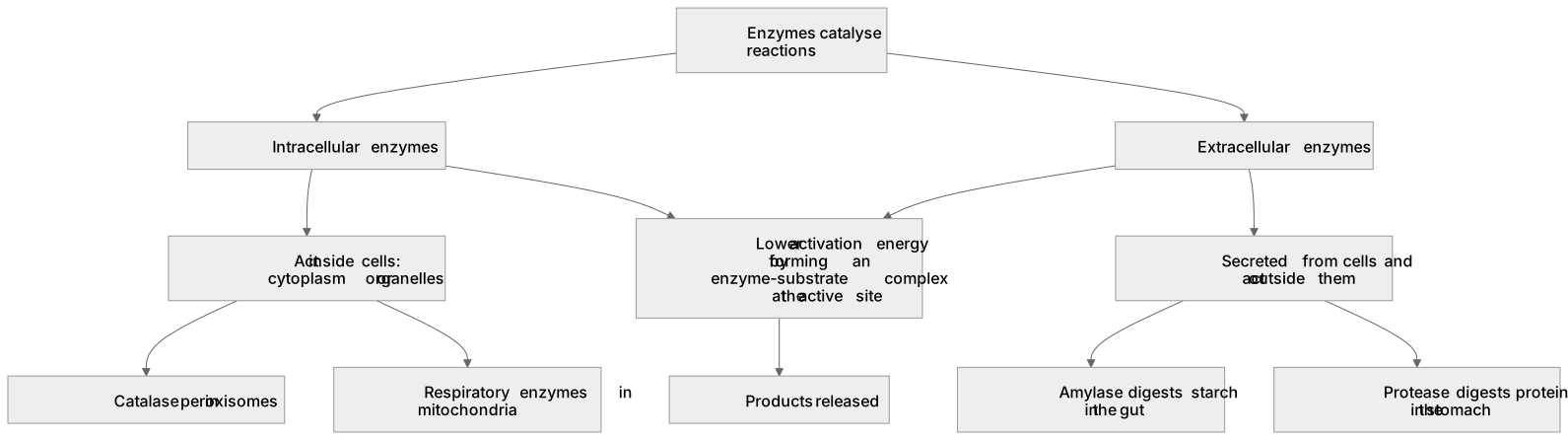
Enzymes catalyse reactions both inside cells and outside them. Intracellular enzymes work within the cytoplasm or organelles; for example, catalase breaks down hydrogen peroxide in peroxisomes, and respiratory enzymes in mitochondria catalyse reactions of the Krebs cycle. Extracellular enzymes are secreted from cells and act outside them; for example, amylase secreted by salivary glands and pancreas digests starch in the gut, and protease secreted into the stomach digests protein. In both cases the enzyme lowers activation energy by forming an enzyme–substrate complex at its active site, and the products are released. The location differs, but the catalytic mechanism is the same. Extracellular digestion allows large food molecules to be broken into smaller soluble molecules that can be absorbed.
What earns the marks
- Intracellular enzymes catalyse reactions inside cells, for example catalase in peroxisomes or respiratory enzymes in mitochondria.
- Extracellular enzymes are secreted from cells and catalyse reactions outside the cell, for example amylase and protease in the digestive tract.
- Extracellular digestion breaks large insoluble molecules into smaller soluble products that can be absorbed.
- The catalytic mechanism is the same whether the enzyme acts inside or outside the cell; only the location differs.
Common mistakes and how to put them right
Assuming all enzymes act inside cells.
Put it right: Is that many enzymes are secreted and act extracellularly, such as digestive amylase and protease.
Confusing the location of an enzyme with its mechanism.
Put it right: Is that intracellular and extracellular enzymes both work by lowering activation energy at the active site.
Stating that extracellular enzymes are absorbed with the products.
Put it right: Is that the enzyme remains in the gut lumen while the products are absorbed.
Exam tips
- Name a specific intracellular enzyme and a specific extracellular enzyme to show the contrast clearly.
- State where each example acts, inside the cell or outside it, rather than only naming the enzyme.
- Explain that the mechanism, forming an enzyme–substrate complex, is common to both locations.
Try the lesson
The start of the Enzymes: (b) the role of enzymes in catalysing both intracellular and extracellular reactions lesson, made from checked teaching notes for this specification point.
Have a go first
Which of these is an example of an enzyme catalysing an intracellular reaction?
Listen
Enzymes catalyse reactions both inside cells and outside them. Intracellular enzymes work within the cytoplasm or organelles; for example, catalase breaks down hydrogen peroxide in peroxisomes, and respiratory enzymes in mitochondria catalyse reactions of the Krebs cycle. Extracellular enzymes are secreted from cells and act outside them; for example, amylase secreted by salivary glands and pancreas digests starch in the gut, and protease secreted into the stomach digests protein. In both cases the enzyme lowers activation energy by forming an enzyme–substrate complex at its active site, and the products are released. The location differs, but the catalytic mechanism is the same. Extracellular digestion allows large food molecules to be broken into smaller soluble molecules that can be absorbed. A strong answer earns marks for these points. Intracellular enzymes catalyse reactions inside cells, for example catalase in peroxisomes or respiratory enzymes in mitochondria. Extracellular enzymes are secreted from cells and catalyse reactions outside the cell, for example amylase and protease in the digestive tract. Extracellular digestion breaks large insoluble molecules into smaller soluble products that can be absorbed. The catalytic mechanism is the same whether the enzyme acts inside or outside the cell; only the location differs. A common slip: Assuming all enzymes act inside cells. Instead, is that many enzymes are secreted and act extracellularly, such as digestive amylase and protease. Exam tip: Name a specific intracellular enzyme and a specific extracellular enzyme to show the contrast clearly.
See it
Key words
Say what each word means before you turn the card.
Intracellular enzyme action
Try answering aloud or in your head before turning the card.
Extracellular enzyme action
Try answering aloud or in your head before turning the card.
Enzyme–substrate complex formation
Try answering aloud or in your head before turning the card.
Digestion and absorption of products
Try answering aloud or in your head before turning the card.
See every definition
- Intracellular enzyme action
- Enzymes catalyse reactions inside cells, working within the cytoplasm or organelles, for example catalase in peroxisomes or respiratory enzymes in mitochondria.
- Extracellular enzyme action
- Enzymes are secreted from cells and act outside them, for example amylase and protease in the digestive tract.
- Enzyme–substrate complex formation
- Both types lower activation energy by forming an enzyme–substrate complex at the active site, and the products are released.
- Digestion and absorption of products
- Extracellular digestion breaks large food molecules into smaller soluble molecules that can be absorbed, while the enzyme remains in the gut lumen.
Label the diagram
Some boxes have lost their names. Pick the right name for each number.
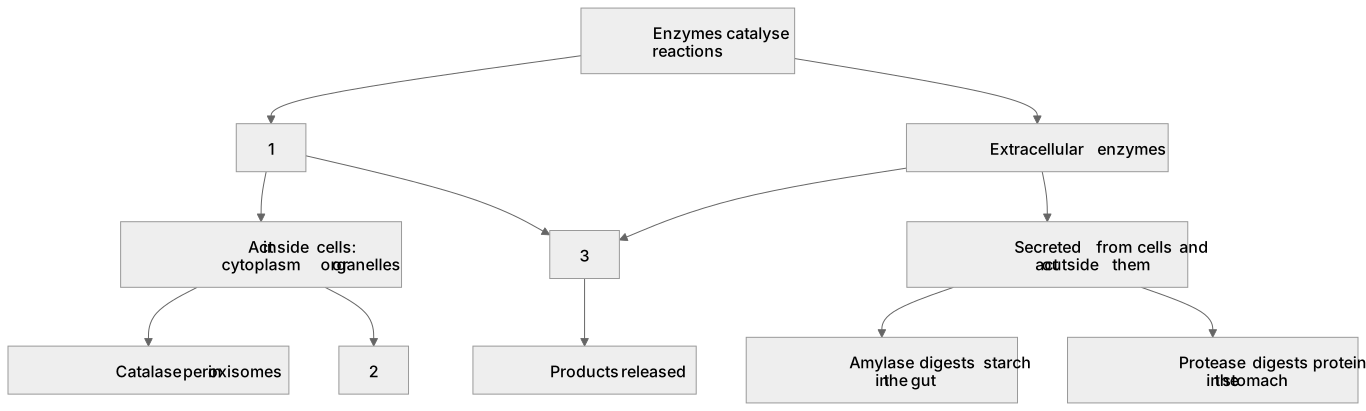
1Box 1
2Box 2
3Box 3
There is more to this lesson
The full lesson goes on to check your understanding and help you earn the marks. Create a free account to carry on, with your progress saved.
A week of Premium from your first lesson · Then the free plan continues · No card, no charge
Test your understanding of Enzymes: (b) the role of enzymes in catalysing both intracellular and extracellular reactions
Active recall beats re-reading. Take an instant quiz now to test what you’ve learned and lock it into long-term memory.
A week of Premium from your first lesson · Then the free plan continues · No card, no charge