OCR · A-Level · Biology
Course version: H420 · Version from Sept 2025
(f) the effects of inhibitors on the rate of enzyme-controlled reactions.
Full specification wording
Enzymes: (f) the effects of inhibitors on the rate of enzyme-controlled reactions.
Inhibitors reduce the rate at which an enzyme-controlled reaction proceeds by interfering with enzyme activity.
Checked against the OCR H420 specification (opens in a new tab) on .
- Point 6 of 6
- 4 key terms
Study notes
From the checked teaching notes for this specification point.
The idea
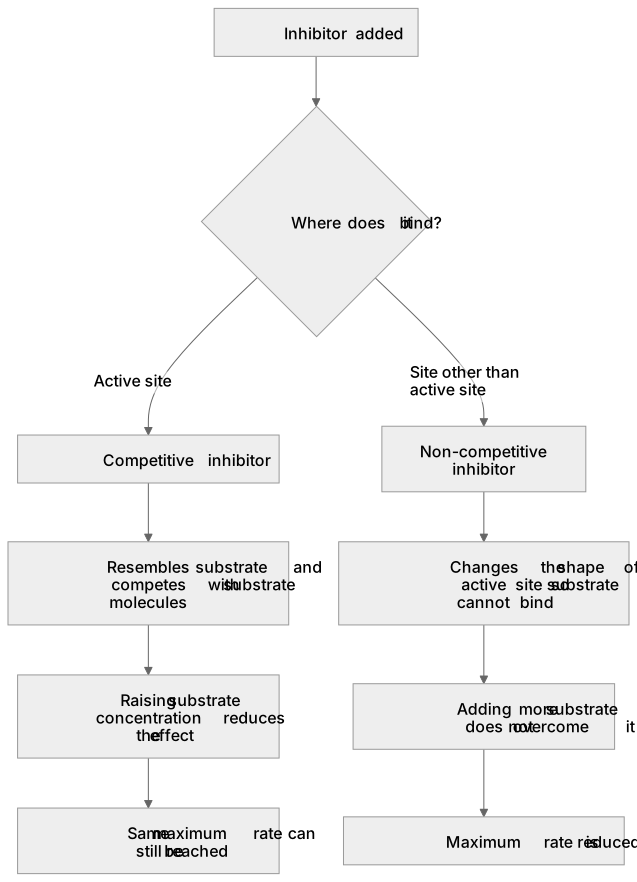
Inhibitors reduce the rate at which an enzyme-controlled reaction proceeds by interfering with enzyme activity. Competitive inhibitors resemble the substrate and bind the active site, so they compete with substrate molecules; their effect is reduced by raising substrate concentration because more substrate molecules occupy the active sites. Non-competitive inhibitors bind at a site other than the active site, changing the shape of the active site so the substrate can no longer bind; adding more substrate does not overcome this, so the maximum rate falls. Both lower the rate, but the pattern of effect differs. When interpreting a rate graph, compare initial rate and maximum rate: competitive inhibition raises the substrate concentration needed to reach a given rate but can still reach the same maximum, whereas non-competitive inhibition lowers the maximum rate achievable.
What earns the marks
- Competitive inhibitors bind to the active site because they have a shape similar to the substrate, so they compete with substrate molecules for the active site.
- Increasing substrate concentration reduces the effect of a competitive inhibitor because more substrate molecules can occupy the active sites.
- Non-competitive inhibitors bind at a site other than the active site, altering the shape of the active site so the substrate cannot bind.
- Adding more substrate does not overcome non-competitive inhibition, so the maximum rate of reaction is reduced.
Common mistakes and how to put them right
Saying a non-competitive inhibitor binds the active site.
Put it right by stating it binds elsewhere and changes the active site shape.
Claiming more substrate overcomes non-competitive inhibition.
Put it right by explaining that the maximum rate stays reduced.
Confusing the effect on maximum rate with the effect on substrate concentration needed.
Put it right by linking competitive inhibition to needing more substrate for the same rate.
Exam tips
- Read the graph axes carefully and compare both the initial rate and the maximum rate before choosing an answer.
- Link each inhibitor type to where it binds and how substrate concentration changes its effect.
- Eliminate options that describe binding at the wrong site or that ignore the effect of substrate concentration.
Try the lesson
The start of the Enzymes: (f) the effects of inhibitors on the rate of enzyme-controlled reactions. lesson, made from checked teaching notes for this specification point.
Have a go first
A competitive inhibitor reduces the rate of an enzyme-controlled reaction. Which statement explains why this happens?
Listen
Inhibitors reduce the rate at which an enzyme-controlled reaction proceeds by interfering with enzyme activity. Competitive inhibitors resemble the substrate and bind the active site, so they compete with substrate molecules; their effect is reduced by raising substrate concentration because more substrate molecules occupy the active sites. Non-competitive inhibitors bind at a site other than the active site, changing the shape of the active site so the substrate can no longer bind; adding more substrate does not overcome this, so the maximum rate falls. Both lower the rate, but the pattern of effect differs. When interpreting a rate graph, compare initial rate and maximum rate: competitive inhibition raises the substrate concentration needed to reach a given rate but can still reach the same maximum, whereas non-competitive inhibition lowers the maximum rate achievable. A strong answer earns marks for these points. Competitive inhibitors bind to the active site because they have a shape similar to the substrate, so they compete with substrate molecules for the active site. Increasing substrate concentration reduces the effect of a competitive inhibitor because more substrate molecules can occupy the active sites. Non-competitive inhibitors bind at a site other than the active site, altering the shape of the active site so the substrate cannot bind. Adding more substrate does not overcome non-competitive inhibition, so the maximum rate of reaction is reduced. A common slip: Saying a non-competitive inhibitor binds the active site. Instead, stating it binds elsewhere and changes the active site shape. Exam tip: Read the graph axes carefully and compare both the initial rate and the maximum rate before choosing an answer.
See it
Key words
Say what each word means before you turn the card.
Competitive inhibitors
Try answering aloud or in your head before turning the card.
Non-competitive inhibitors
Try answering aloud or in your head before turning the card.
Effect of substrate concentration on inhibition
Try answering aloud or in your head before turning the card.
Interpreting rate of reaction graphs
Try answering aloud or in your head before turning the card.
See every definition
- Competitive inhibitors
- These resemble the substrate and bind the active site, so they compete with substrate molecules, and their effect is reduced by raising substrate concentration.
- Non-competitive inhibitors
- These bind at a site other than the active site, changing the shape of the active site so the substrate can no longer bind, and adding more substrate does not overcome this.
- Effect of substrate concentration on inhibition
- Raising substrate concentration reduces the effect of a competitive inhibitor because more substrate molecules occupy the active sites, but adding more substrate does not overcome non-competitive inhibition.
- Interpreting rate of reaction graphs
- Compare initial rate and maximum rate: competitive inhibition raises the substrate concentration needed to reach a given rate but can still reach the same maximum, whereas non-competitive inhibition lowers the maximum rate achievable.
There is more to this lesson
The full lesson goes on to check your understanding and help you earn the marks. Create a free account to carry on, with your progress saved.
A week of Premium from your first lesson · Then the free plan continues · No card, no charge
Test your understanding of Enzymes: (f) the effects of inhibitors on the rate of enzyme-controlled reactions.
Active recall beats re-reading. Take an instant quiz now to test what you’ve learned and lock it into long-term memory.
A week of Premium from your first lesson · Then the free plan continues · No card, no charge