OCR · A-Level · Biology
Course version: H420 · Version from Sept 2025
(e) the need for coenzymes and cofactors in some enzyme-controlled reactions
Full specification wording
Enzymes: (e) the need for coenzymes and cofactors in some enzyme-controlled reactions
Some enzyme-controlled reactions proceed only when a helper substance is present.
Checked against the OCR H420 specification (opens in a new tab) on .
- Point 5 of 6
- 4 key terms
Study notes
From the checked teaching notes for this specification point.
The idea
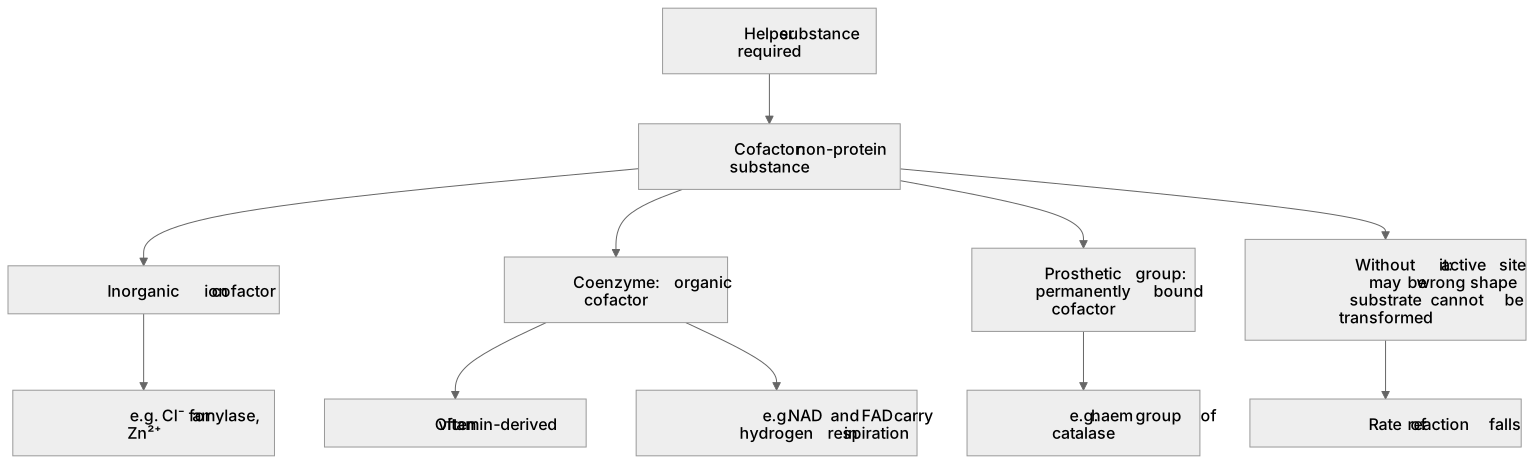
Some enzyme-controlled reactions proceed only when a helper substance is present. A cofactor is a non-protein substance required for an enzyme to catalyse a reaction; it may be an inorganic ion, such as Cl⁻ for amylase or Zn²⁺ for some enzymes, bound loosely or tightly to the enzyme. A coenzyme is an organic cofactor, often derived from a vitamin, that binds temporarily and transfers chemical groups or electrons between reactions; NAD and FAD carry hydrogen in respiration, and coenzyme A carries acetyl groups. Prosthetic groups are cofactors bound permanently, as in the haem group of catalase. Without the cofactor the active site may be the wrong shape or the substrate cannot be chemically transformed, so the rate falls.
What earns the marks
- A cofactor is a non-protein substance needed for an enzyme to catalyse a reaction.
- Inorganic cofactors include ions such as Cl⁻ and Zn²⁺ that may bind loosely or tightly and help form a correctly shaped active site or stabilise the enzyme–substrate complex.
- A coenzyme is an organic cofactor, often vitamin-derived, that binds temporarily and transfers groups or electrons, for example NAD and FAD carrying hydrogen in respiration.
- A prosthetic group is a permanently bound cofactor, such as the haem group of catalase.
- Without the required cofactor or coenzyme the reaction is not catalysed effectively, so the rate of reaction is reduced.
Common mistakes and how to put them right
Treating coenzyme and cofactor as identical.
Put it right by stating that a coenzyme is one type of organic cofactor, while cofactors also include inorganic ions.
Assuming a cofactor is part of the protein chain.
Put it right by noting cofactors are non-protein and may be loosely or permanently bound.
Believing a cofactor is consumed as a substrate.
Put it right by explaining it assists catalysis and is regenerated or reused rather than being the substrate converted to product.
Exam tips
- Read the stem to see whether the substance named is organic or inorganic before choosing between coenzyme and cofactor.
- Link the cofactor to a specific effect, such as correct active-site shape or group transfer, rather than just naming it.
- Eliminate options that describe the cofactor as the substrate or as part of the polypeptide chain.
Try the lesson
The start of the Enzymes: (e) the need for coenzymes and cofactors in some enzyme-controlled reactions lesson, made from checked teaching notes for this specification point.
Have a go first
Which of the following is an example of a coenzyme?
Listen
Some enzyme-controlled reactions proceed only when a helper substance is present. A cofactor is a non-protein substance required for an enzyme to catalyse a reaction; it may be an inorganic ion, such as Cl⁻ for amylase or Zn²⁺ for some enzymes, bound loosely or tightly to the enzyme. A coenzyme is an organic cofactor, often derived from a vitamin, that binds temporarily and transfers chemical groups or electrons between reactions; NAD and FAD carry hydrogen in respiration, and coenzyme A carries acetyl groups. Prosthetic groups are cofactors bound permanently, as in the haem group of catalase. Without the cofactor the active site may be the wrong shape or the substrate cannot be chemically transformed, so the rate falls. A strong answer earns marks for these points. A cofactor is a non-protein substance needed for an enzyme to catalyse a reaction. Inorganic cofactors include ions such as Cl⁻ and Zn²⁺ that may bind loosely or tightly and help form a correctly shaped active site or stabilise the enzyme–substrate complex. A coenzyme is an organic cofactor, often vitamin-derived, that binds temporarily and transfers groups or electrons, for example NAD and FAD carrying hydrogen in respiration. A prosthetic group is a permanently bound cofactor, such as the haem group of catalase. A common slip: Treating coenzyme and cofactor as identical. Instead, stating that a coenzyme is one type of organic cofactor, while cofactors also include inorganic ions. Exam tip: Read the stem to see whether the substance named is organic or inorganic before choosing between coenzyme and cofactor.
See it
Key words
Say what each word means before you turn the card.
Cofactor
Try answering aloud or in your head before turning the card.
Coenzyme
Try answering aloud or in your head before turning the card.
Prosthetic group
Try answering aloud or in your head before turning the card.
Effect of missing cofactors on reaction rate
Try answering aloud or in your head before turning the card.
See every definition
- Cofactor
- A non-protein substance required for an enzyme to catalyse a reaction, which may be an inorganic ion bound loosely or tightly to the enzyme.
- Coenzyme
- An organic cofactor, often derived from a vitamin, that binds temporarily and transfers chemical groups or electrons between reactions.
- Prosthetic group
- A cofactor bound permanently to an enzyme, as in the haem group of catalase.
- Effect of missing cofactors on reaction rate
- Without the cofactor the active site may be the wrong shape or the substrate cannot be chemically transformed, so the rate falls.
Label the diagram
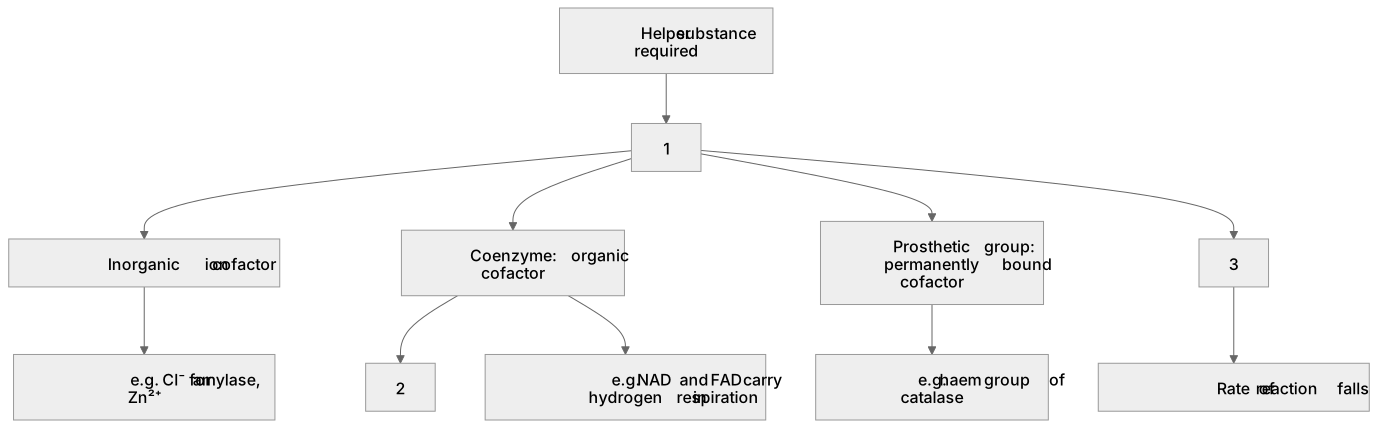
Some boxes have lost their names. Pick the right name for each number.
1Box 1
2Box 2
3Box 3
There is more to this lesson
The full lesson goes on to check your understanding and help you earn the marks. Create a free account to carry on, with your progress saved.
A week of Premium from your first lesson · Then the free plan continues · No card, no charge
Test your understanding of Enzymes: (e) the need for coenzymes and cofactors in some enzyme-controlled reactions
Active recall beats re-reading. Take an instant quiz now to test what you’ve learned and lock it into long-term memory.
A week of Premium from your first lesson · Then the free plan continues · No card, no charge