OCR · A-Level · Biology
Course version: H420 · Version from Sept 2025
(d) precision and accuracy of measurements and data, including margins of…
Full specification wording
Evaluation: (d) precision and accuracy of measurements and data, including margins of error, percentage errors and uncertainties in apparatus
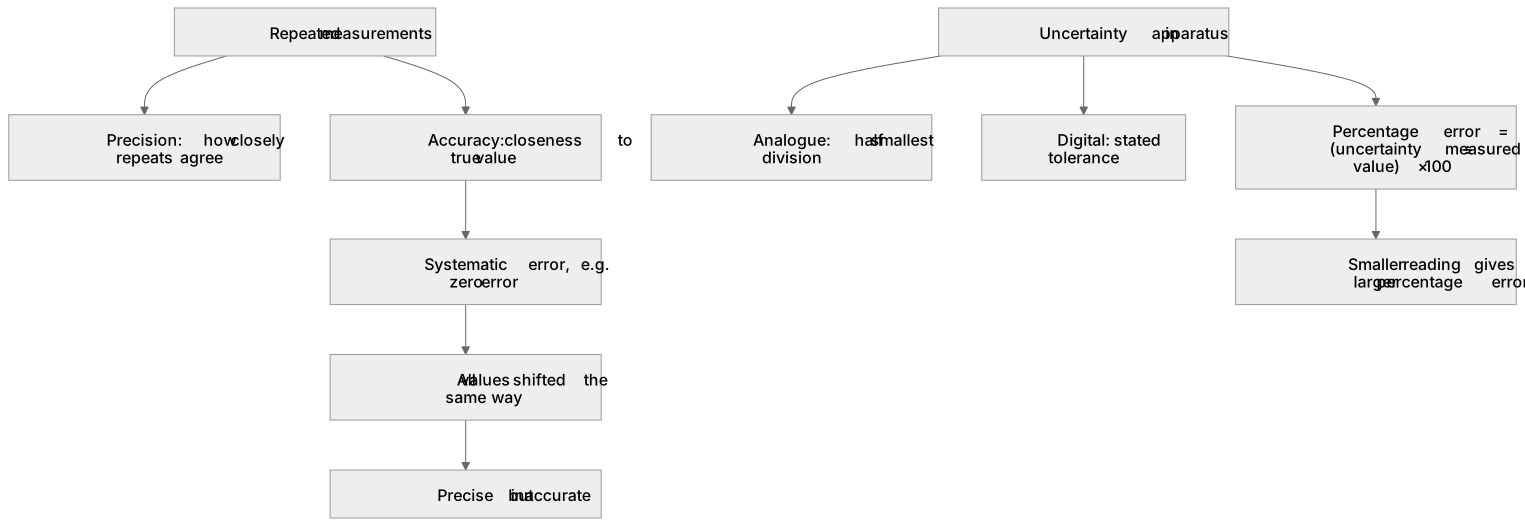
Precision describes how closely repeated measurements agree with each other, while accuracy describes how close a measurement is to the true value.
Checked against the OCR H420 specification (opens in a new tab) on .
- Point 2 of 2
- 4 key terms
Study notes
From the checked teaching notes for this specification point.
The idea
Precision describes how closely repeated measurements agree with each other, while accuracy describes how close a measurement is to the true value. A set of readings can be precise yet inaccurate if a systematic error, such as a zero error on a balance, shifts every value the same way. Uncertainty in apparatus is the doubt in a single reading, often taken as half the smallest scale division for an analogue instrument or the stated tolerance for a digital one. Margin of error is the range within which the true value is expected to lie. Percentage error compares the uncertainty with the measured value: percentage error = (uncertainty ÷ measured value) × 100.
For example: A 0.01 cm³ uncertainty on a 2.00 cm³ reading gives (0.01 ÷ 2.00) × 100 = 0.5%, but the same uncertainty on 0.20 cm³ gives 5%, so small readings carry larger percentage errors.
What earns the marks
- Distinguishes precision (agreement between repeat readings) from accuracy (closeness to the true value).
- Explains that a systematic error can make precise readings inaccurate because all values are shifted in the same direction.
- States that apparatus uncertainty is the doubt in a reading, e.g. half the smallest division for an analogue scale or the manufacturer's tolerance for a digital instrument.
- Defines margin of error as the range within which the true value is expected to lie.
- Calculates percentage error as (uncertainty ÷ measured value) × 100 and recognises that the same absolute uncertainty gives a larger percentage error for a smaller reading.
- Selects the correct interpretation when given a set of readings, e.g. identifying low spread but a consistent offset from the true value.
Common mistakes and how to put them right
Treating precision and accuracy as synonyms.
Put it right by defining precision as agreement between repeats and accuracy as closeness to the true value.
Assuming repeated readings that agree must be accurate.
Put it right by explaining that a systematic error shifts all readings equally, so they can be precise but inaccurate.
Using the whole smallest scale division as the uncertainty for an analogue instrument.
Put it right by using half the smallest division unless the question states otherwise.
Dividing the measured value by the uncertainty when calculating percentage error.
Put it right by using (uncertainty ÷ measured value) × 100.
Exam tips
- Read the stem carefully to see whether it asks about spread of repeats (precision) or closeness to a true value (accuracy) before choosing an option.
- When a percentage error option is offered, estimate the size of the reading first: a small reading with a fixed uncertainty must give a larger percentage error.
- Eliminate options that confuse margin of error with uncertainty in a single reading, since the margin describes the range around the true value.
Try the lesson
The start of the Evaluation: (d) precision and accuracy of measurements and data, including margins of error, percentage errors and uncertainties in apparatus lesson, made from checked teaching notes for this specification point.
Have a go first
A student takes three readings of a length: 12.4 cm, 12.5 cm and 12.4 cm. The true length is 15.0 cm. Which description best fits these readings?
Listen
Precision describes how closely repeated measurements agree with each other, while accuracy describes how close a measurement is to the true value. A set of readings can be precise yet inaccurate if a systematic error, such as a zero error on a balance, shifts every value the same way. Uncertainty in apparatus is the doubt in a single reading, often taken as half the smallest scale division for an analogue instrument or the stated tolerance for a digital one. Margin of error is the range within which the true value is expected to lie. Percentage error compares the uncertainty with the measured value: percentage error = (uncertainty ÷ measured value) × 100. For example, a 0.01 cm³ uncertainty on a 2.00 cm³ reading gives (0.01 ÷ 2.00) × 100 = 0.5%, but the same uncertainty on 0.20 cm³ gives 5%, so small readings carry larger percentage errors. A strong answer earns marks for these points. Distinguishes precision (agreement between repeat readings) from accuracy (closeness to the true value). Explains that a systematic error can make precise readings inaccurate because all values are shifted in the same direction. States that apparatus uncertainty is the doubt in a reading, e.g. half the smallest division for an analogue scale or the manufacturer's tolerance for a digital instrument. Defines margin of error as the range within which the true value is expected to lie. A common slip: Treating precision and accuracy as synonyms. Instead, defining precision as agreement between repeats and accuracy as closeness to the true value. Exam tip: Read the stem carefully to see whether it asks about spread of repeats (precision) or closeness to a true value (accuracy) before choosing an option.
See it
Key words
Say what each word means before you turn the card.
Precision versus accuracy
Try answering aloud or in your head before turning the card.
Uncertainty in apparatus
Try answering aloud or in your head before turning the card.
Margin of error
Try answering aloud or in your head before turning the card.
Percentage error calculation
Try answering aloud or in your head before turning the card.
See every definition
- Precision versus accuracy
- Precision describes how closely repeated measurements agree with each other, while accuracy describes how close a measurement is to the true value.
- Uncertainty in apparatus
- The doubt in a single reading, often taken as half the smallest scale division for an analogue instrument or the stated tolerance for a digital one.
- Margin of error
- The range within which the true value is expected to lie.
- Percentage error calculation
- Compares the uncertainty with the measured value: percentage error = (uncertainty ÷ measured value) × 100.
Label the diagram
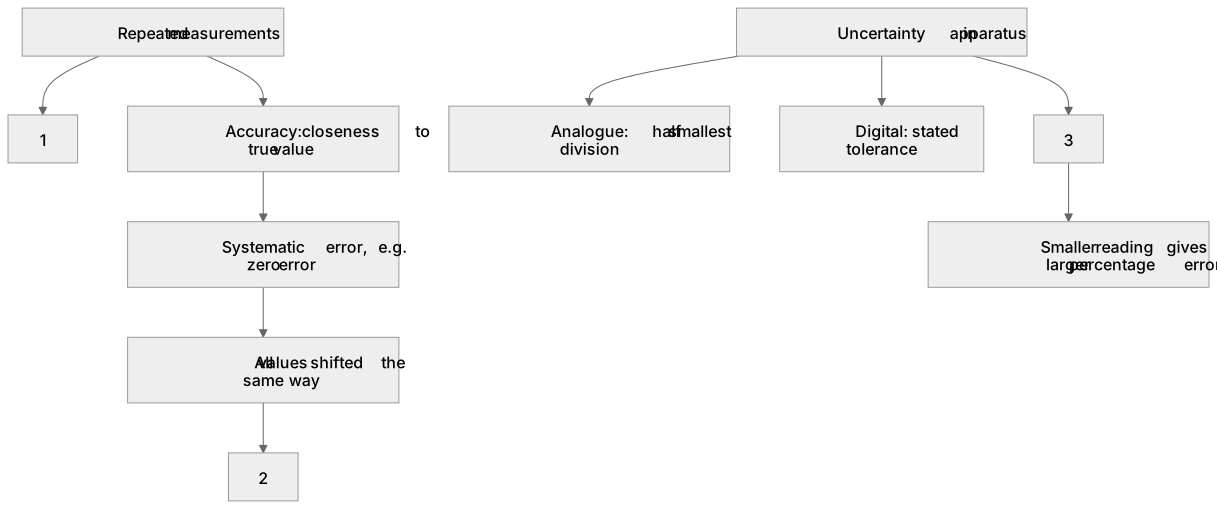
Some boxes have lost their names. Pick the right name for each number.
1Box 1
2Box 2
3Box 3
There is more to this lesson
The full lesson goes on to check your understanding and help you earn the marks. Create a free account to carry on, with your progress saved.
A week of Premium from your first lesson · Then the free plan continues · No card, no charge
Test your understanding of Evaluation: (d) precision and accuracy of measurements and data, including margins of error, percentage errors and uncertainties in apparatus
Active recall beats re-reading. Take an instant quiz now to test what you’ve learned and lock it into long-term memory.
A week of Premium from your first lesson · Then the free plan continues · No card, no charge