OCR · A-Level · Biology
Course version: H420 · Version from Sept 2025
Exchange surfaces: (a) the need for specialised exchange surfaces
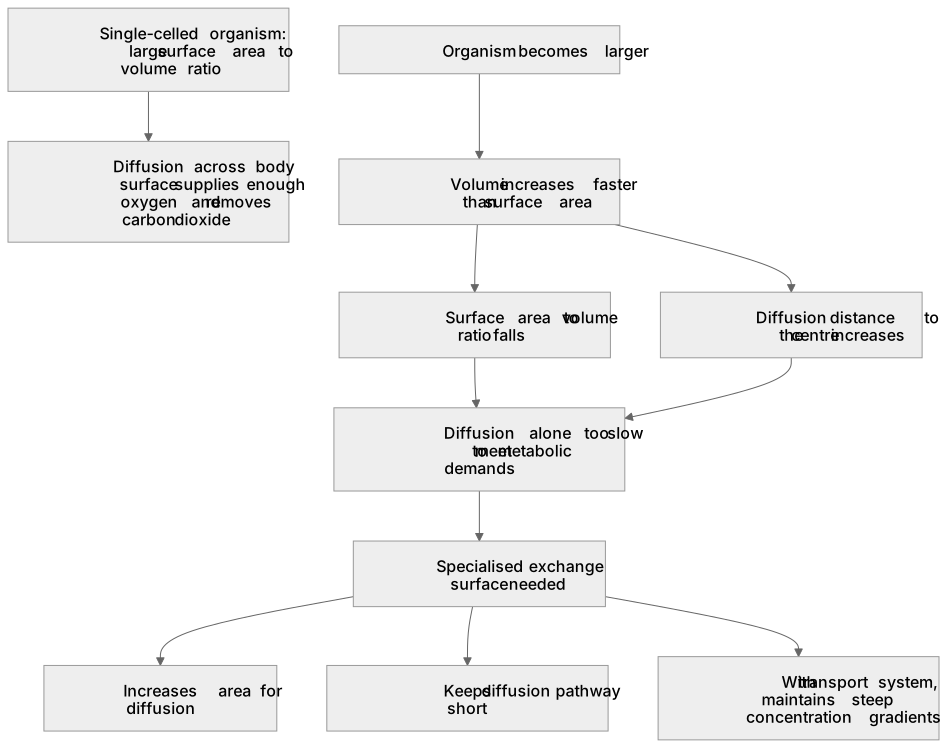
Single-celled organisms such as Amoeba have a large surface area relative to their volume, so diffusion across the body surface supplies enough oxygen and removes enough carbon dioxide.
Checked against the OCR H420 specification (opens in a new tab) on .
- Point 1 of 7
- 4 key terms
Study notes
From the checked teaching notes for this specification point.
The idea
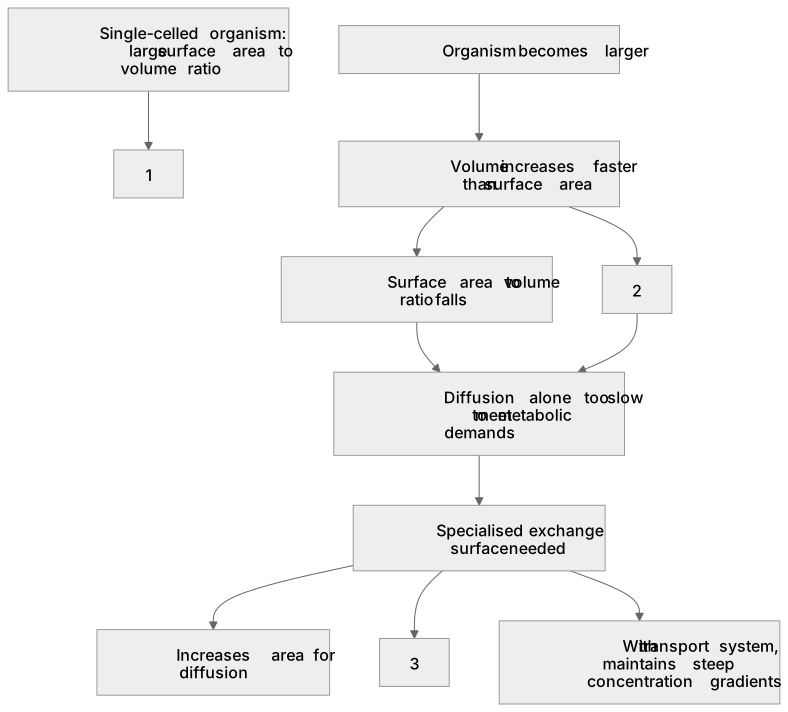
Single-celled organisms such as Amoeba have a large surface area relative to their volume, so diffusion across the body surface supplies enough oxygen and removes enough carbon dioxide. As an organism becomes larger, its volume increases faster than its surface area, so the surface area to volume ratio falls. Diffusion distance from the outside to the centre also increases. Diffusion alone then becomes too slow to meet the metabolic demands of active tissues, especially in warm-blooded animals with high respiration rates. Specialised exchange surfaces therefore increase the area available for diffusion, keep the diffusion pathway short and, with transport systems, maintain steep concentration gradients. Learners should be able to explain why a large, active organism cannot rely on its general body surface and why a dedicated surface is needed.
What earns the marks
- Large organisms have a smaller surface area to volume ratio than small organisms, so diffusion across the body surface is insufficient.
- An increased diffusion distance to the centre of a large organism slows diffusion, so a thin specialised surface is needed.
- Active, metabolically demanding organisms need a fast supply of oxygen and rapid removal of carbon dioxide, which simple diffusion cannot provide.
- Specialised exchange surfaces, often with a transport system, maintain steep concentration gradients so diffusion continues at a useful rate.
Common mistakes and how to put them right
Thinking that large organisms have a larger surface area to volume ratio.
Put it right: The ratio falls as size increases, even though absolute surface area rises.
Assuming diffusion stops in large organisms.
Put it right: It still occurs but is too slow to meet demand, so the correction is about rate and demand, not absence.
Confusing the need for an exchange surface with the need for a transport system.
Put it right: Both matter, but the exchange surface itself increases area and shortens the diffusion pathway.
Exam tips
- Always compare surface area to volume ratio, not surface area alone, when explaining the need for specialisation.
- Link the explanation to metabolic demand, naming oxygen supply and carbon dioxide removal.
- Use a named example such as a single-celled organism relying on body-surface diffusion to contrast with a larger active animal.
Try the lesson
The start of the Exchange surfaces: (a) the need for specialised exchange surfaces lesson, made from checked teaching notes for this specification point.
Have a go first
A single-celled organism such as Amoeba has a large surface area compared with its volume. Why does it not need a specialised exchange surface?
Listen
Single-celled organisms such as Amoeba have a large surface area relative to their volume, so diffusion across the body surface supplies enough oxygen and removes enough carbon dioxide. As an organism becomes larger, its volume increases faster than its surface area, so the surface area to volume ratio falls. Diffusion distance from the outside to the centre also increases. Diffusion alone then becomes too slow to meet the metabolic demands of active tissues, especially in warm-blooded animals with high respiration rates. Specialised exchange surfaces therefore increase the area available for diffusion, keep the diffusion pathway short and, with transport systems, maintain steep concentration gradients. Learners should be able to explain why a large, active organism cannot rely on its general body surface and why a dedicated surface is needed. A strong answer earns marks for these points. Large organisms have a smaller surface area to volume ratio than small organisms, so diffusion across the body surface is insufficient. An increased diffusion distance to the centre of a large organism slows diffusion, so a thin specialised surface is needed. Active, metabolically demanding organisms need a fast supply of oxygen and rapid removal of carbon dioxide, which simple diffusion cannot provide. Specialised exchange surfaces, often with a transport system, maintain steep concentration gradients so diffusion continues at a useful rate. Exam tip: Always compare surface area to volume ratio, not surface area alone, when explaining the need for specialisation.
See it
Key words
Say what each word means before you turn the card.
Surface area to volume ratio
Try answering aloud or in your head before turning the card.
Diffusion distance
Try answering aloud or in your head before turning the card.
Metabolic demand
Try answering aloud or in your head before turning the card.
Concentration gradients
Try answering aloud or in your head before turning the card.
See every definition
- Surface area to volume ratio
- As an organism becomes larger, its volume increases faster than its surface area, so this ratio falls.
- Diffusion distance
- The distance from the outside to the centre of an organism, which increases as the organism becomes larger.
- Metabolic demand
- The need of active tissues, especially in warm-blooded animals with high respiration rates, for oxygen supply and carbon dioxide removal.
- Concentration gradients
- Gradients that specialised exchange surfaces, with transport systems, maintain steep so that diffusion continues at a useful rate.
Label the diagram
Some boxes have lost their names. Pick the right name for each number.
1Box 1
2Box 2
3Box 3
There is more to this lesson
The full lesson goes on to check your understanding and help you earn the marks. Create a free account to carry on, with your progress saved.
A week of Premium from your first lesson · Then the free plan continues · No card, no charge
Test your understanding of Exchange surfaces: (a) the need for specialised exchange surfaces
Active recall beats re-reading. Take an instant quiz now to test what you’ve learned and lock it into long-term memory.
A week of Premium from your first lesson · Then the free plan continues · No card, no charge